teamLab SuperNature Macao | teamLab

メイン画像
2020.6.15(Mon) - PermanentThe Venetian Macao, Macao
メイン画像
2020.6.15(Mon) - PermanentThe Venetian Macao, Macao

Immerse the Body, Create with Others, and Become One

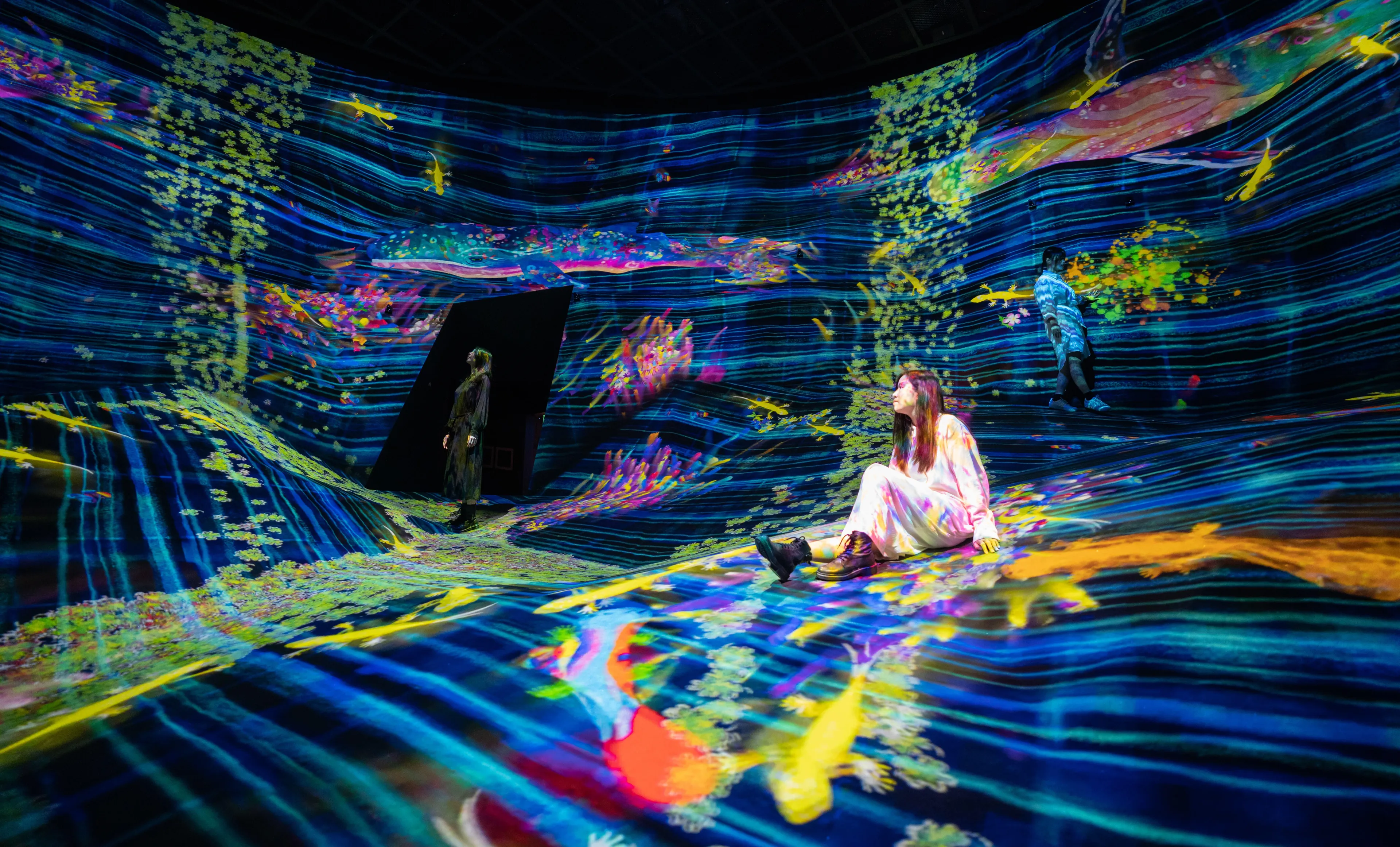
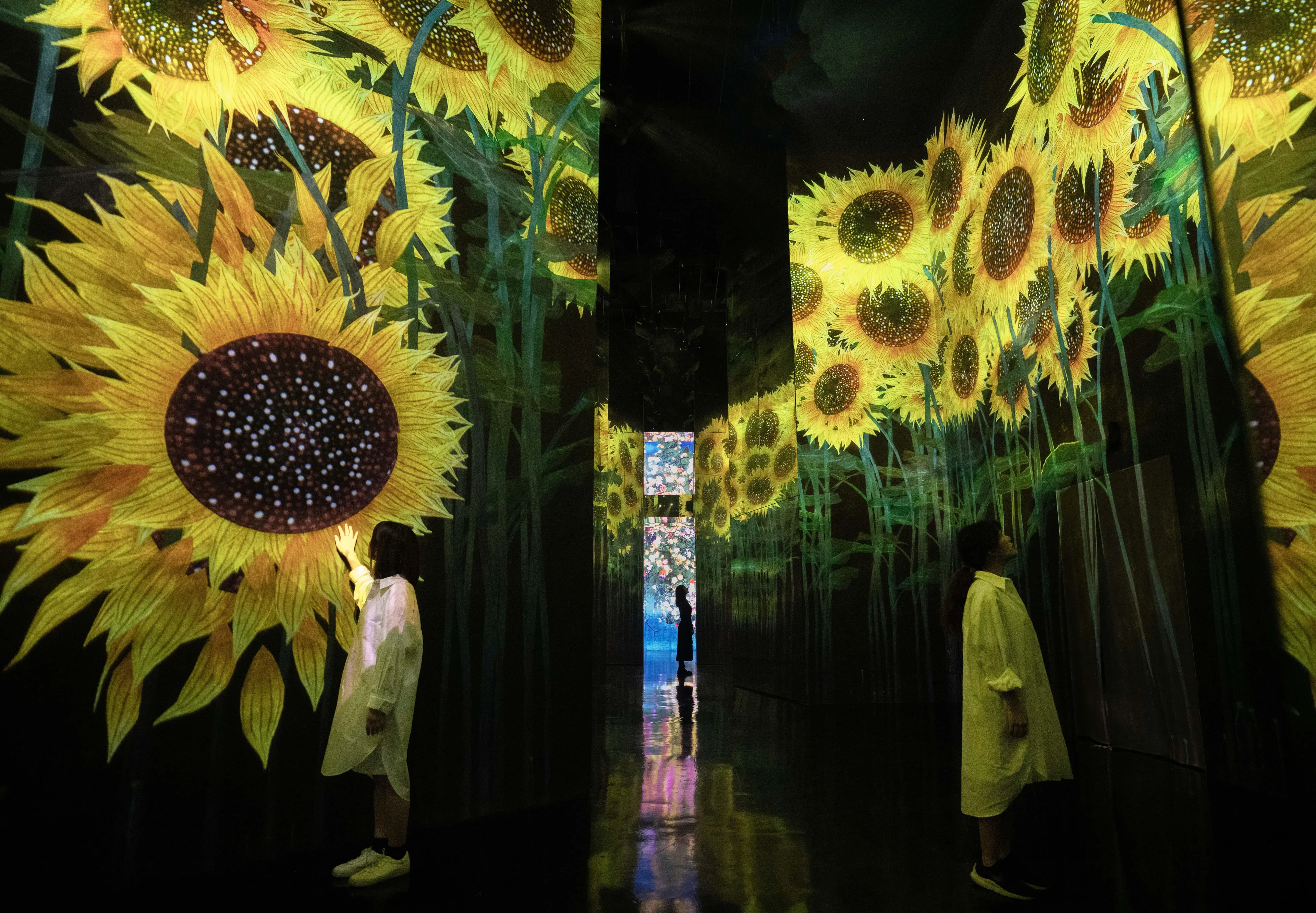
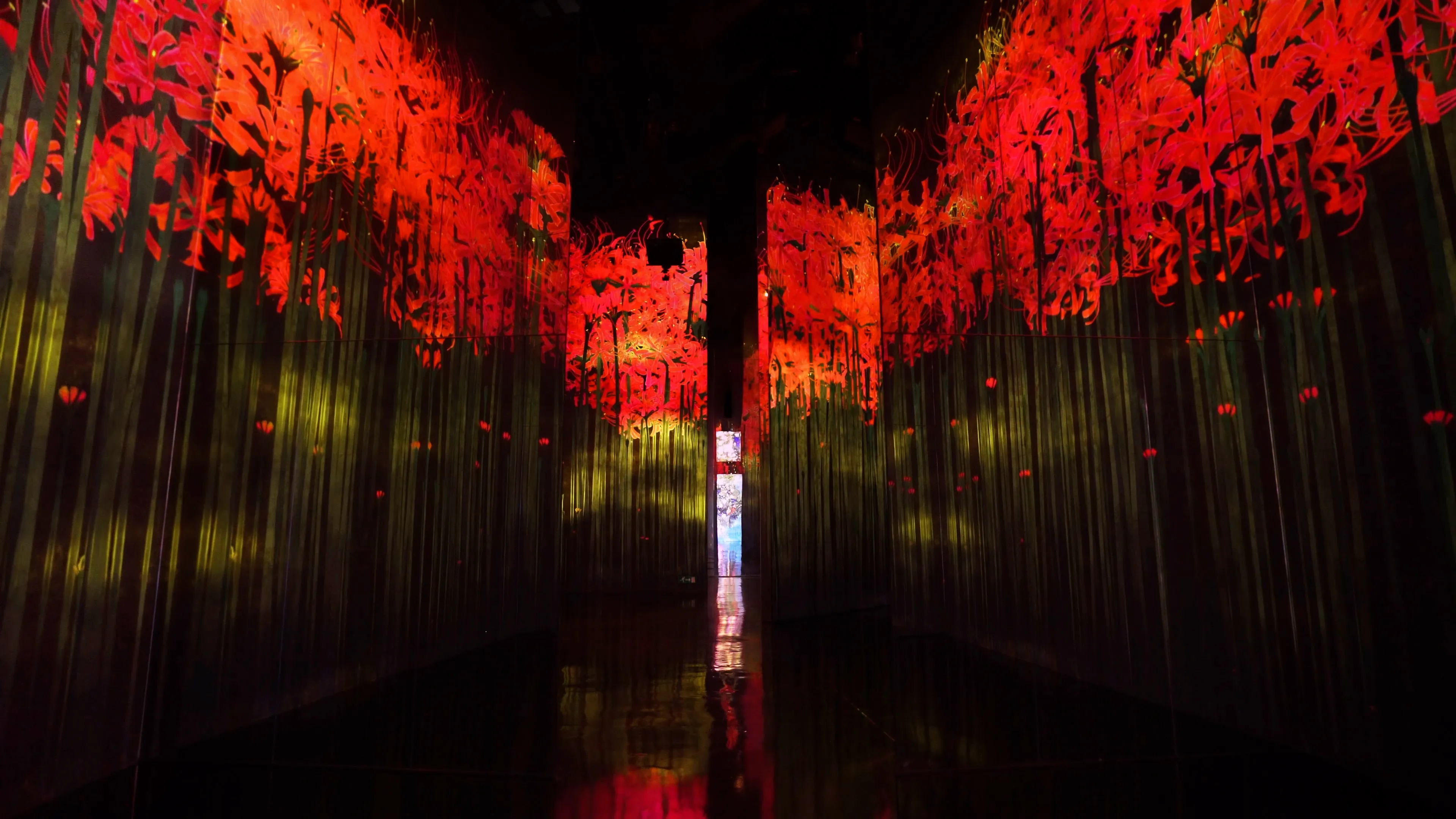
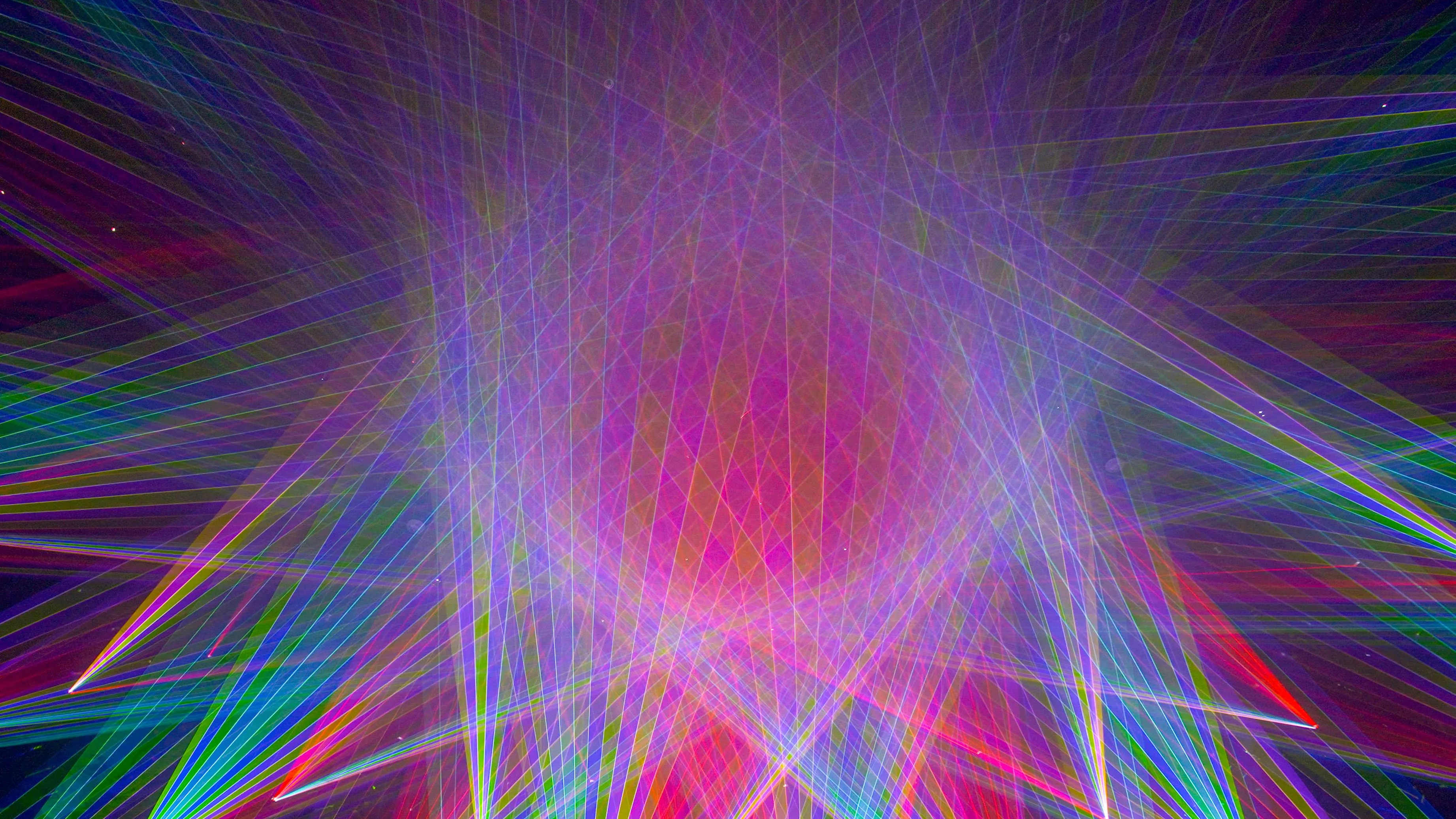
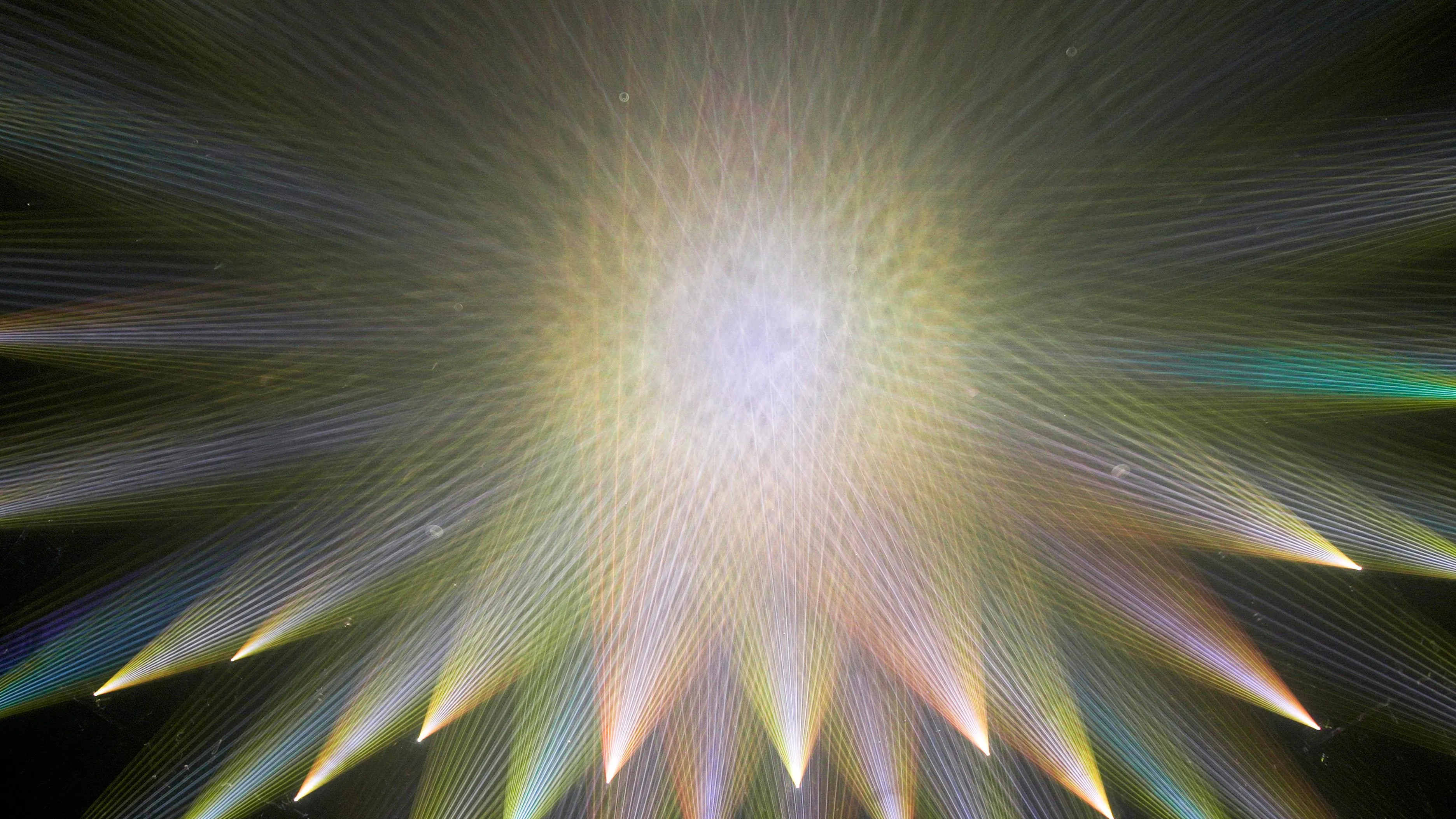
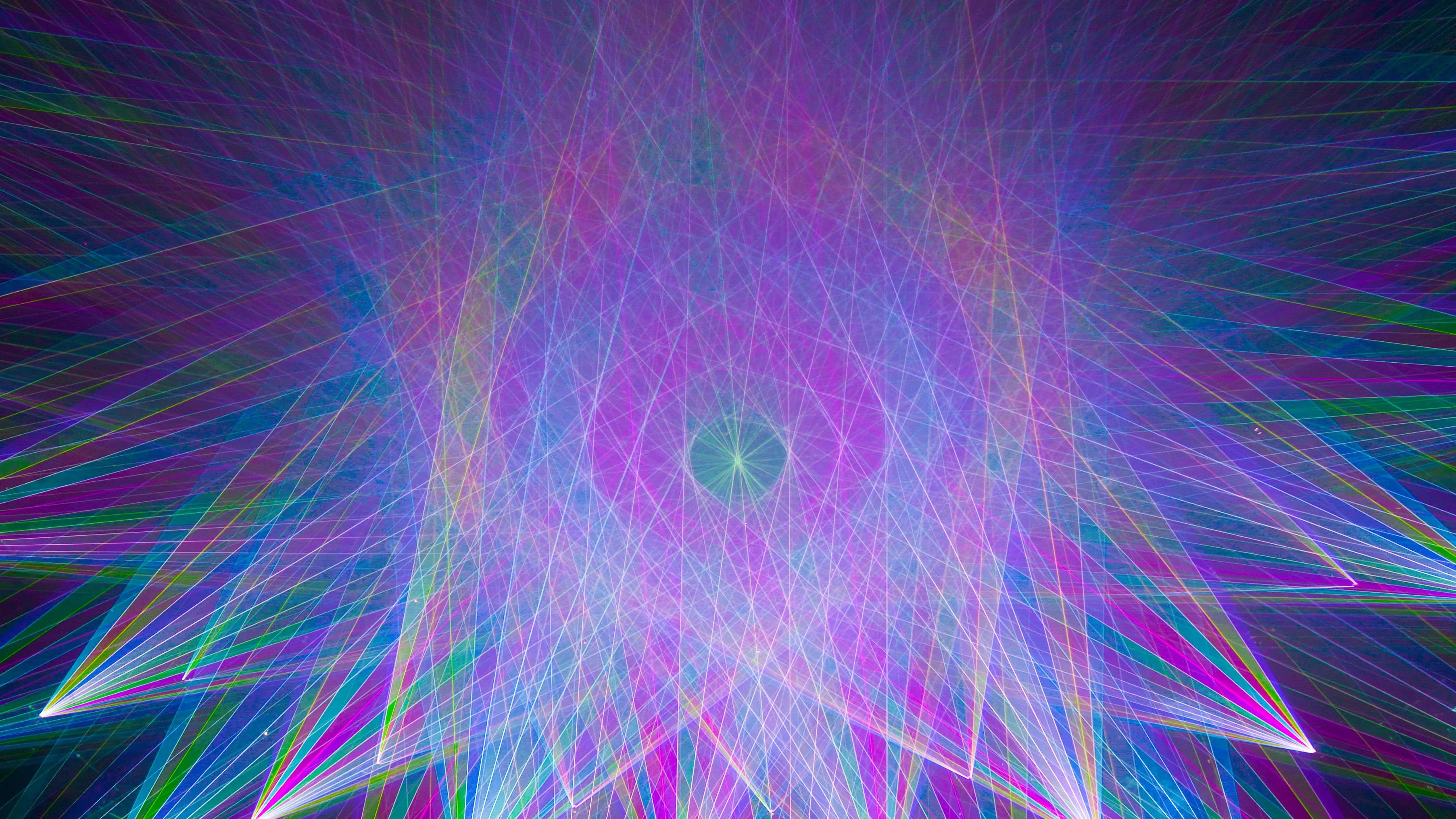
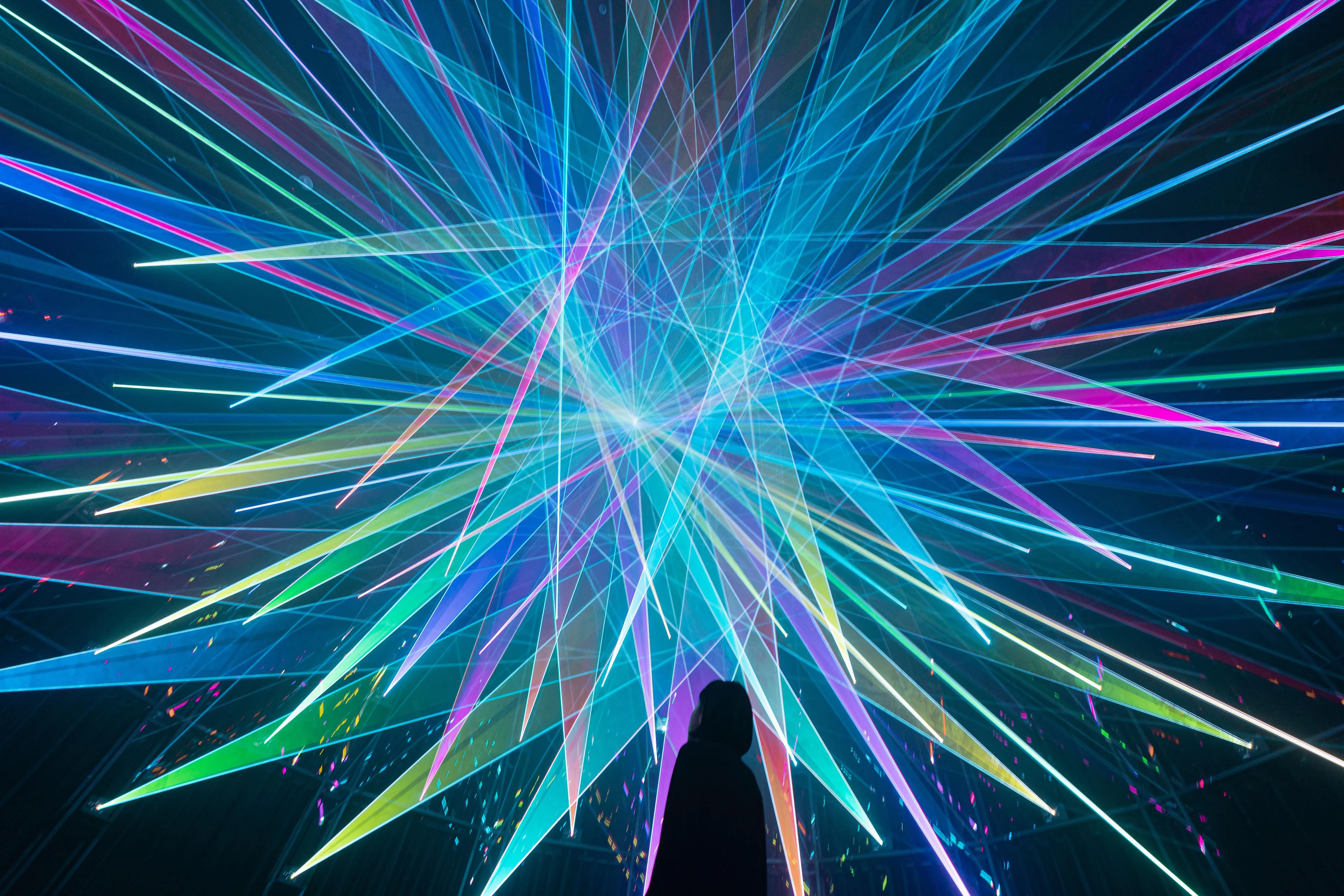
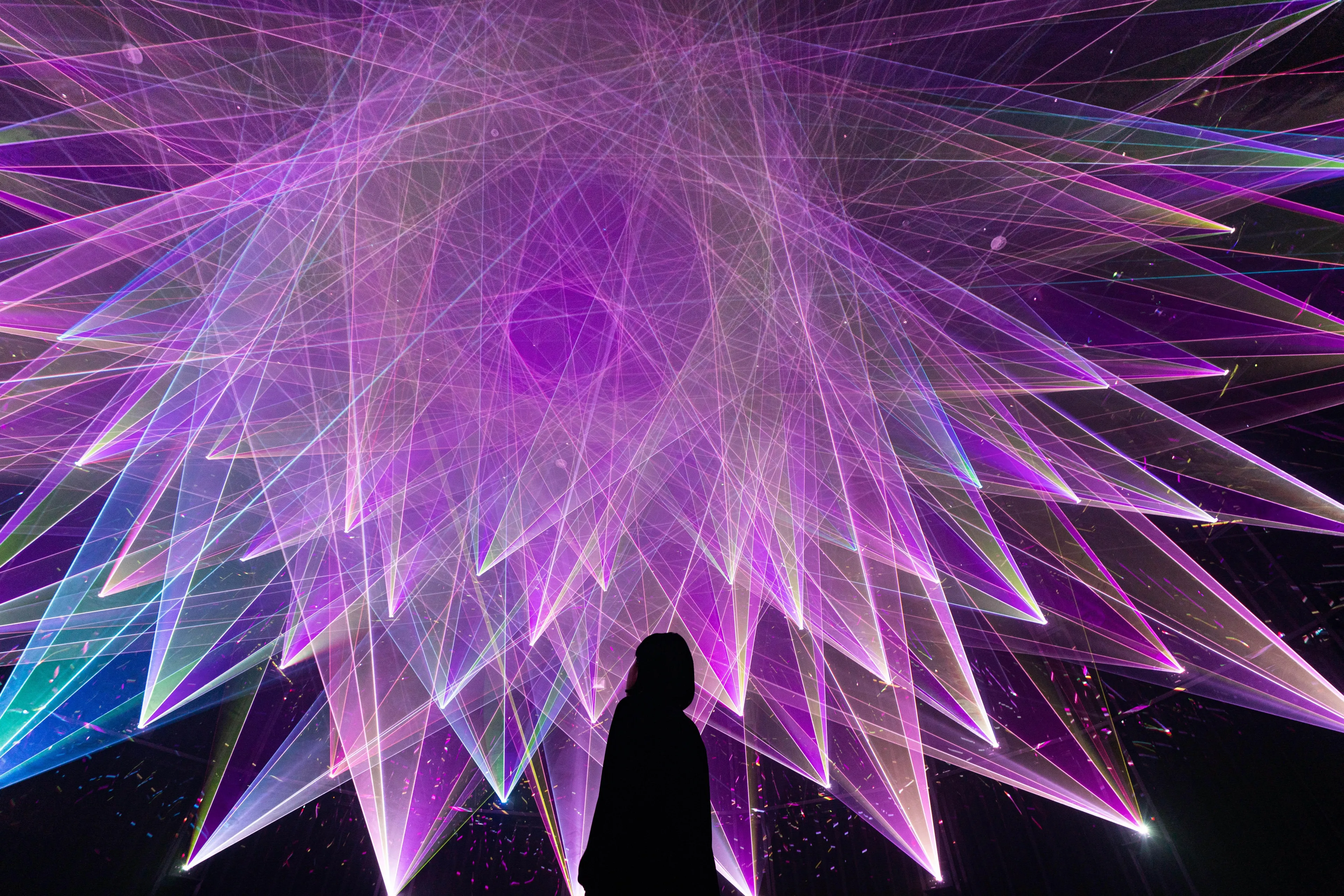
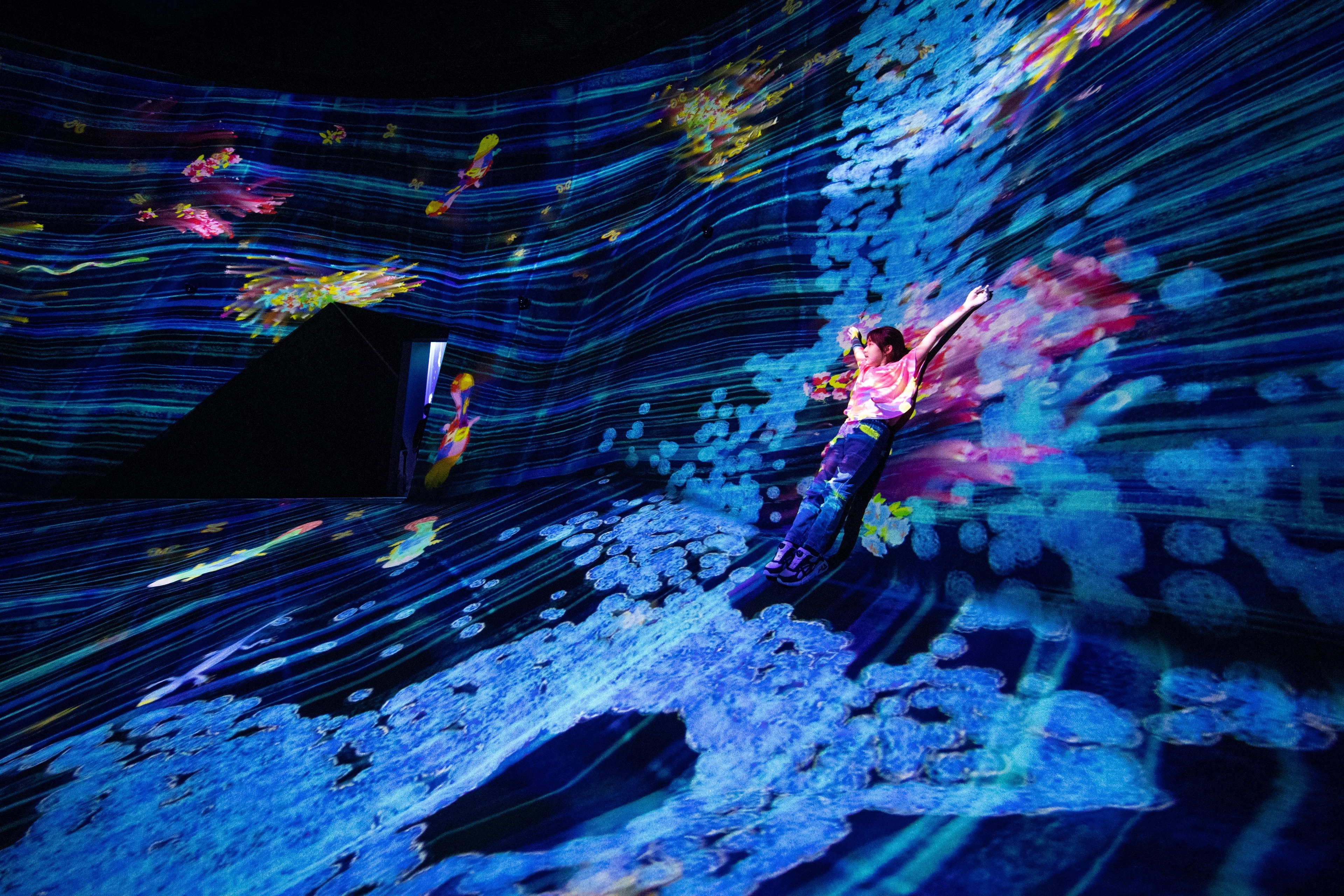
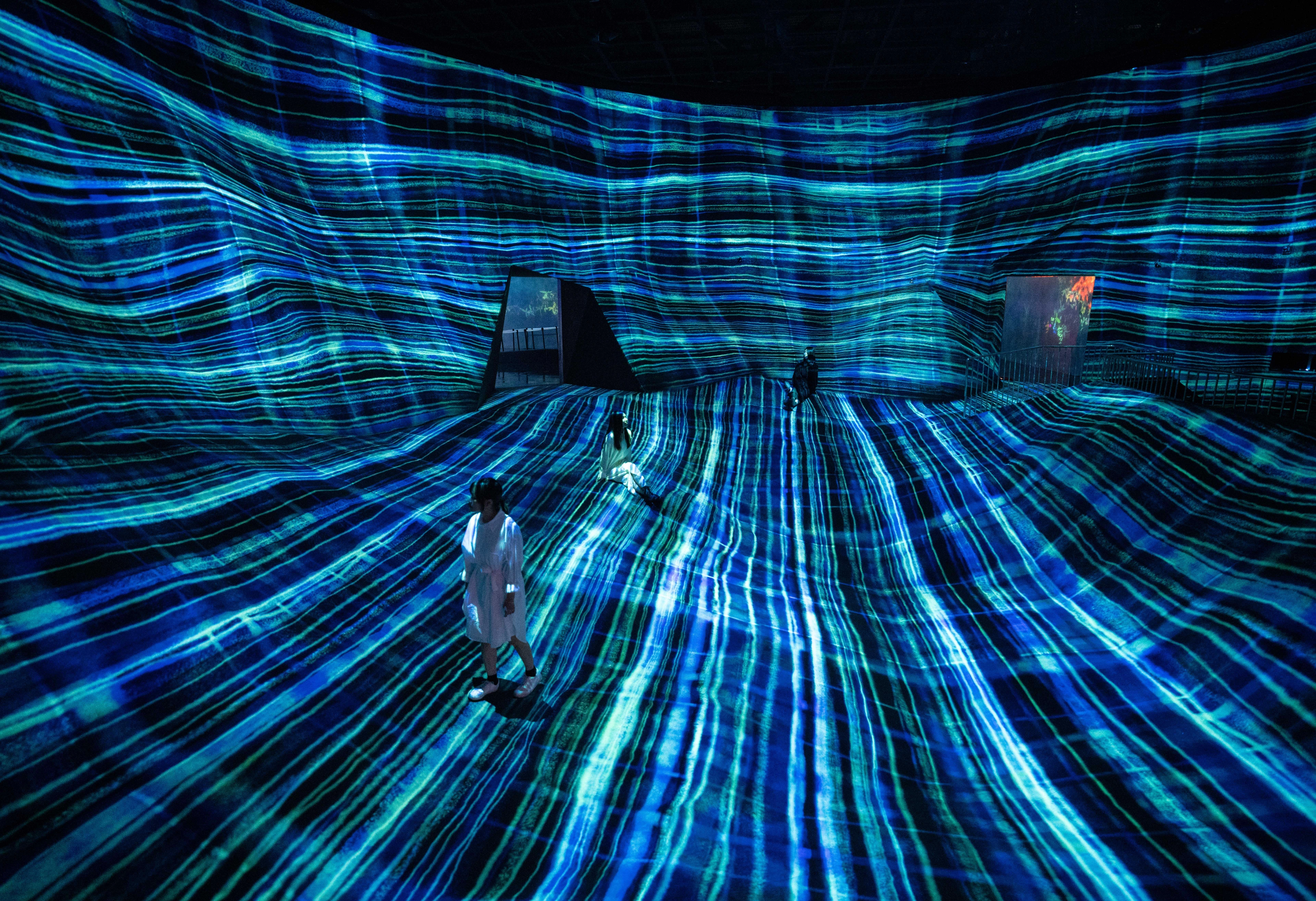
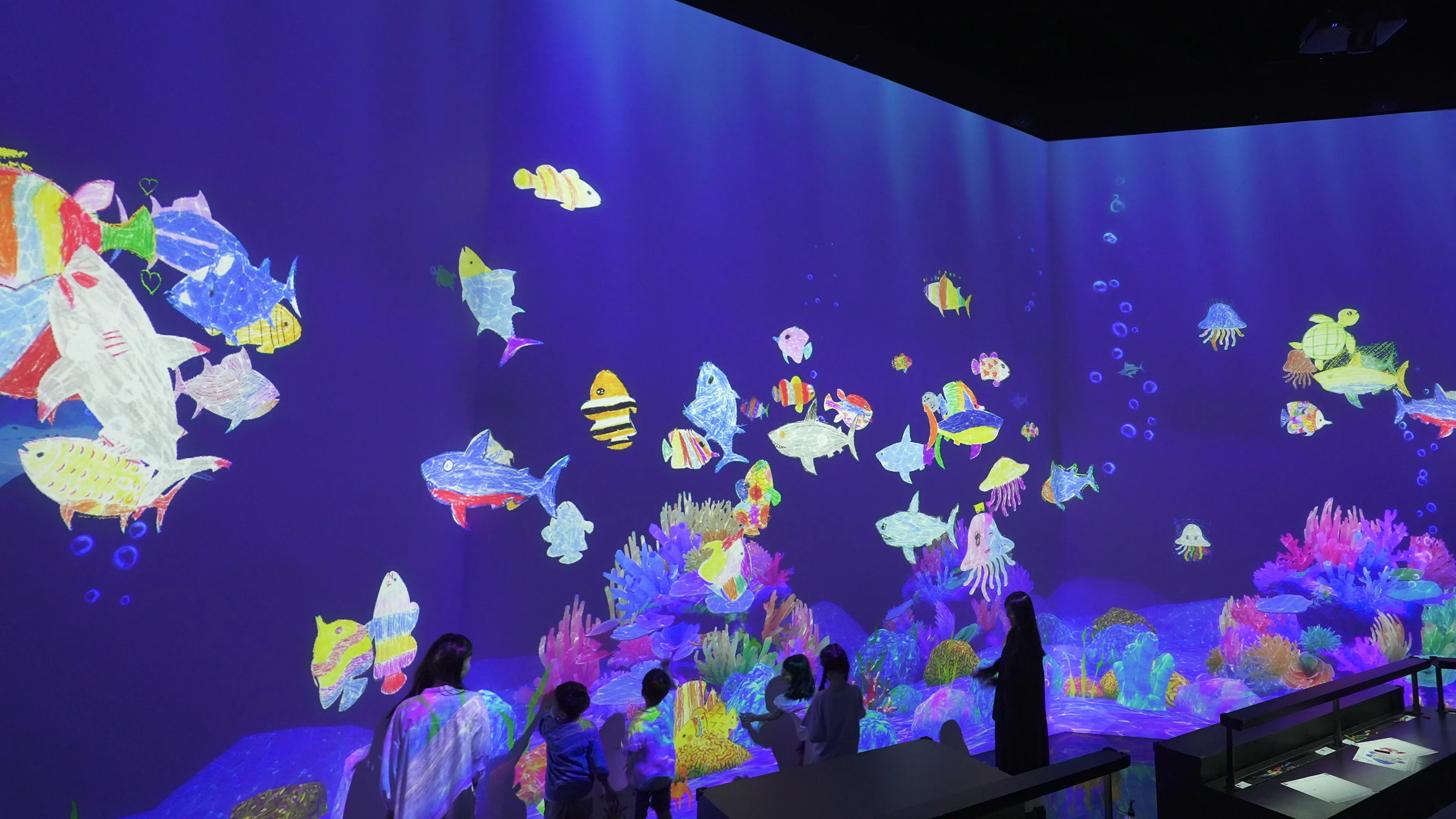
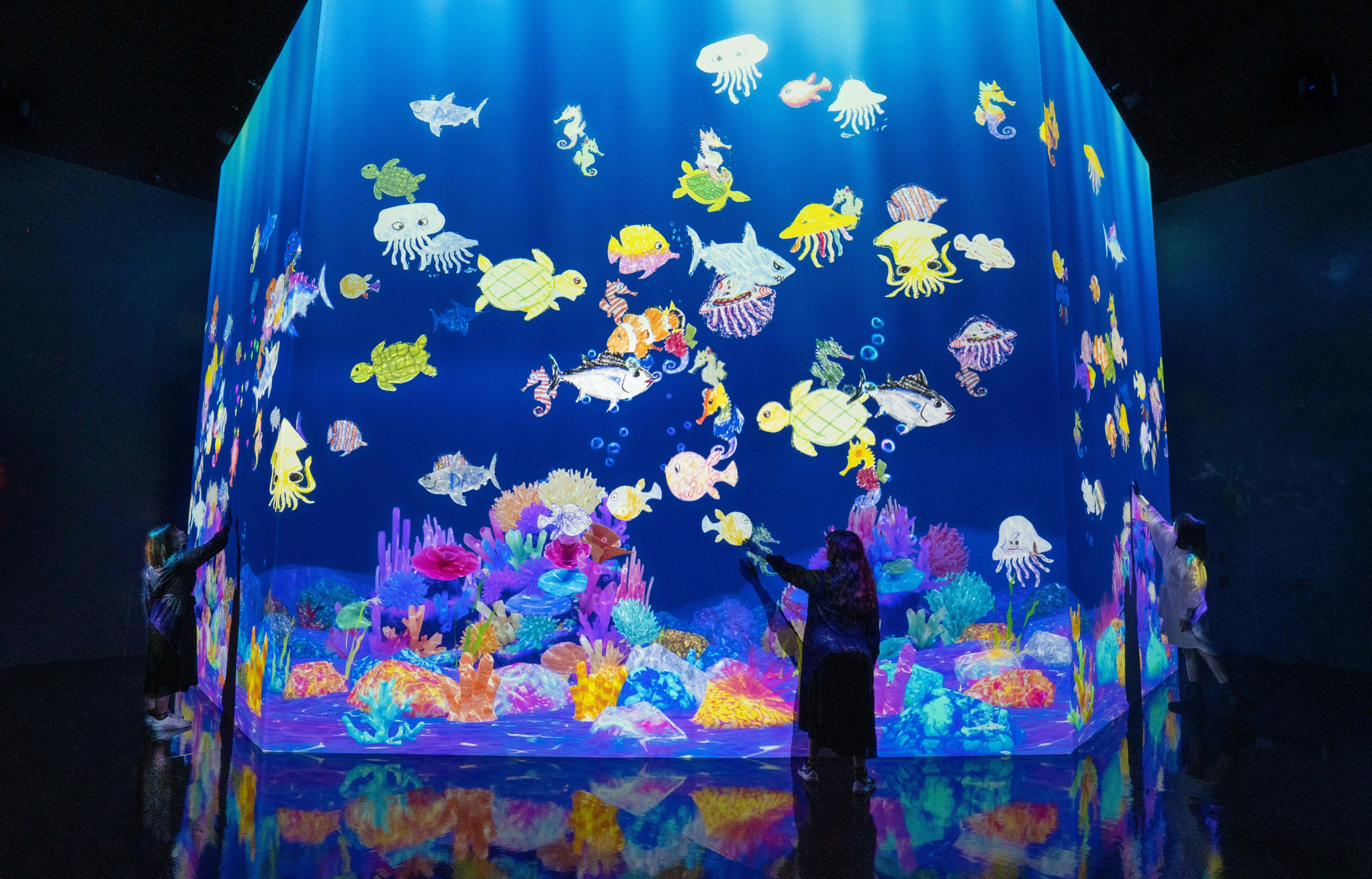
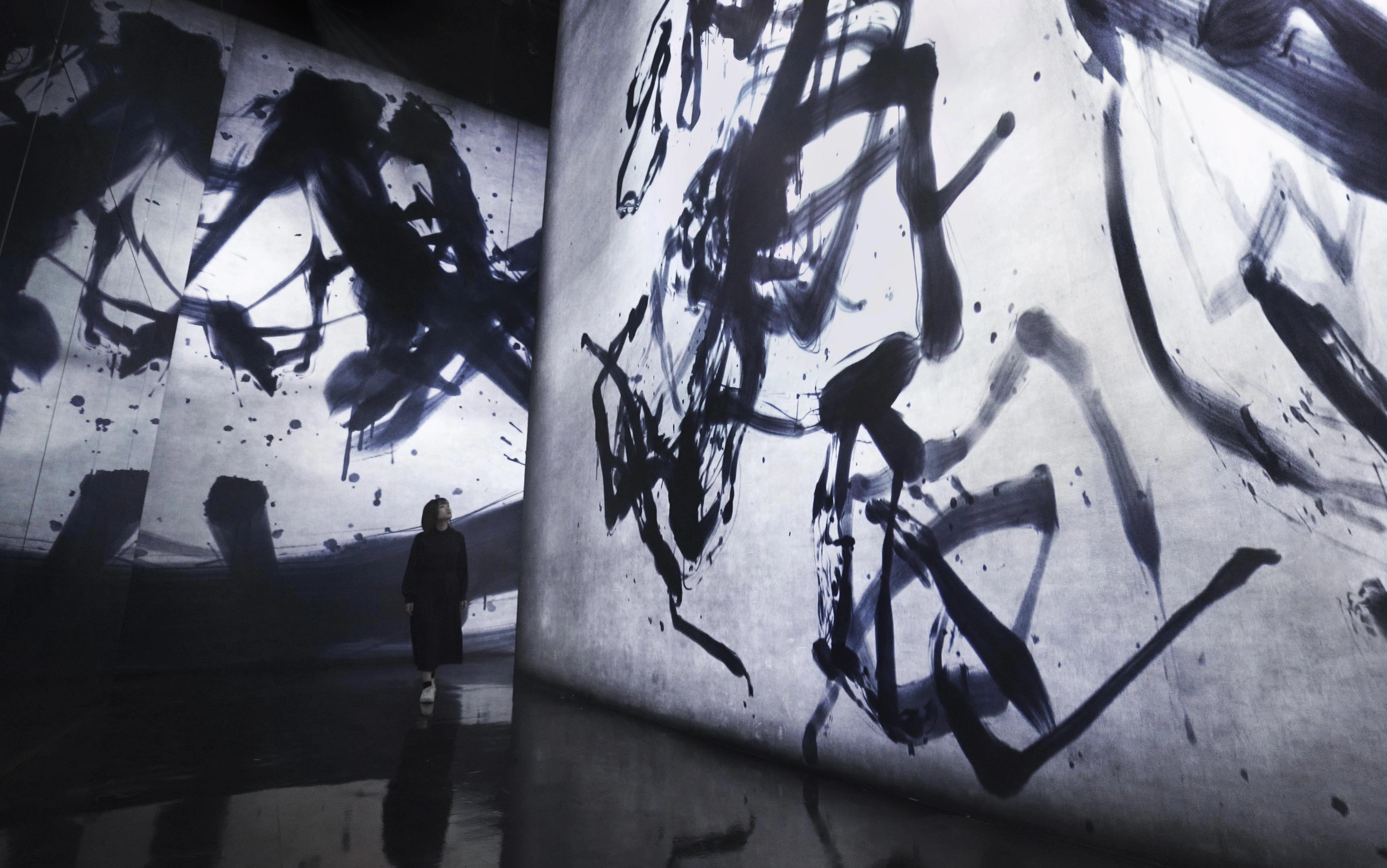
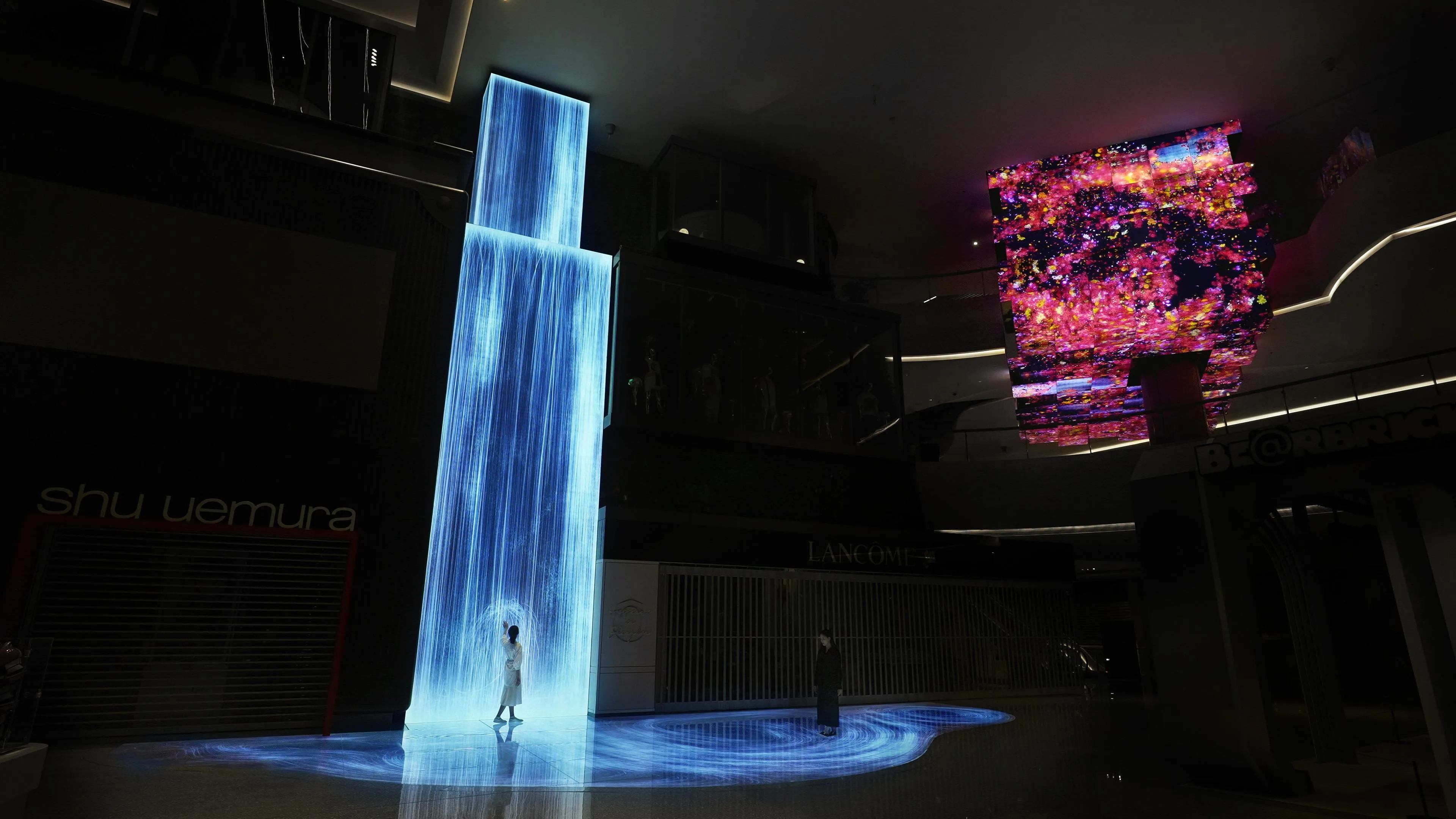
teamLab SuperNature is an extremely complex, three-dimensional interactive space with varying elevations that spans 5,000 square meters and is comprised of enormous 8-meter-tall works by art collective teamLab. It is a “body immersive” art space centered around a group of artworks that aim to explore new perceptions of the world and the continuity between humans and nature.

People immerse their bodies in massive art with others, influencing and becoming one with the art. Through the experience of transcending the boundaries between the body and the artwork, people redefine their perception of the boundaries between the self and the world, and thereby recognize the continuity between humans and the world.

Immerse the body in a complex, three-dimensional world, create a world with others, and become one with that world.

SuperNature World


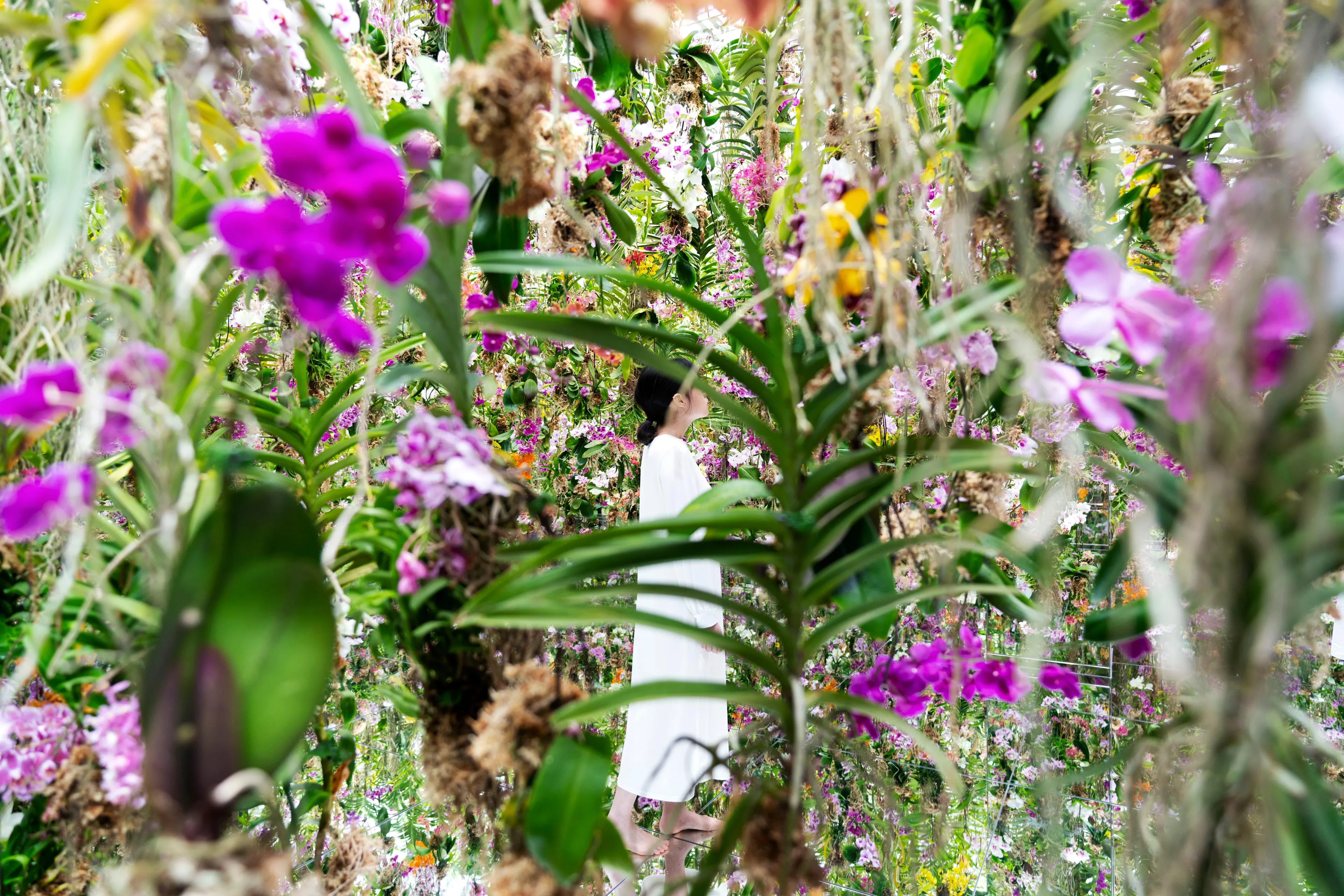
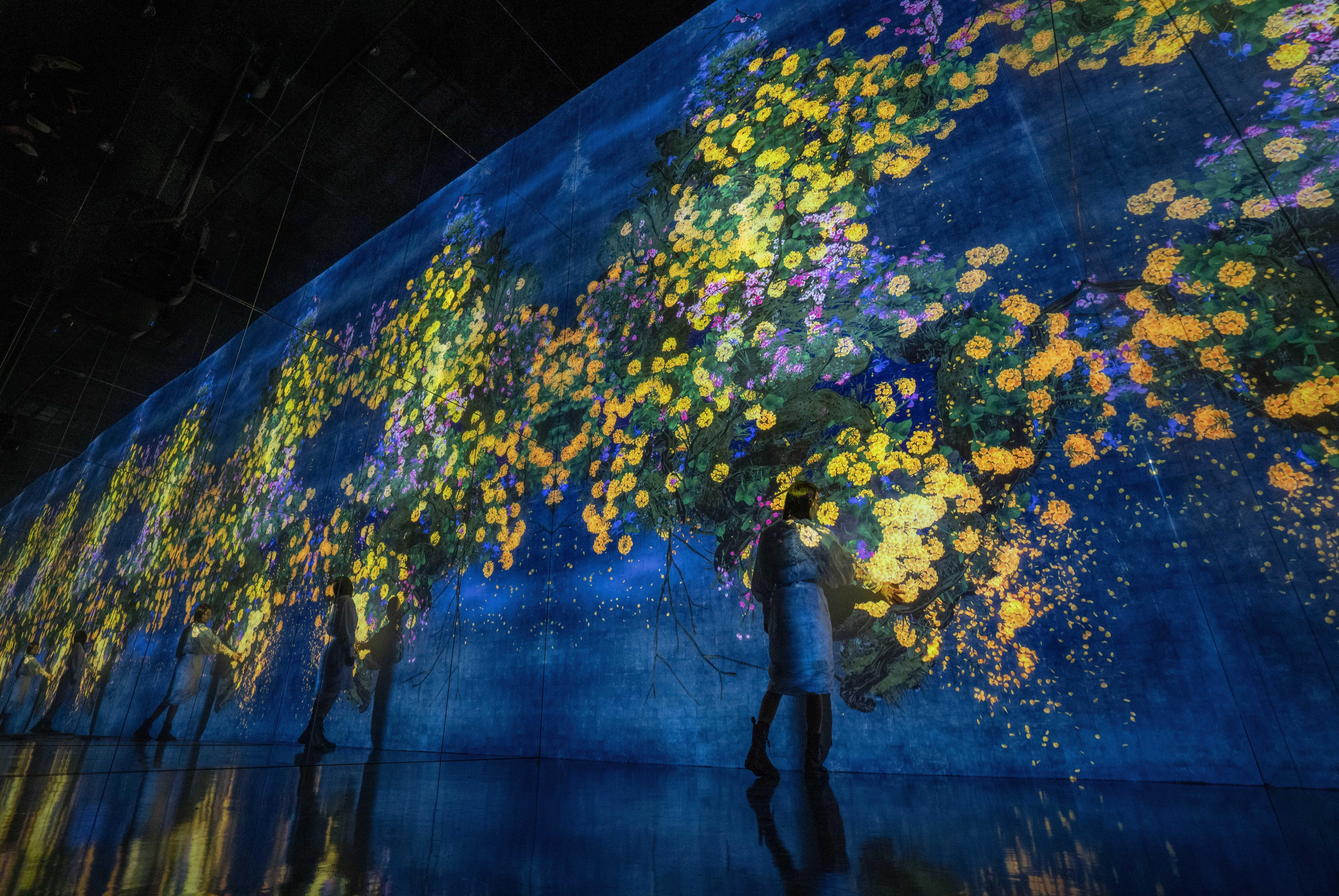
Floating Flower Garden: Flowers and I are of the Same Root, the Garden and I are One

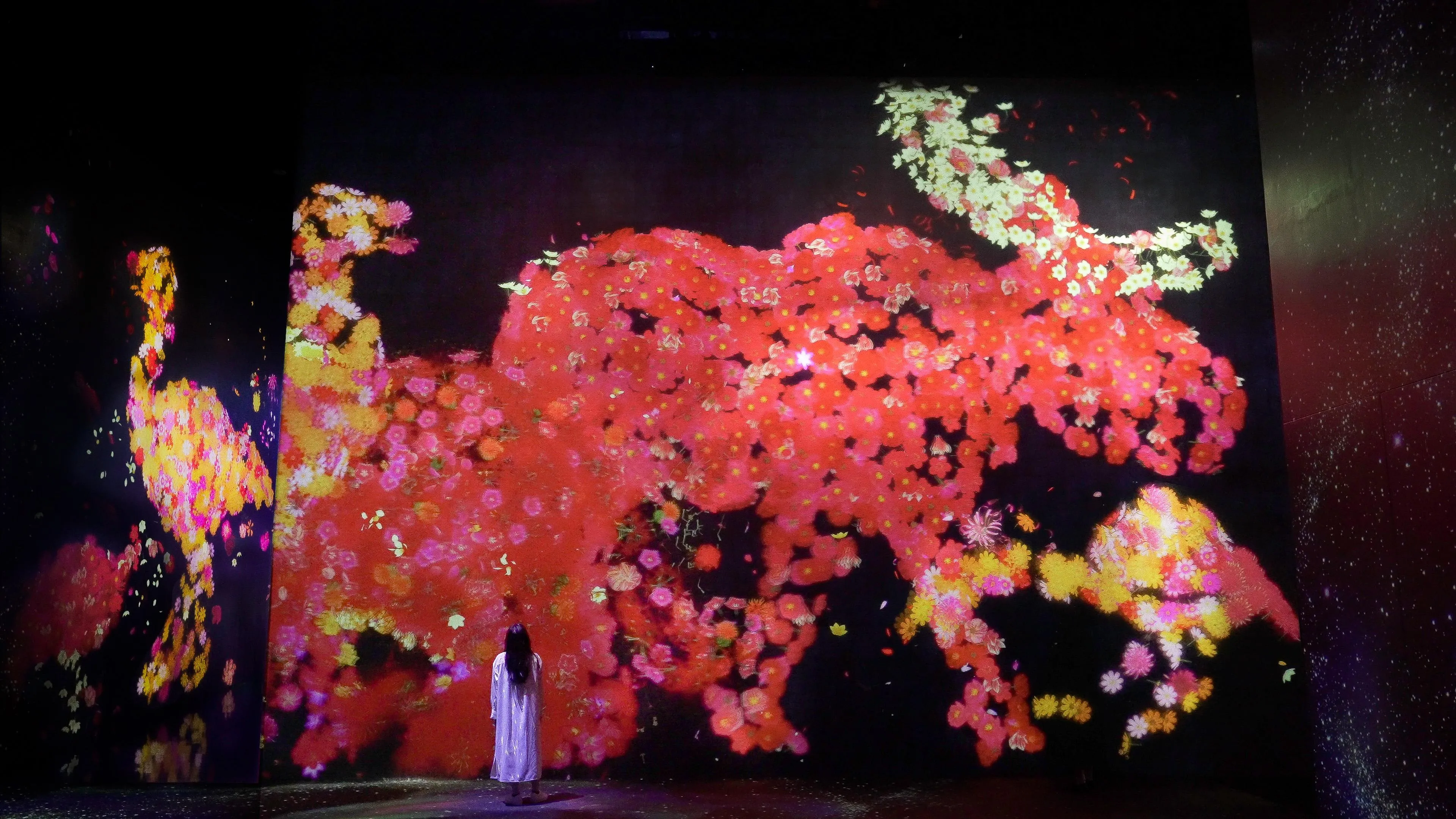
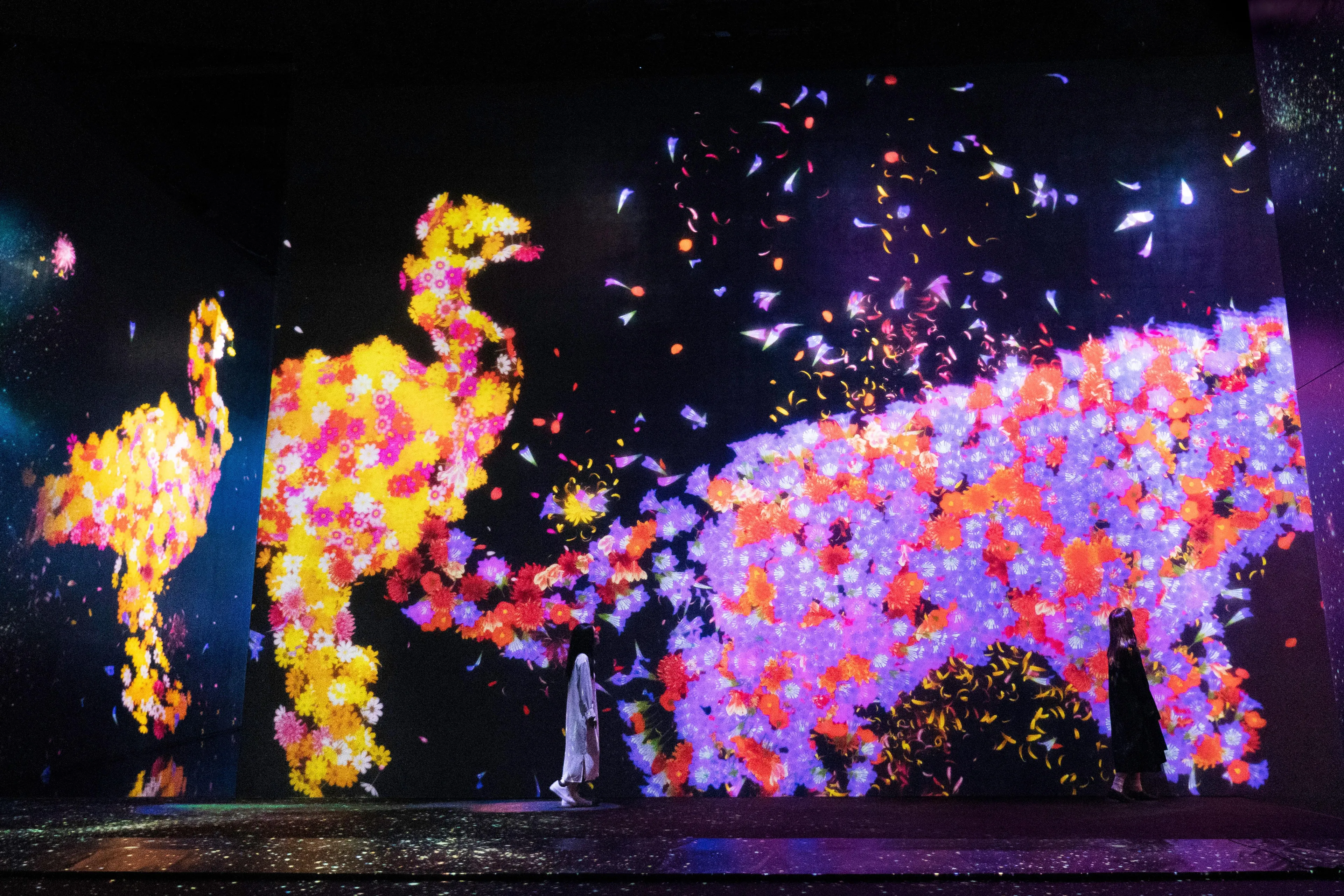
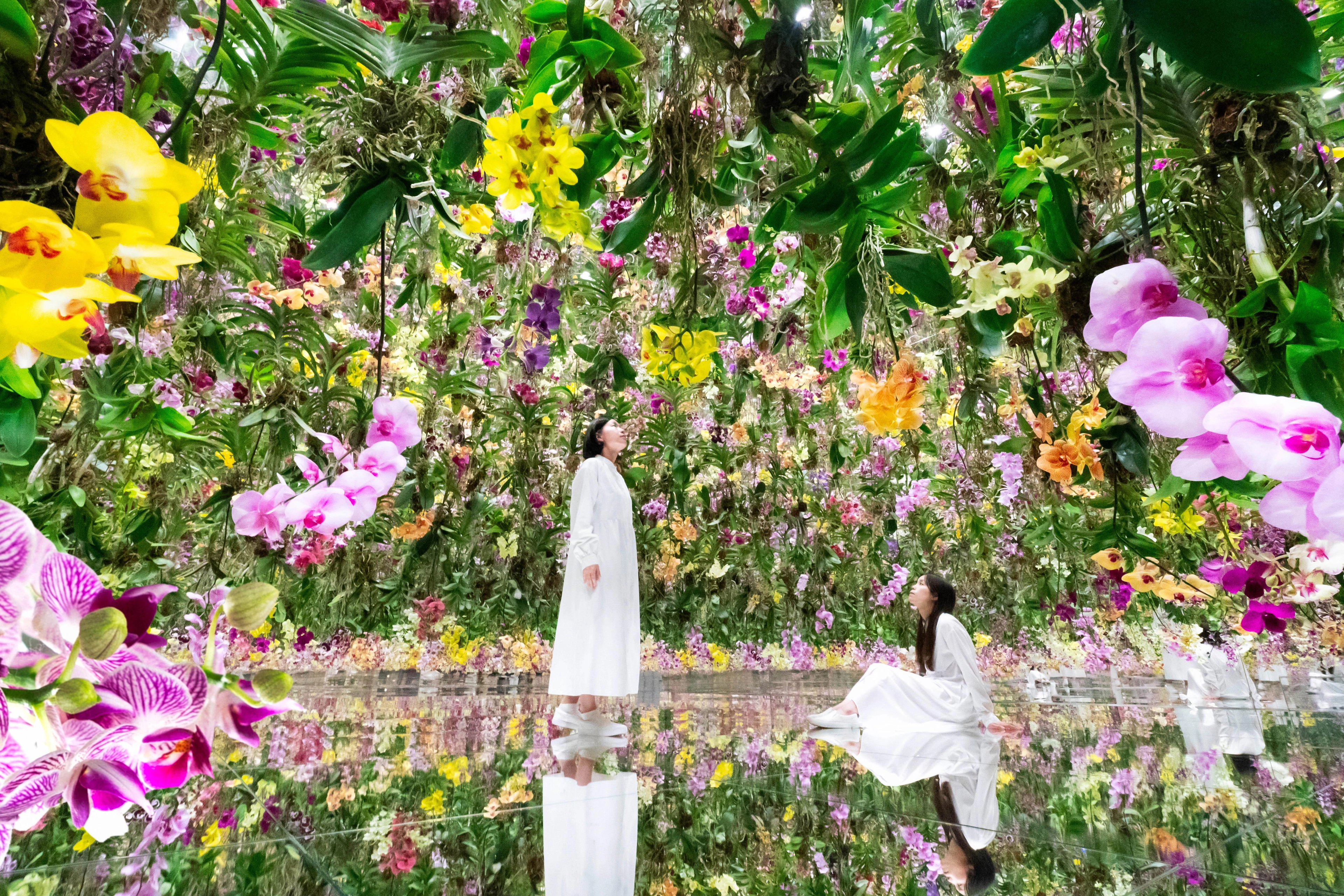
This floating flower garden consists of a three-dimensional mass of flowers.The artwork space is completely filled with flowers, but as the flowers float up above people, open spaces are created. Because of this, people are able to freely wander around the flower mass space. If you encounter other people within the artwork, your space will connect with theirs and become one single space.
Zen gardens are said to have been created as a place for groups of Zen priests to carry out training in order to become one with nature. There is a Zen kōan (a question or story that is part of Zen priests’ theological training) called “Nansen’s Flower”. Someone asked the monk Nansen about the famous saying, “Heaven and I are of the same root. All things and I are of the same substance”, remarking on how wonderful it was. Nansen, pointing to a flower in the garden, said, “People these days see this flower as if they were in a dream”.In this work, people immerse themselves in flowers, becoming one with the garden. When someone continues to look at a flower closely, the flower looks back. At that moment, they become one with the flower and may truly see flowers for the first time.
The flowers in this artwork are orchids. Most orchids are able to grow without soil by absorbing water from the air. The flowers in this artwork are alive, growing, and blooming with each passing day. It could be said that they are growing in mid-air. Although flowering plants were the last of the plant species to appear on earth, at least 220,000 of the 250,000 terrestrial plant species are flowering plants. Evolution has favored diversity, and it can be said that flowers were born to produce diversity. Orchids were flowering plants that most enjoyed diversity, and it is said that approximately 10% of all plant species belong to the orchid family. Because of their diversity, many orchids evolved to become most adapted to live on rocks and trees instead of land with soil where other plants grew abundantly. In an area without soil, in other words, traditionally a least favorable environment for plants, orchids evolved to be most adapted for a world without competition. They are thought to have appeared at a later stage of evolution compared to other plants, and continue to diversify to this day, making us wonder what evolution chose to favor.
Orchids are known to have co-evolved with certain pollen-carrying insects. The flowers’ aromas become stronger at the time of day when the partner insects are active. Because of this, the scent of the artwork space changes each moment between morning, day, evening, and night. Since many of the orchids in this work are partnered with nocturnal insects, the tightly-packed orchids produce a powerful fragrance at night.

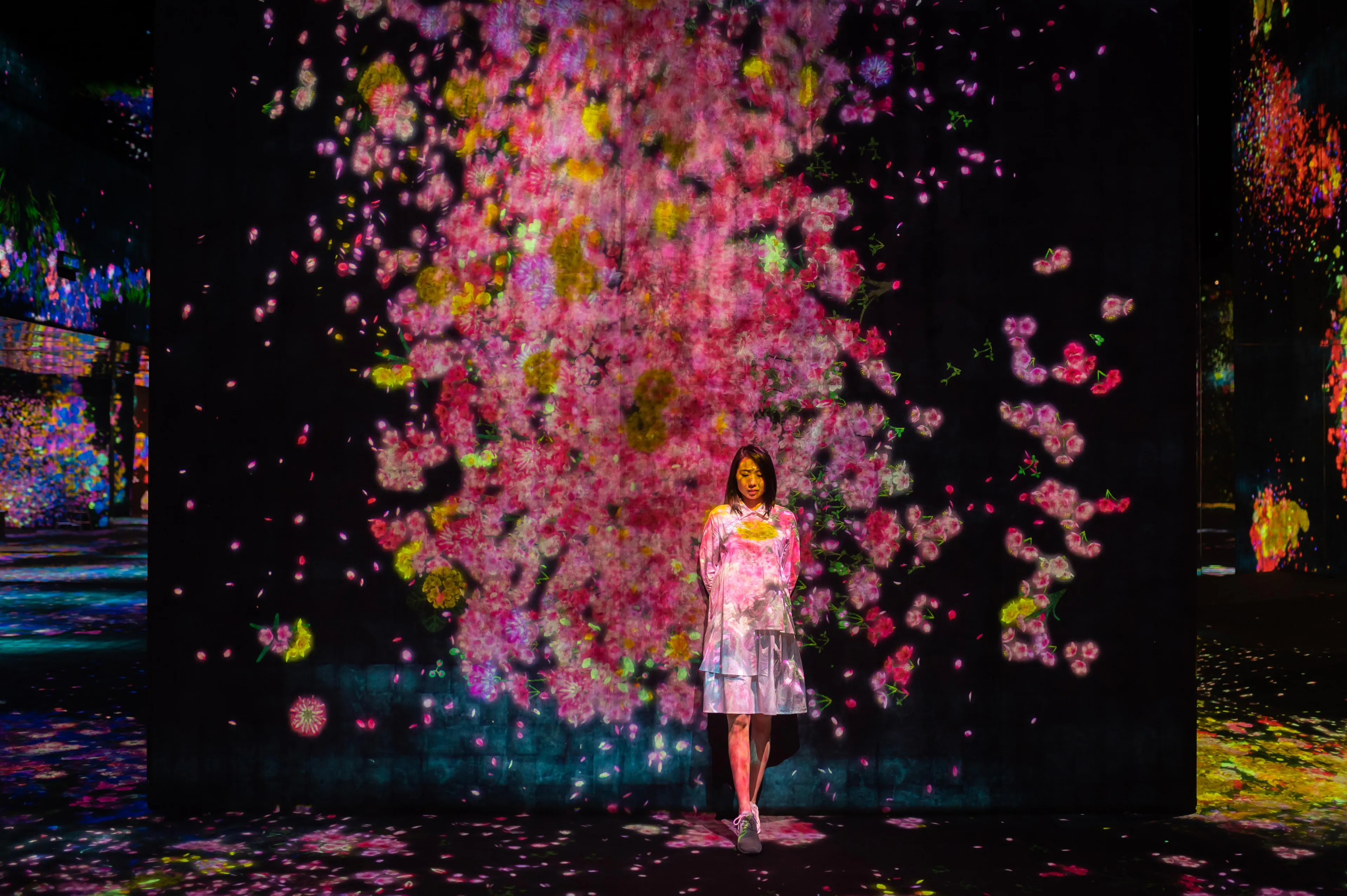
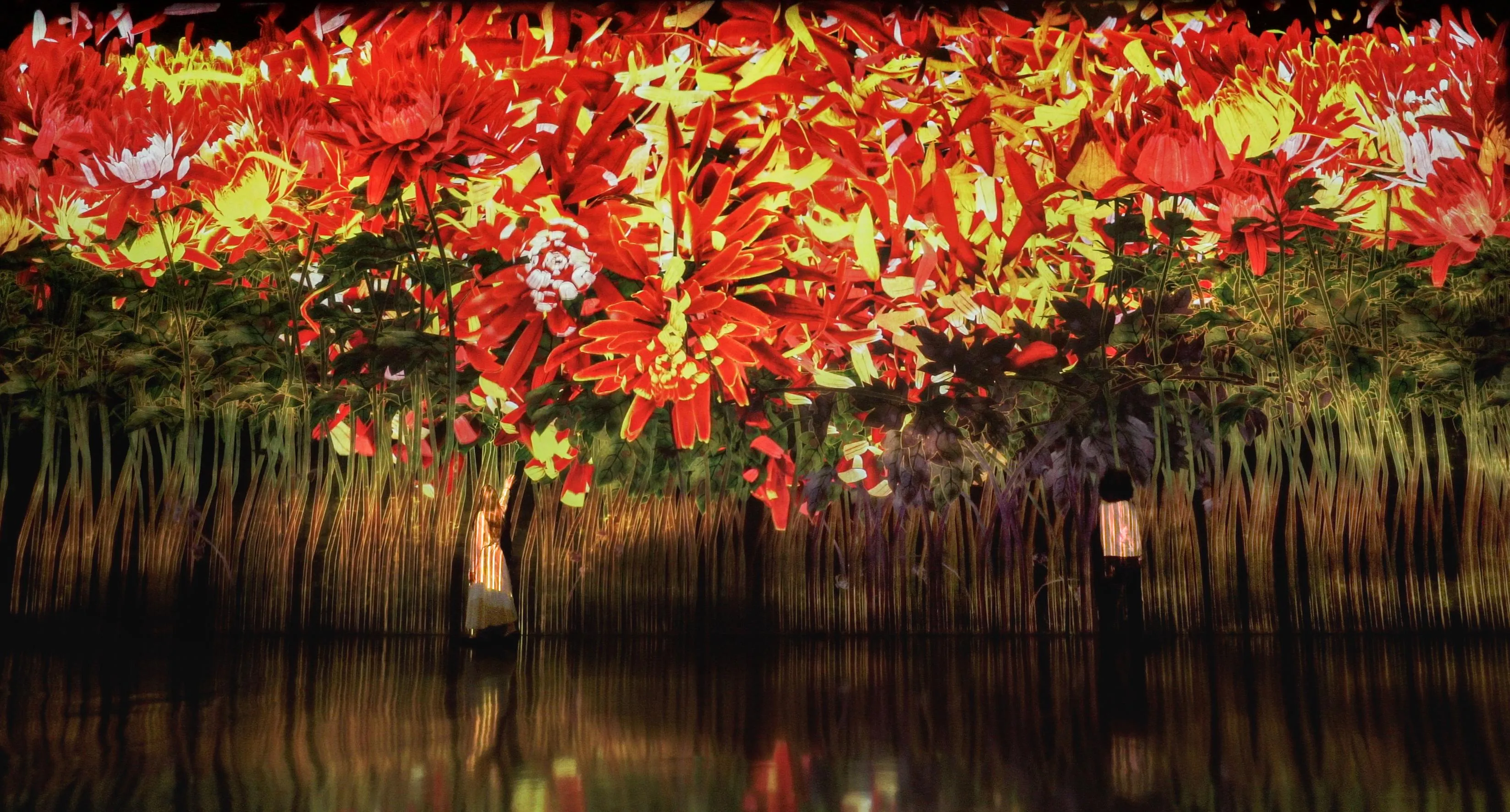
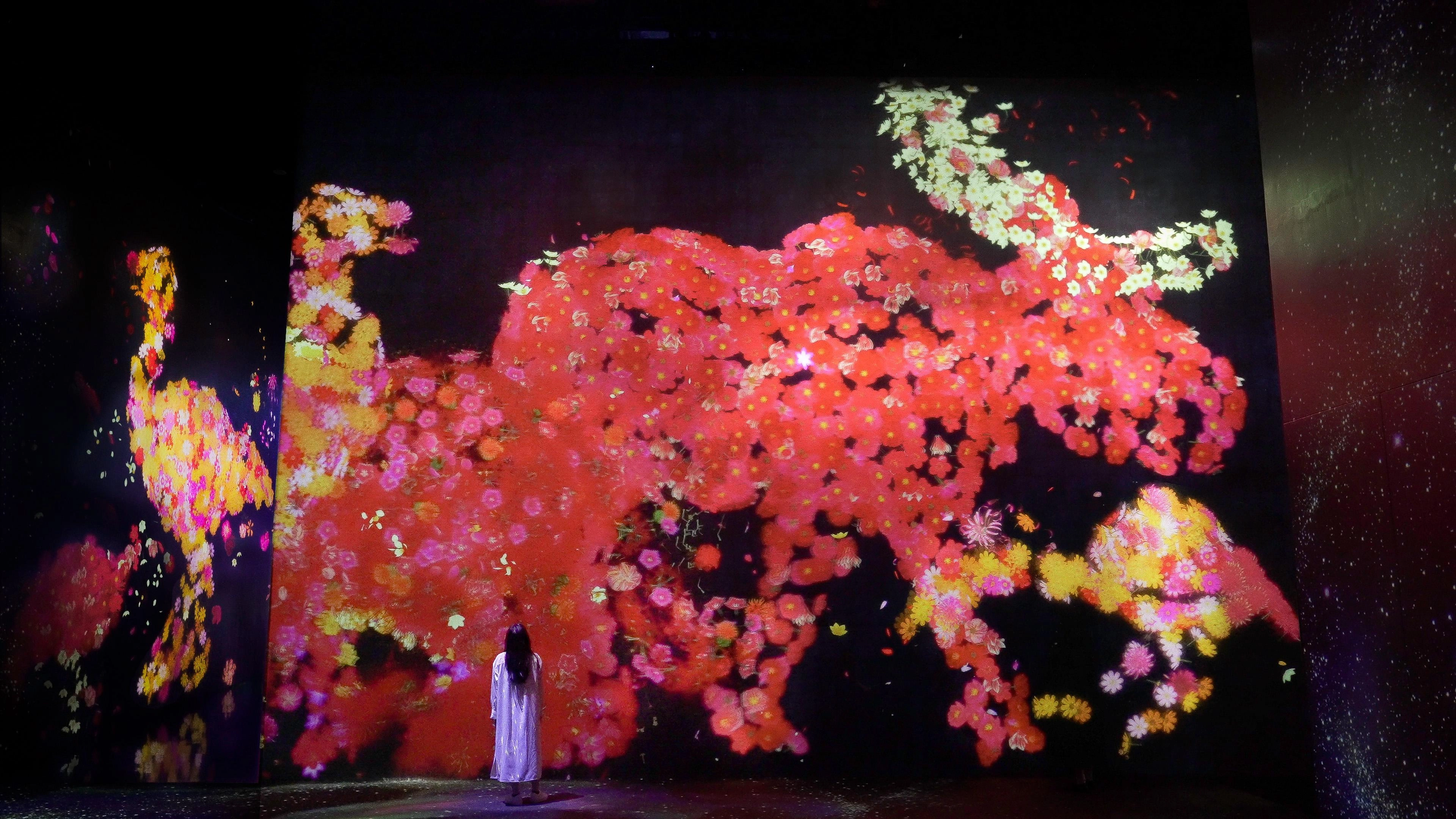
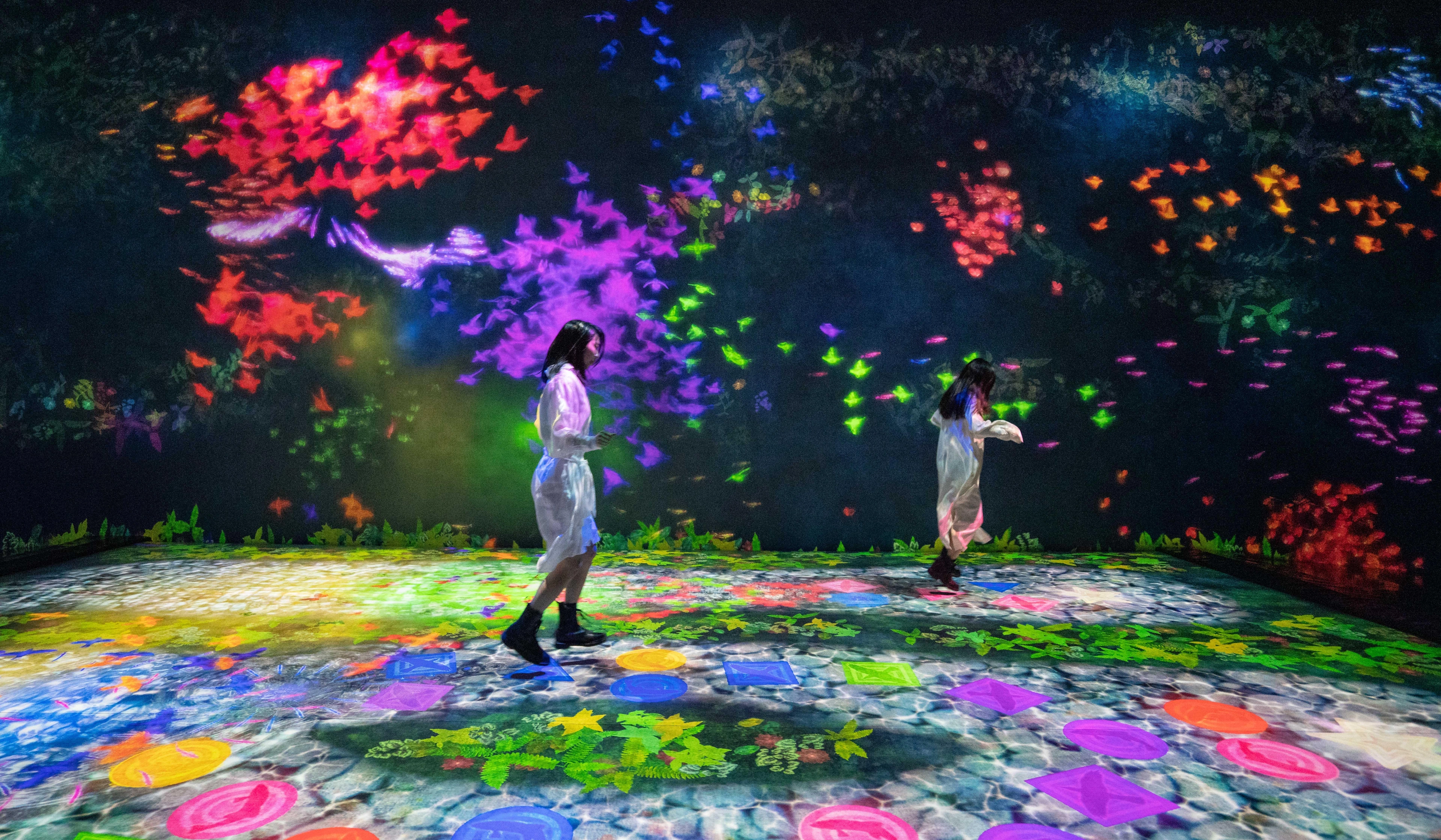
Valley of Flowers and People: Lost, Immersed and Reborn

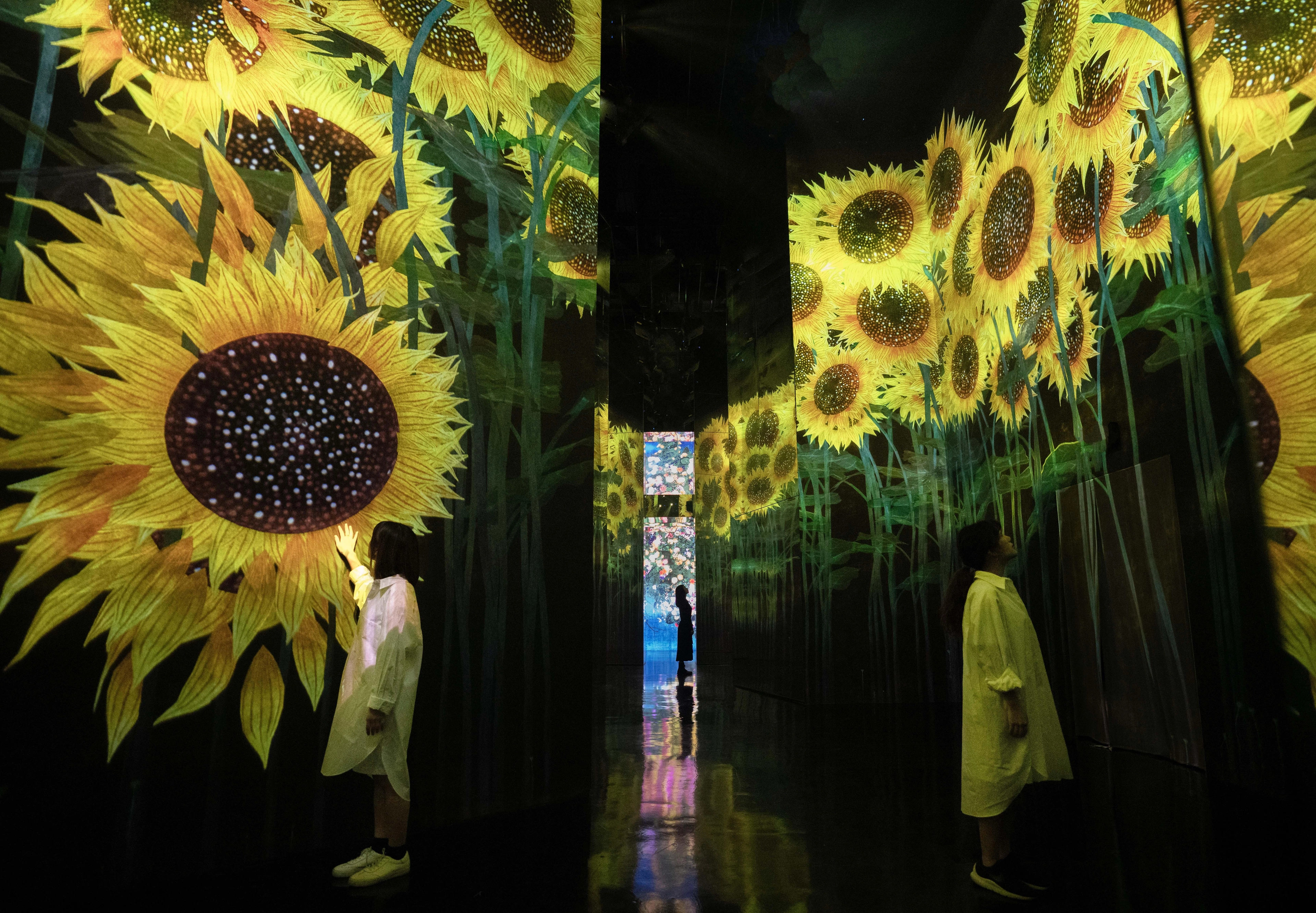
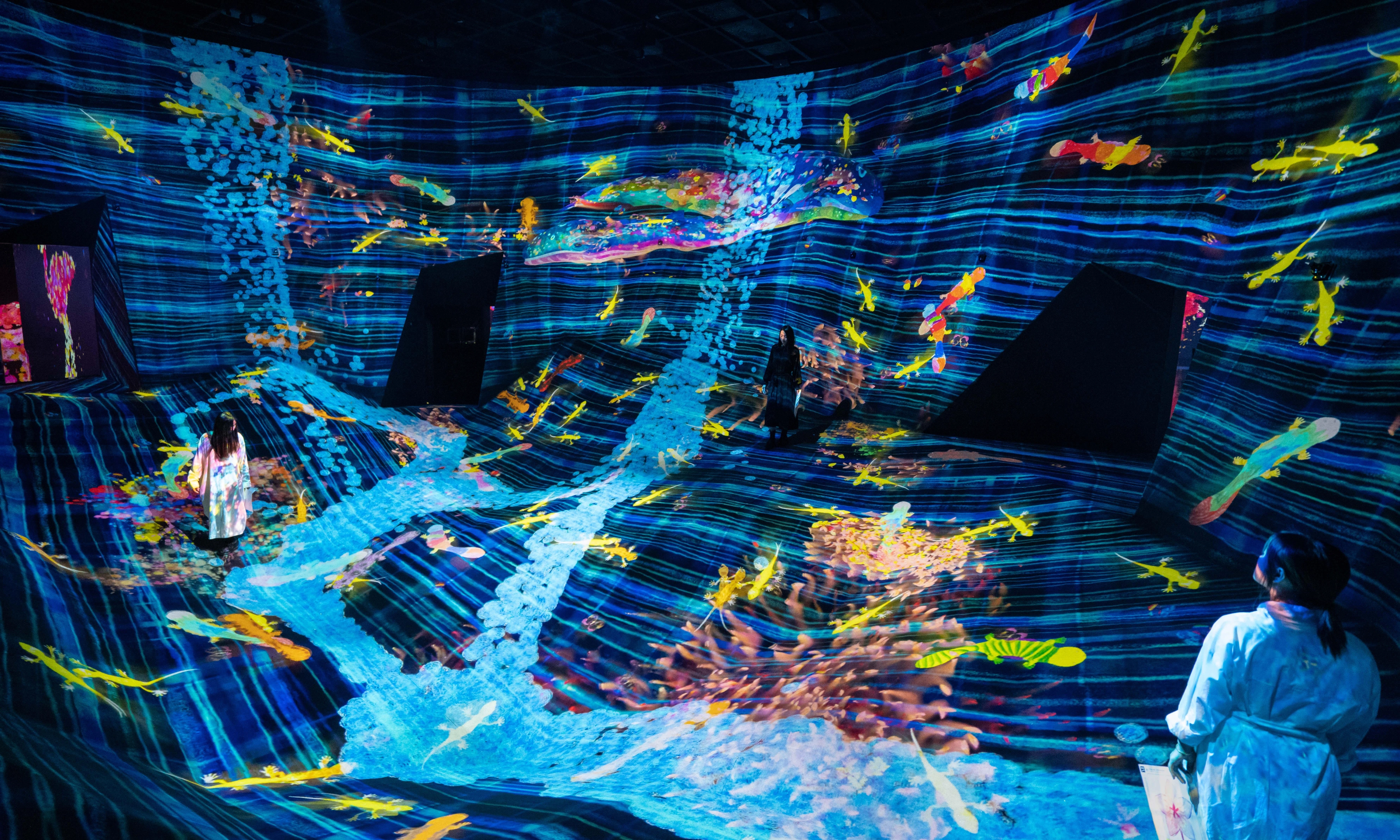
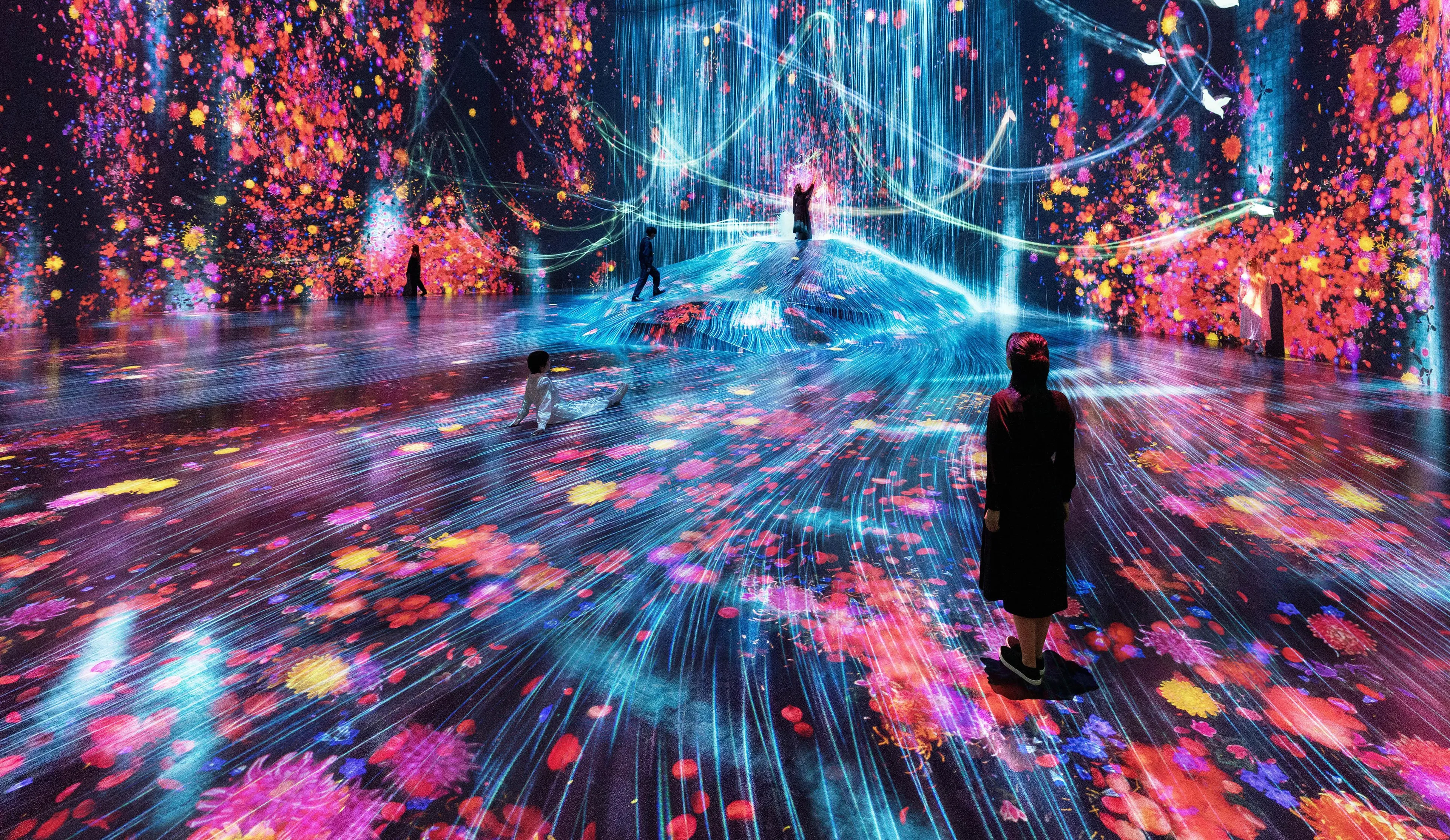
Flowers bud, bloom, and in the course of time, wither and die. While eternally repeating the process of life and death, the places where they grow change gradually. When people stand still, the flowers surrounding them grow and bloom abundantly, but when people touch the flowers or walk around, they scatter and die all at once.The artwork is not a pre-recorded image that is played back; it continues to be rendered in real time under the influence of people's behavior. The picture at this moment can never be seen again.
In spring in the Kunisaki Peninsula, there are many cherry blossoms in the mountains and canola blossoms at their base. A visit to this region led teamLab to wonder how many of these flowers were planted by people and how many of them were native to the environment. It was a place overflowing with flowers, a place of great serenity and contentment. This nature is an ecosystem influenced by human activity, making us feel that nature and humanity are not in conflict. Perhaps a truly comforting nature is one that encompasses human presence as part of the ecosystem. Based on the premise that nature cannot be completely controlled, this artwork explores human activity that lives closely aligned to the rules of nature.
This artwork is an ecological pictorial space drawn through Ultrasubjective Space, which continues to be generated along with the body, others, time, and the environment. Viewers physically walk around and touch inside the world of the artwork, transforming it together with others in the same space.
This pictorial space differs from images or paintings flattened by a lens or single-point perspective. In such images or paintings, space appears behind the picture plane; the space that opens there and the space the viewer inhabits are split, and the picture plane becomes a boundary surface. The viewpoint is fixed at a single point, and bodily freedom is lost.On the other hand, a picture plane formed by Ultrasubjective Space is not a boundary that separates where we are from the world of the artwork. The world of the artwork is not outside a window; it appears as a single field that is continuously connected, without boundary, to the space in which the viewer’s body exists. Moreover, any position — front, back, left, or right — can become a viewpoint, so viewpoints exist in infinite number, and the viewer is physically free to move.Not bound to a single point, the viewer moves their body and lets their eyes roam freely, continually re-composing the world of the artwork as it changes over time, and building the pictorial space within themselves. In that moment, the artwork becomes a centerless, subjective, and embodied pictorial space in which the viewer walks and touches.
In this space, the boundaries between the viewer and the artwork become ambiguous. The artwork transforms simply by the presence of a body there, and the behavior of others also changes the world of the artwork. In conventional art, other people were often considered an obstacle that interferes with a one-on-one relationship with the artwork. However, here, the presence of others enriches and creates new changes in the artwork.
This artwork is an attempt to expand painting from a world on the other side of the screen into a space continuous with the body, others, time, and the environment. The artwork continues to be generated within the relationships among the behavior of people, the life and death of flowers, the passage of time, and the entire space. Here, the painting does not exist on its own as a completed entity; it relates to people's bodies and includes the presence of others, existing as an ecological field without boundaries.

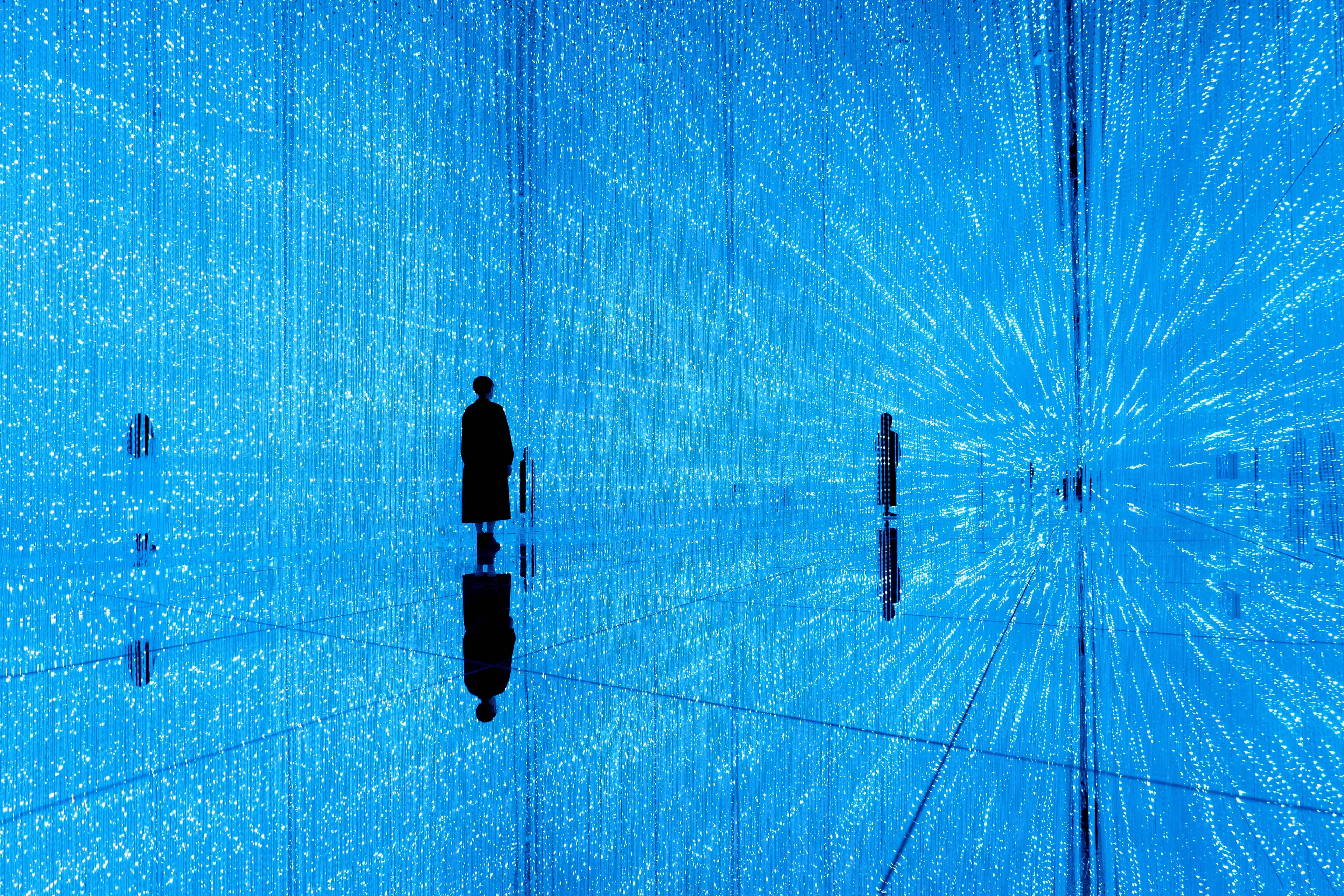
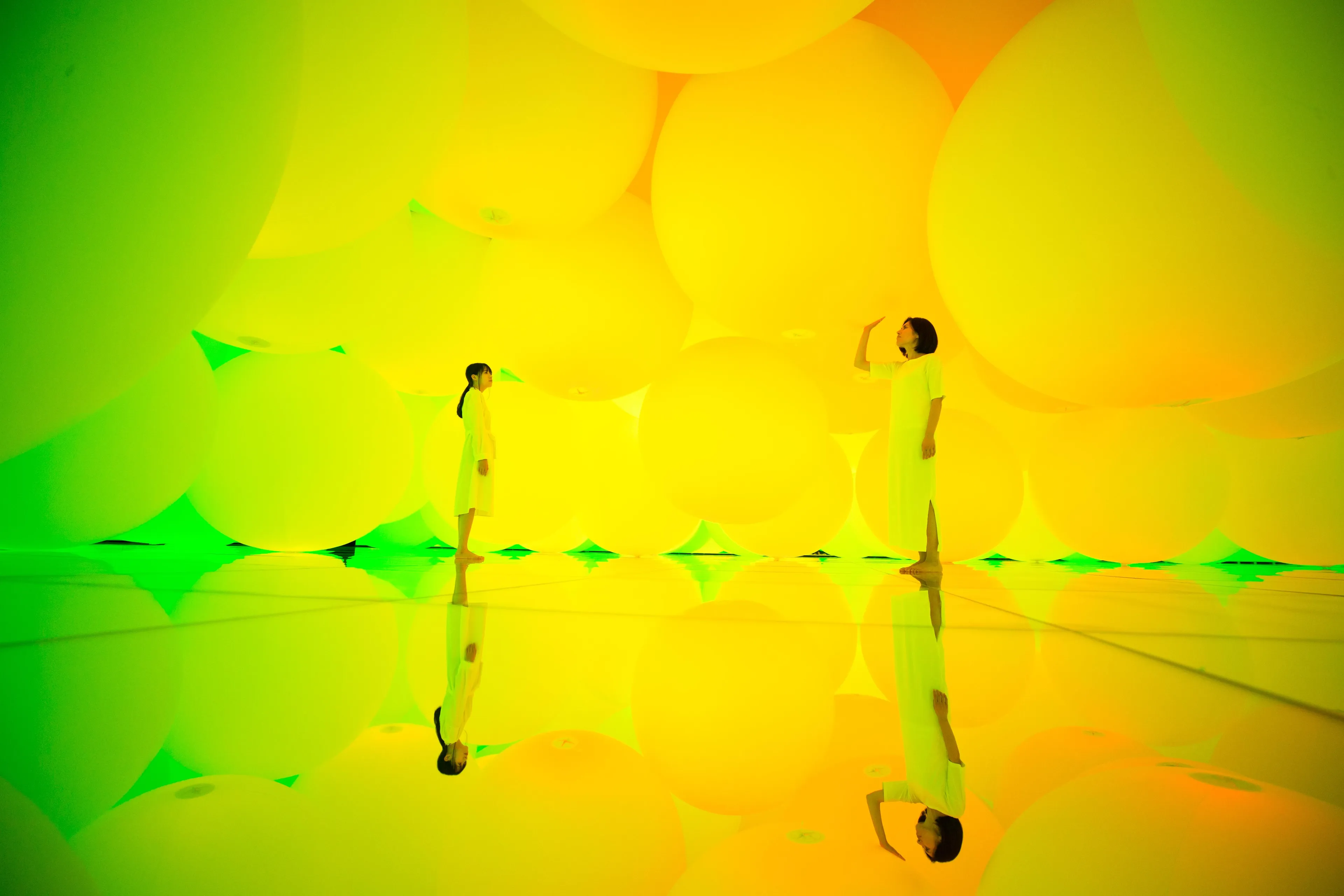
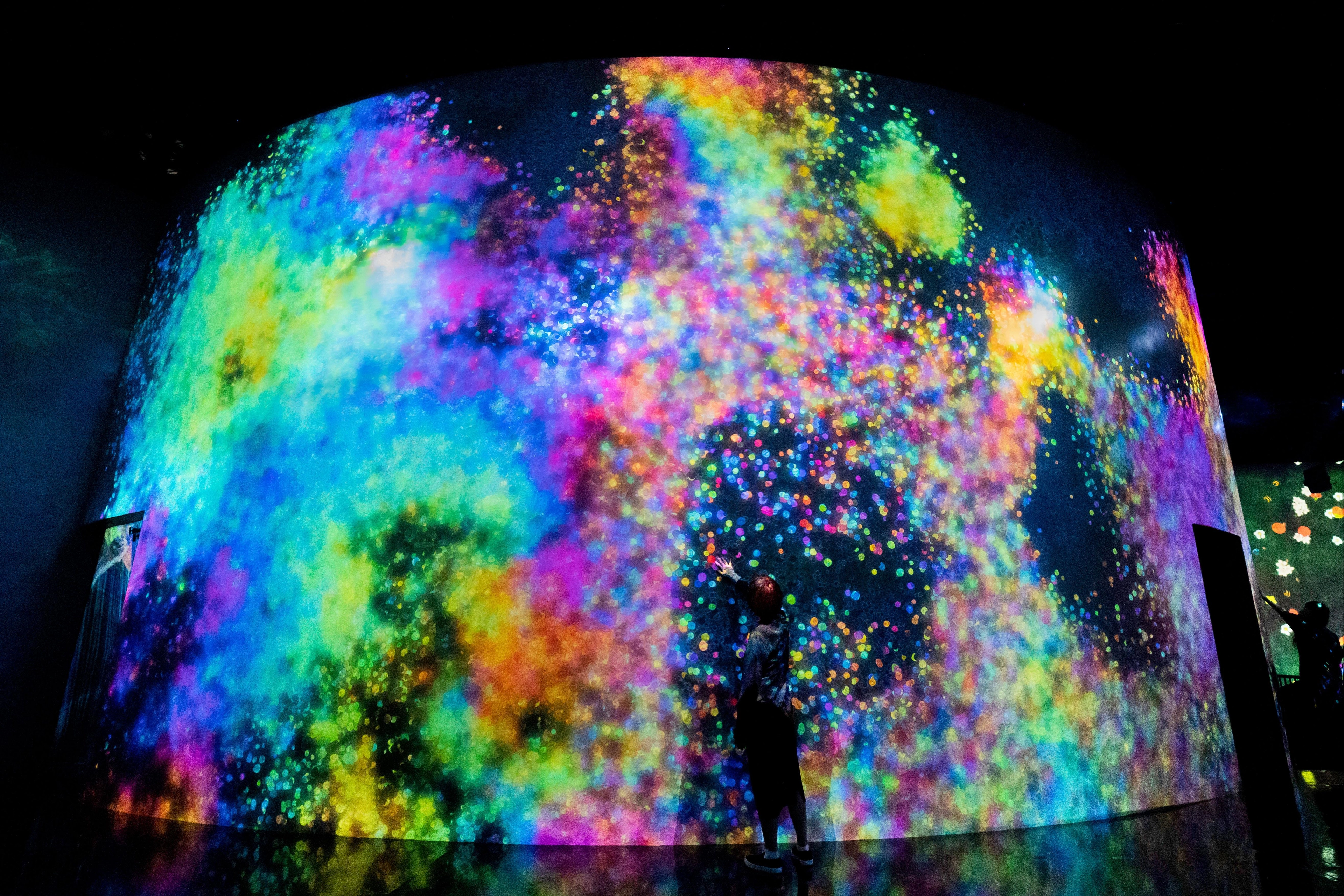
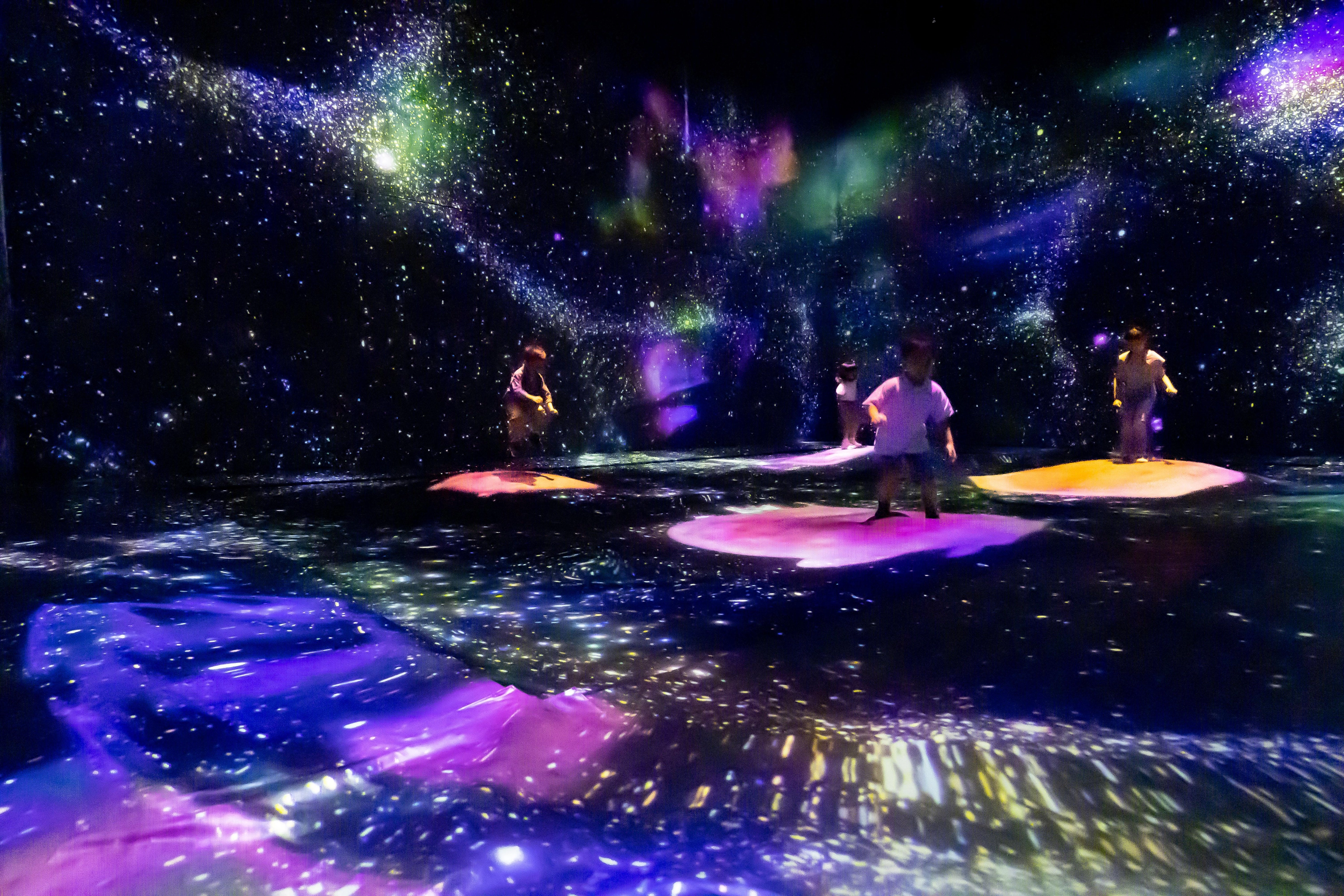
Expanding Three-Dimensional Existence in Transforming Space - Flattening 3 Colors and 9 Blurred Colors, Free Floating

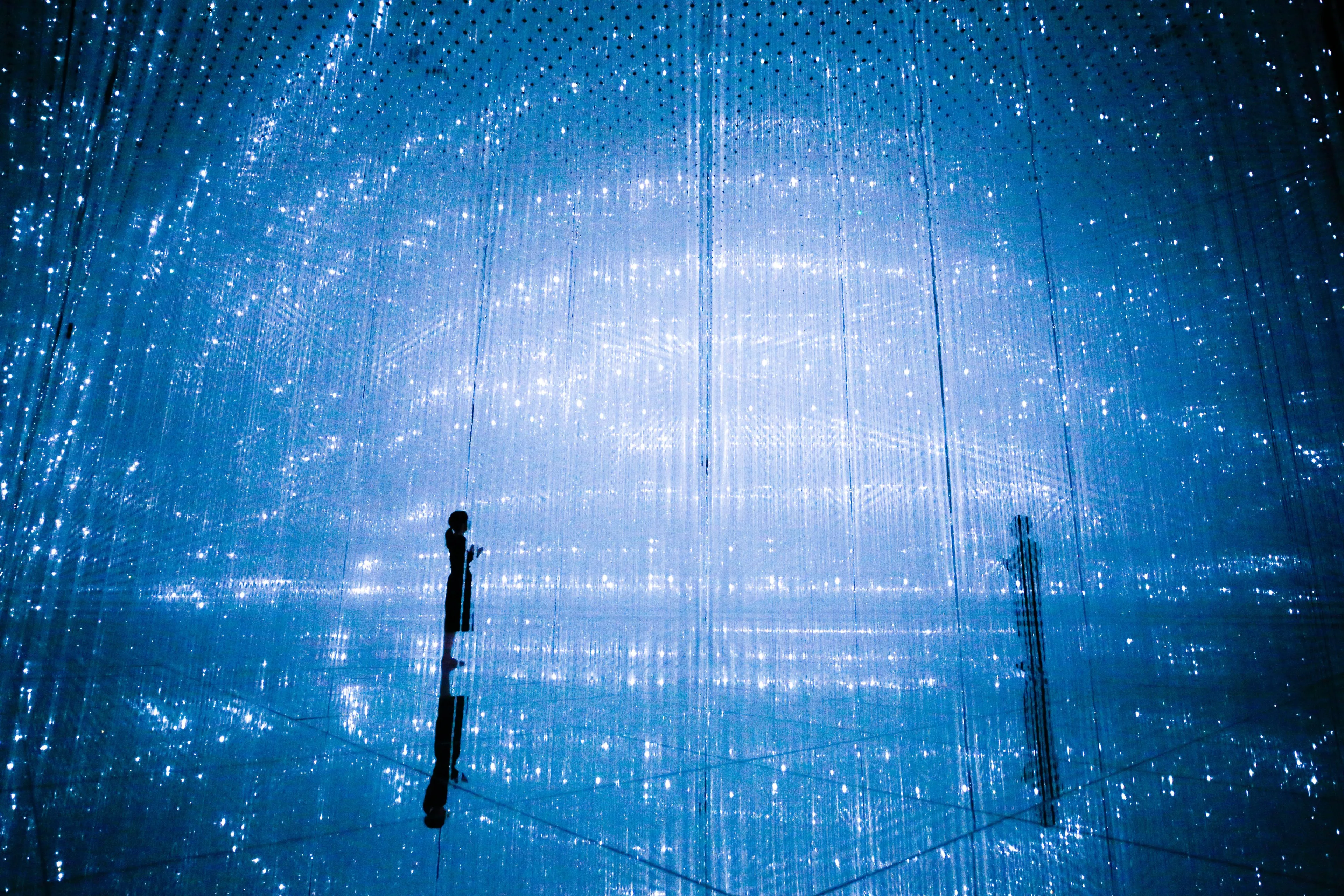
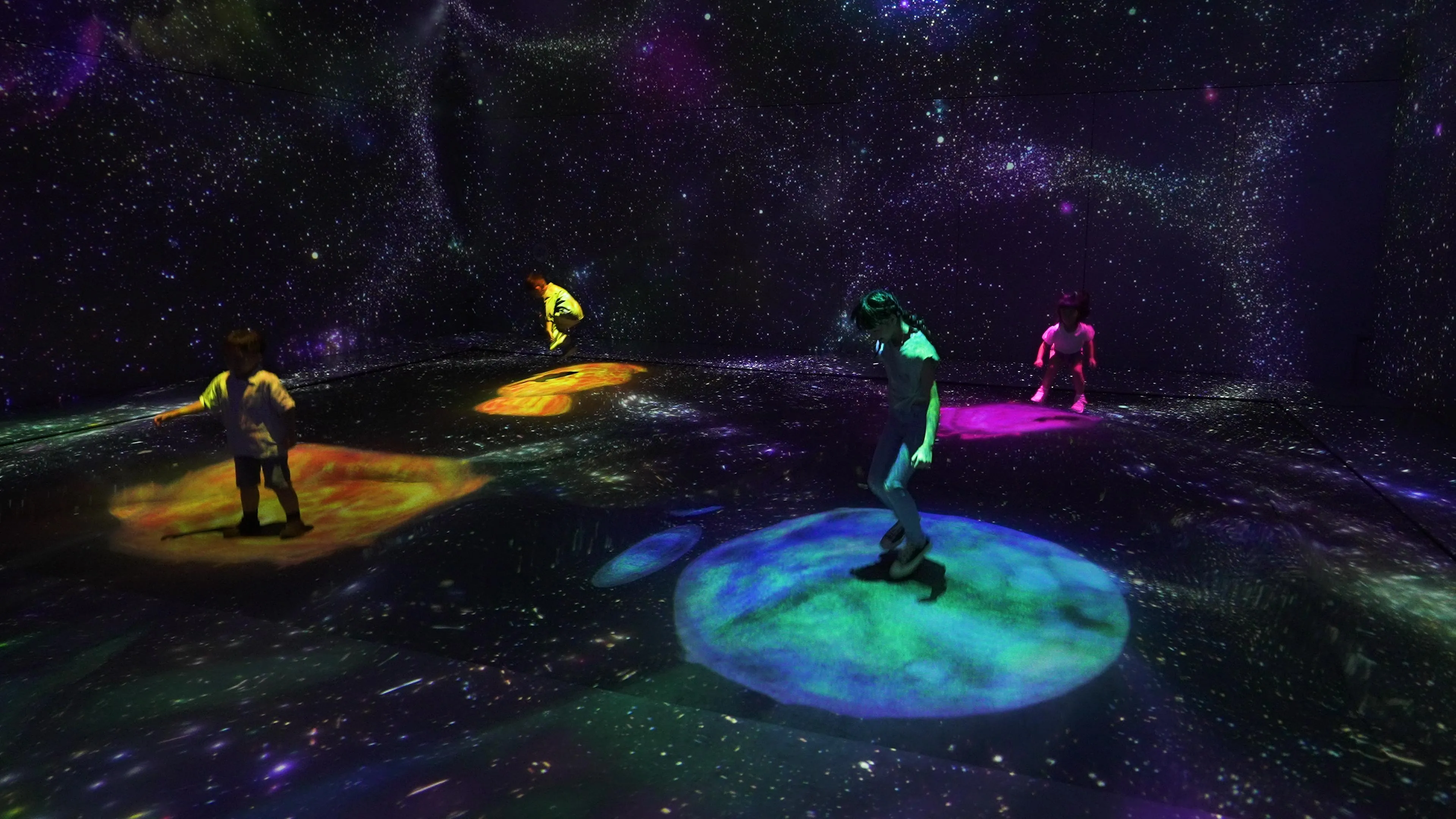
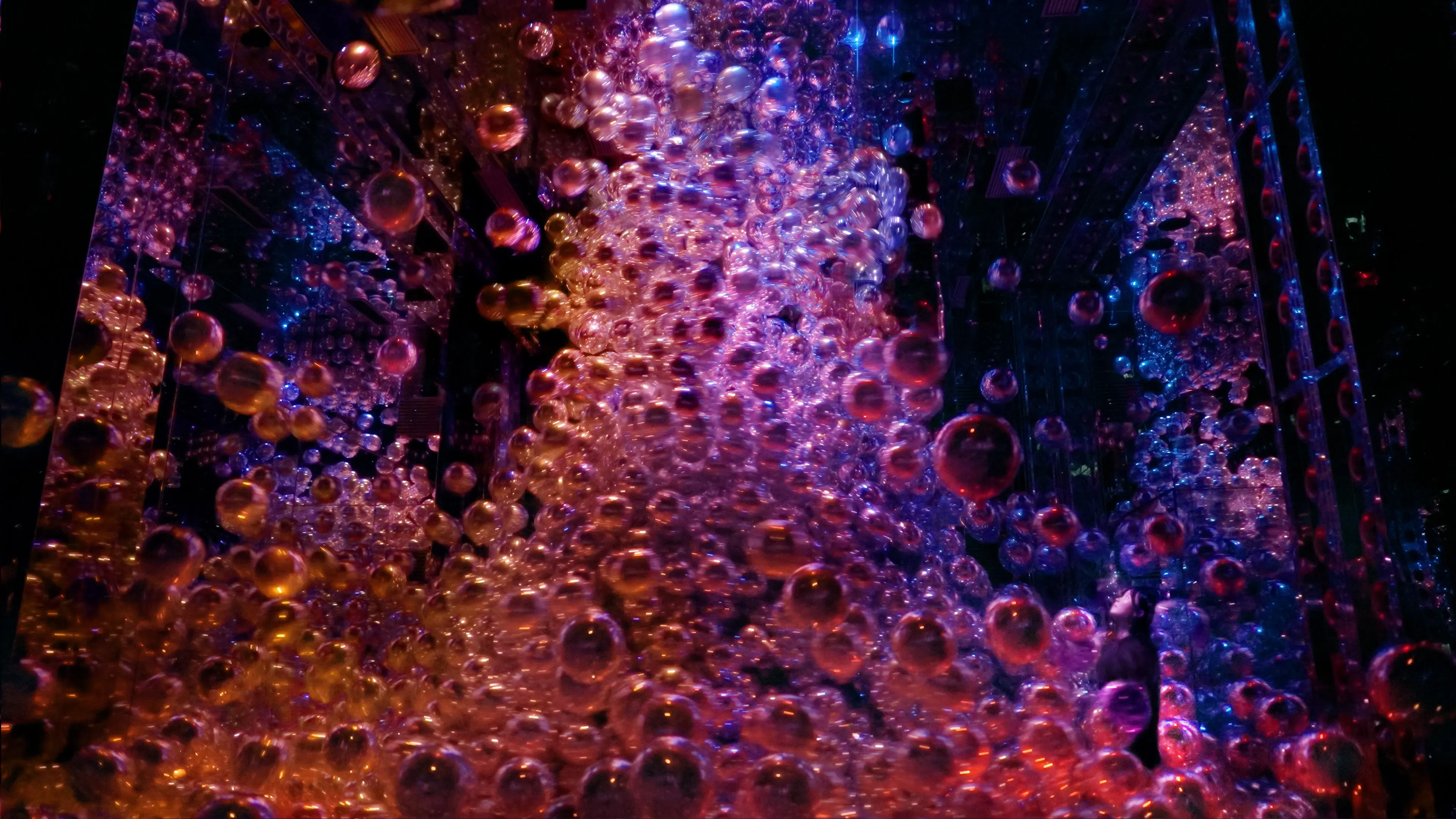
The space is filled with spheres of free floating light. People move through the spheres and enter the space. When people move through or strike them, the spheres change color, and that color resonates out. The spheres around that sphere change color tone and in turn resonate out the color in three-dimensions to nearby spheres.
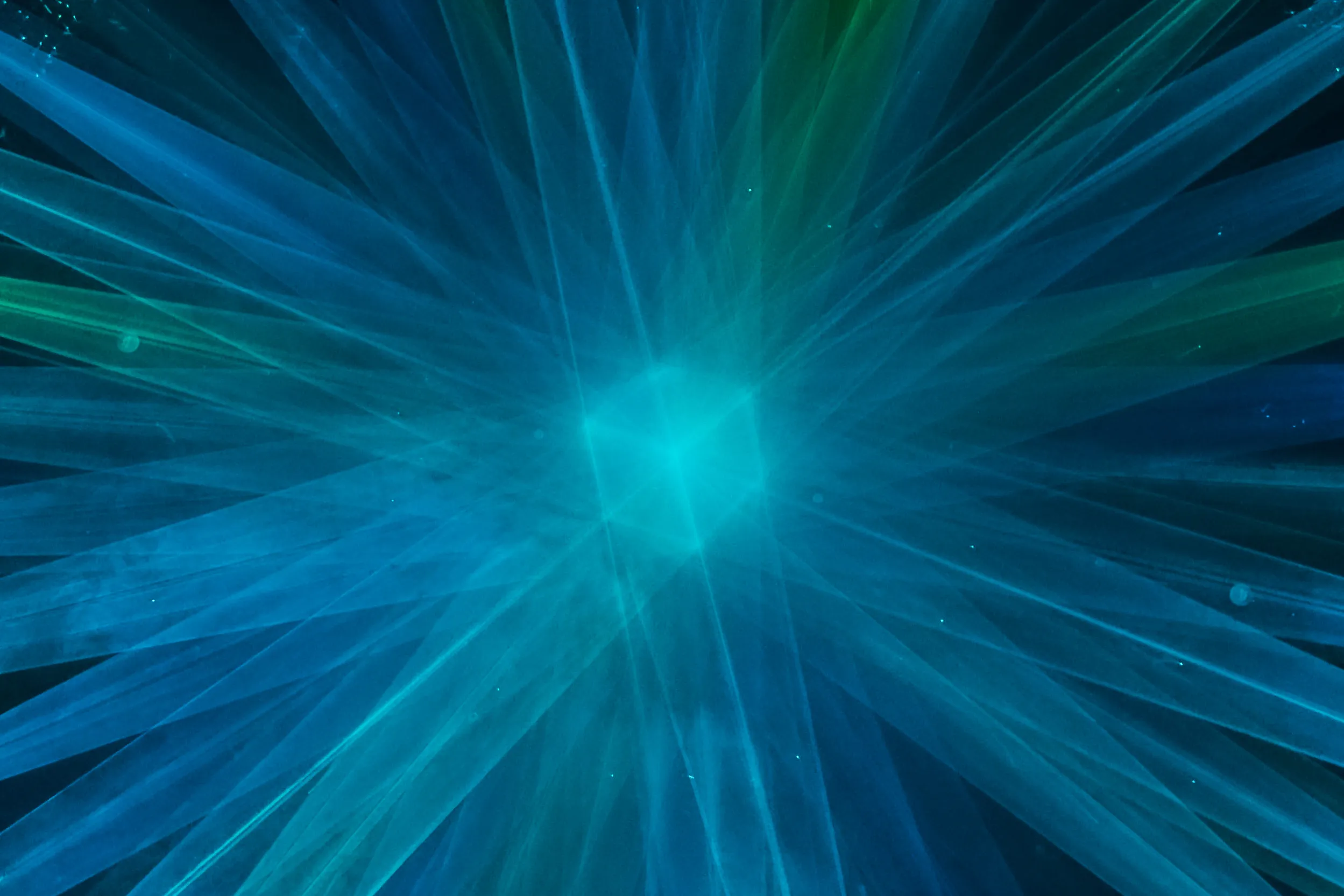
When the spheres change color, the space itself shifts between a collection of spheres forming a three-dimensional space and a flat color wall.
Even if each sphere moves freely on its own, the behavior of light is maintained across the whole of the space (a three-dimensional image in which one sphere is regarded as one dot). Therefore, the light behaves as a group and can be thought of as one three-dimensional existing space. At this time, the light spreads spherically around the impacted sphere.
Since each sphere is free floating within the collection of sphere elements that make up the three-dimensional space, people recognize it as existing three-dimensionally and part the spheres entering into the three-dimensional existing space.
The shape of the space is determined by the collection of floating spheres and changes according to people's actions (pushing or colliding). Depending on the degree of entanglement of the spheres, and wind and pressure changes, the shape of the space itself will change, empty spaces becoming high density, and spheres rising to the ceiling all at once.
Before the modern era in Japan, Kasane no Irome were seasonal colors created in silk. The colors were the result of a combination of front and back colors, (silk at the time was so thin that the liner was transparent, creating complex colors), overlapping color gradations, complex weave colors, and combinations of warp and weft. Since the sphere colors are produced by light, it has been possible to create nine blurred colors, (light in water, sunlight on water plants, morning glow, morning sky, sky at twilight,  peach, plum, iris, spring maple), as well as 3 colors that flatten the space (blue, red, and green), producing a total of twelve colors.
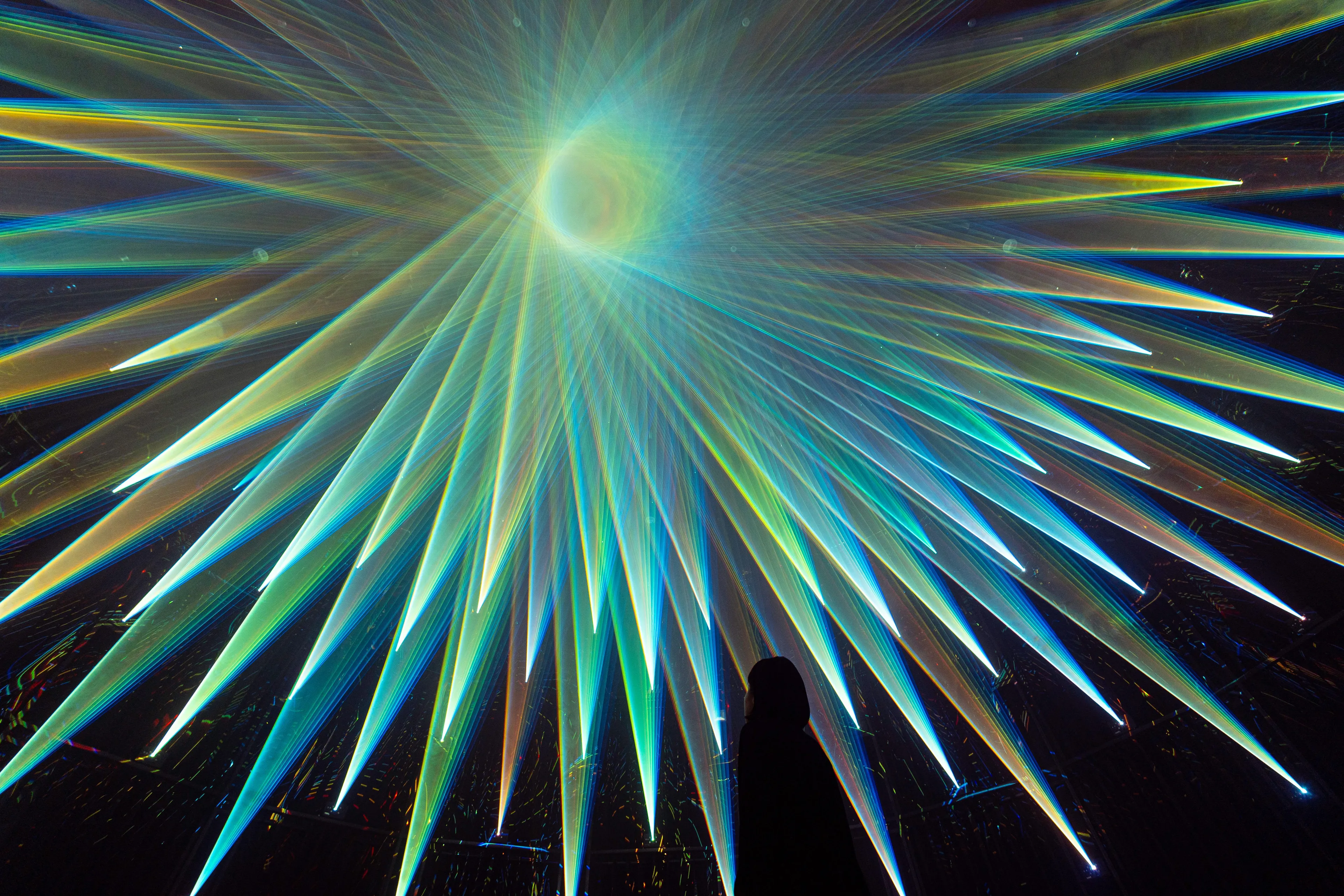
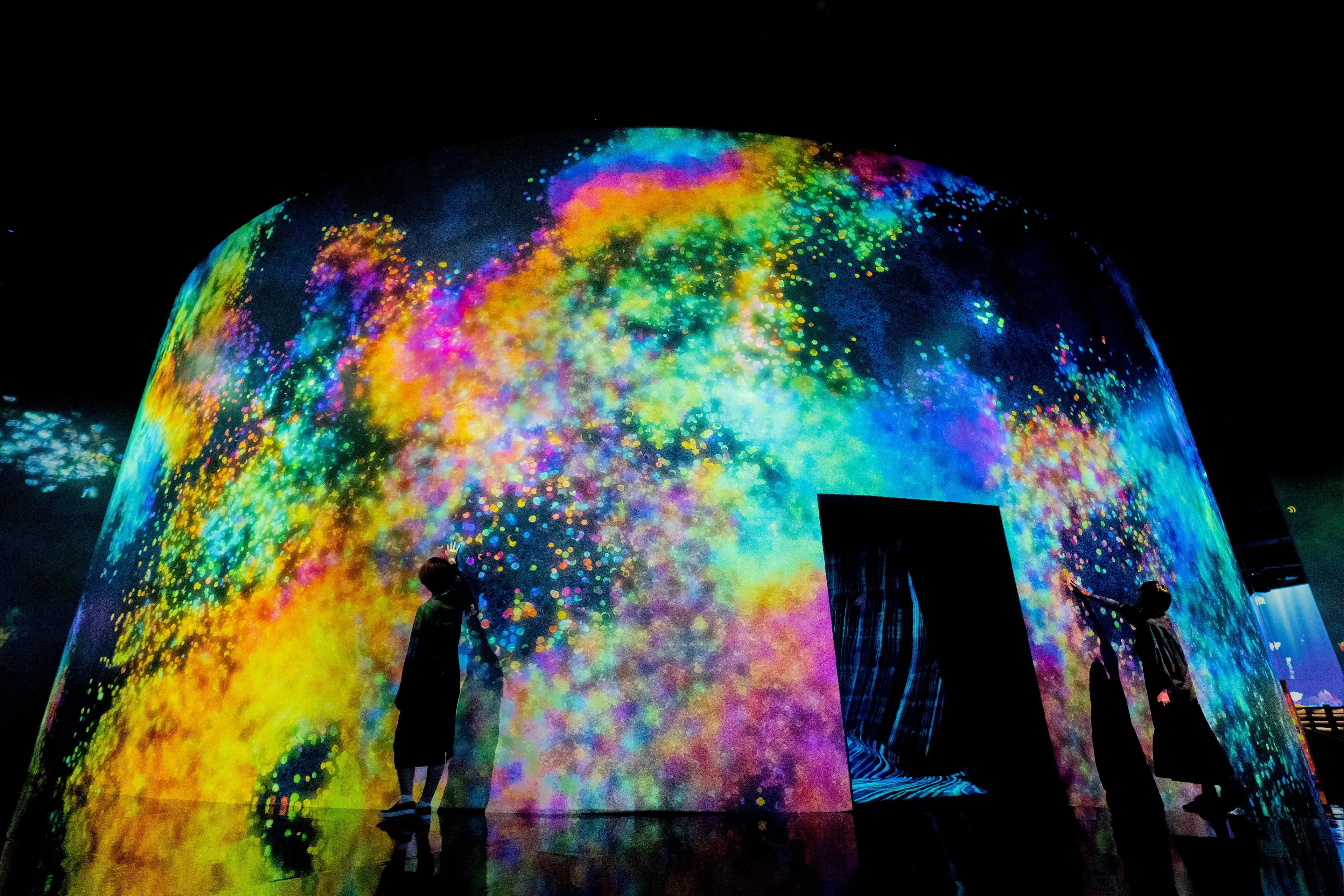
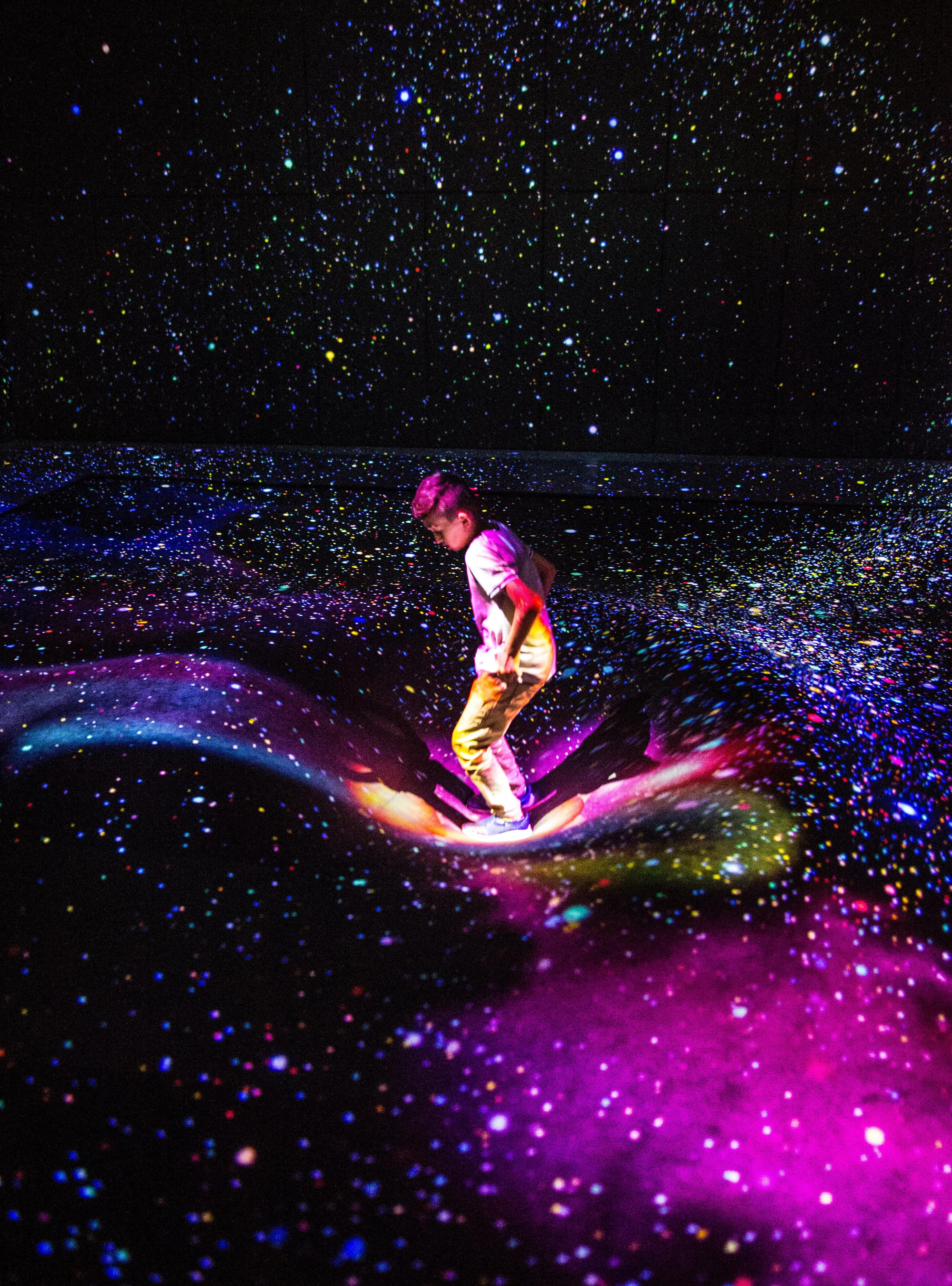
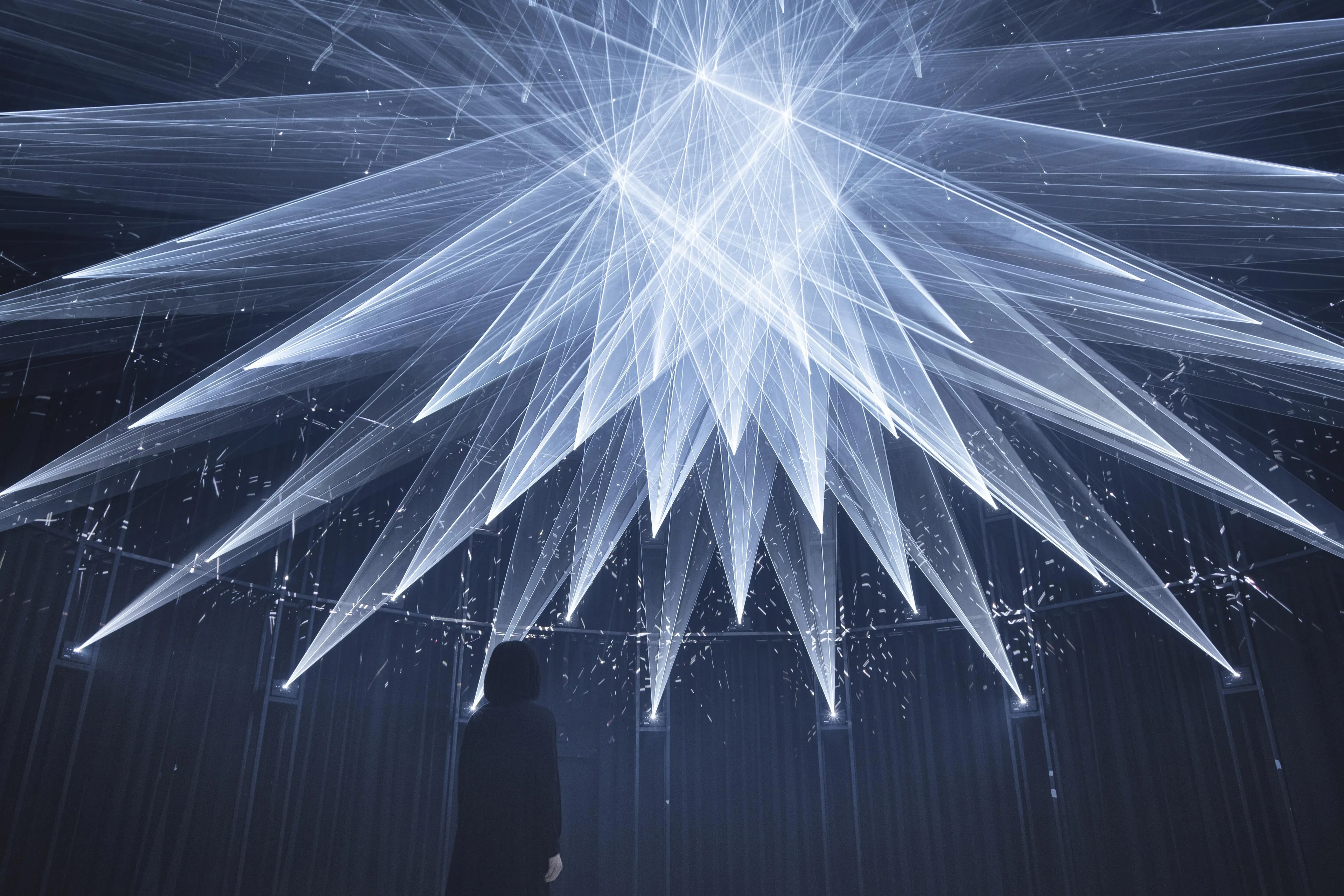
Autonomous Abstraction, Continuous Phenomena from the Universe to the Self

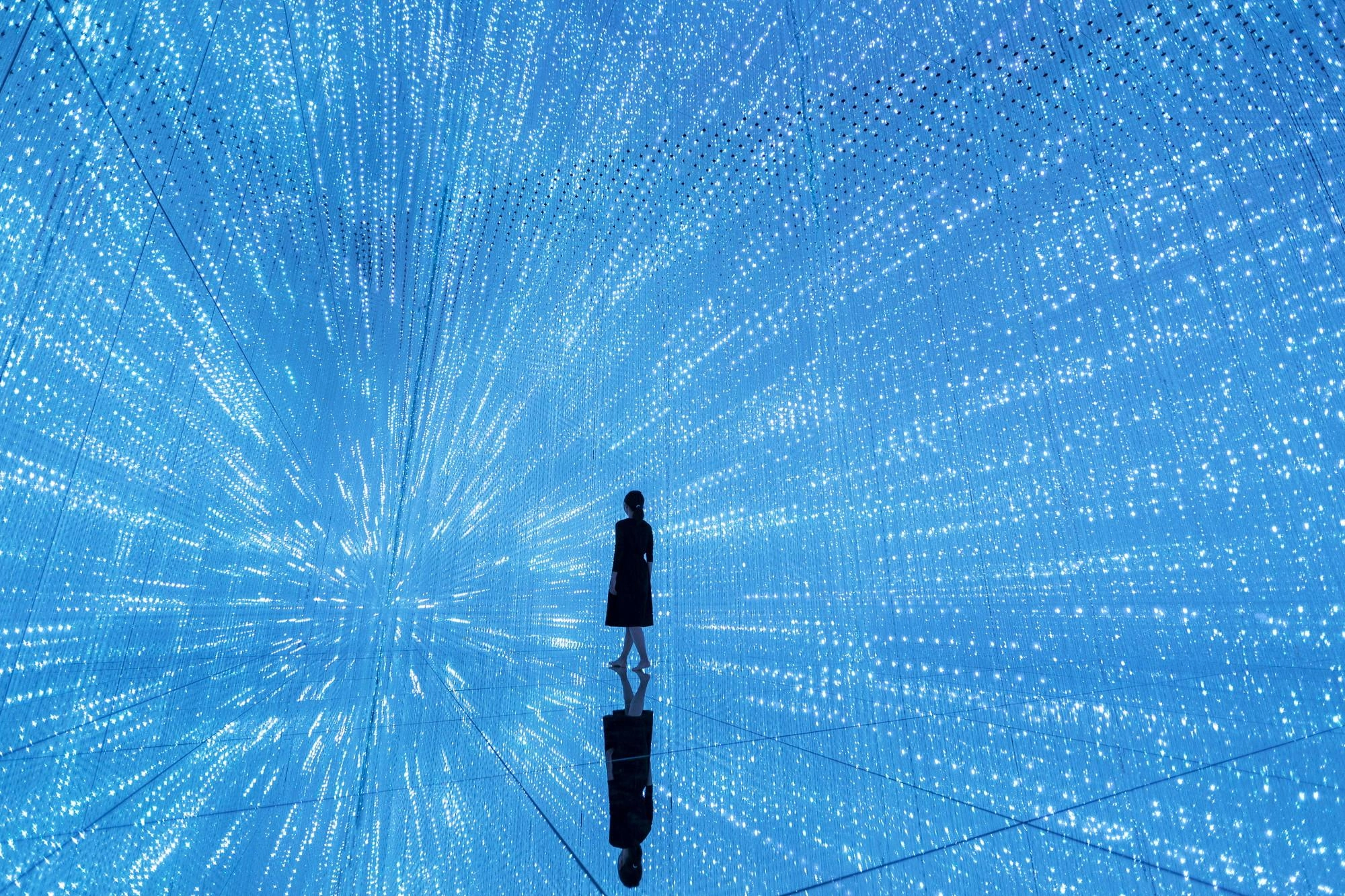
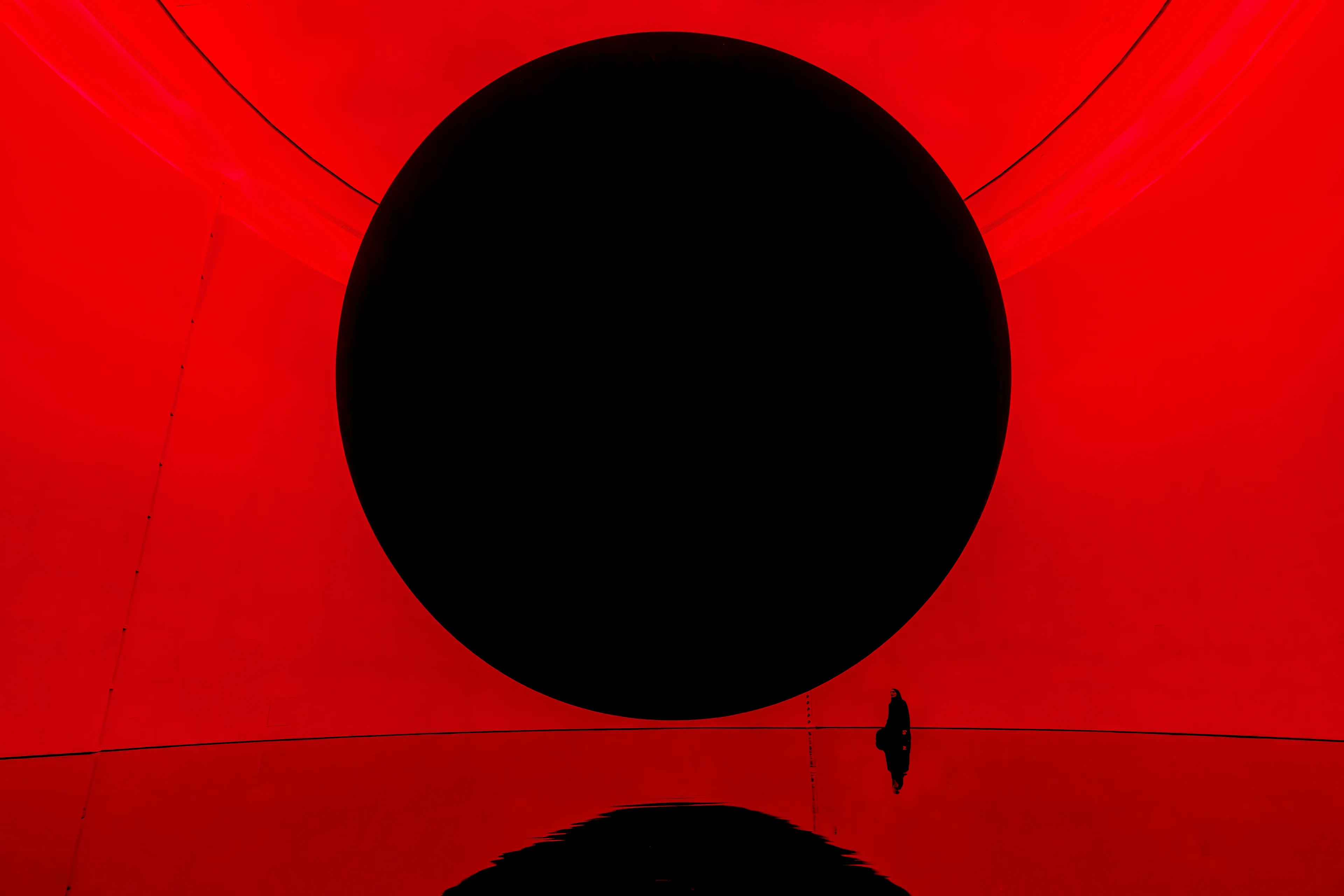
Autonomous abstraction.The dots of light blink and change color in cycles unique to each dot. A spontaneous order phenomenon occurs between dots that are close to each other, and their hues and the rhythm at which they blink gradually synchronize. When people touch them, the rhythm of the blinking hues change and are randomized, but the dots close to each other once again cause a spontaneous order phenomenon between them.The dots of lights emit a tone each time they blink. The tones can be heard continuously throughout the space; what sounds like music is solely created by the continuous tones produced by the blinking lights.

A spontaneous order phenomenon occurs when different rhythms influence each other and synchronize. Examples include when the pendulums of two clocks gradually begin to swing together; when many fireflies gather in one tree and all start blinking at the same time, creating a larger light as a whole; or when the cells that make up the heart synchronize and tremble simultaneously to create the pulse of the heart. This can be seen in various systems, from physical phenomena, neurophysiology, to ecosystems. Although the individual parts do not have the ability to observe the whole, the phenomenon of self-organization is the creation of an ordered and larger structure, resulting from the autonomous behavior of each individual part influencing each other. This phenomenon is also known as spontaneous order.
It is believed that entropy (a measurement of the lack of order in a system) in the universe will steadily increase (the law of increasing entropy) and that entities with form eventually collapse. Despite that, it is a wonder that the sun was created and the planets were born, that life was formed and societies exist. However, the reason why the universe, life, nature, and society continue to be maintained in spite of this may be because order is continuously formed on its own through the shared phenomenon of self-organization in the midst of disorder. In other words, the universe and our own existence are a continuous order created by the same phenomenon.

Athletics Forest

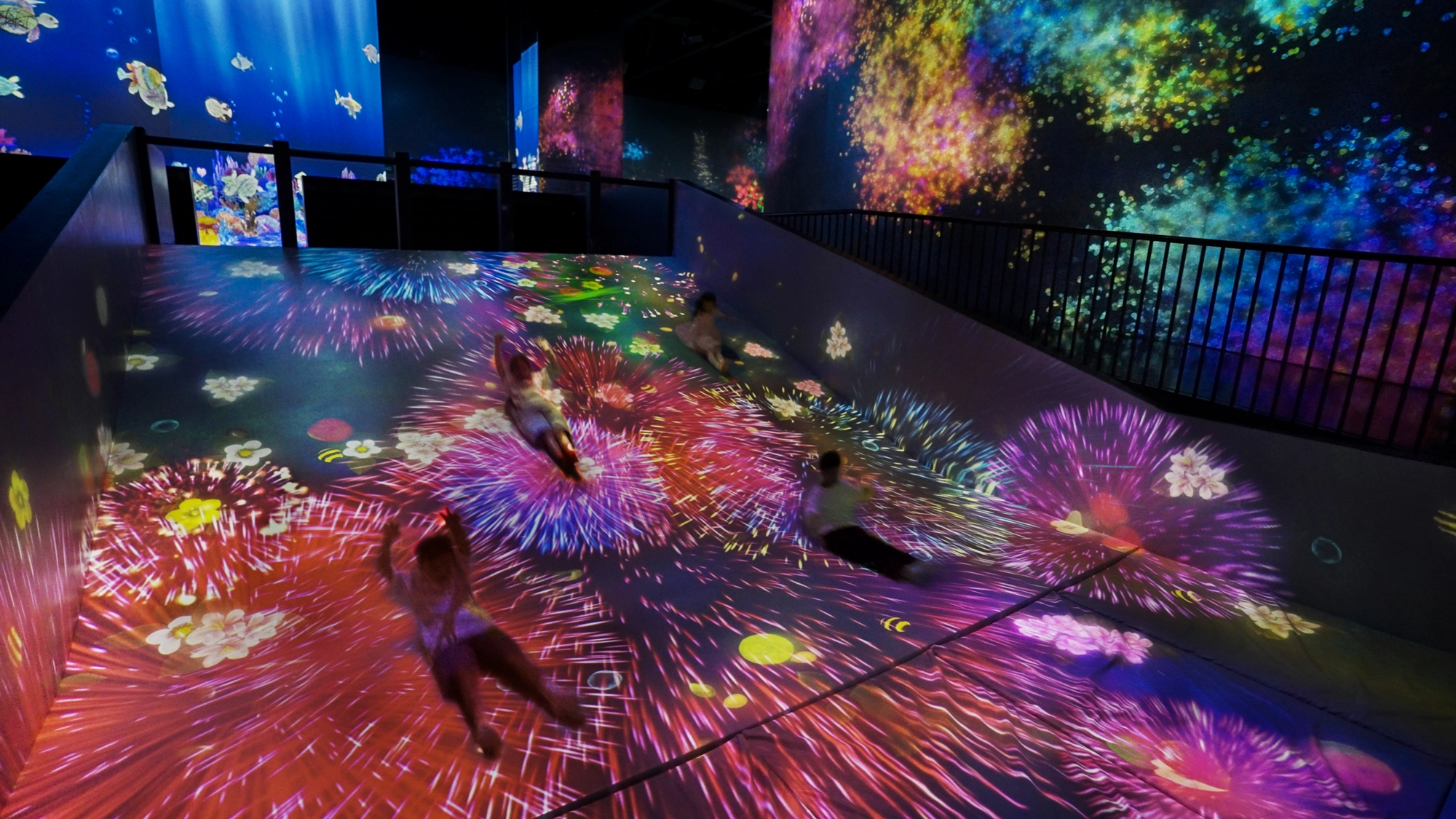
teamLab Athletics Forest is a new “creative physical space” that trains spatial recognition ability by promoting the growth of the hippocampus of the brain. It is based on the concept of understanding the world through the body and thinking of the world three-dimensionally. In a complex, physically challenging, three-dimensional space, immerse your body in an interactive world.
  • Athletics Forest Highlight Video

Athletics Forest Highlight Video

Future Park

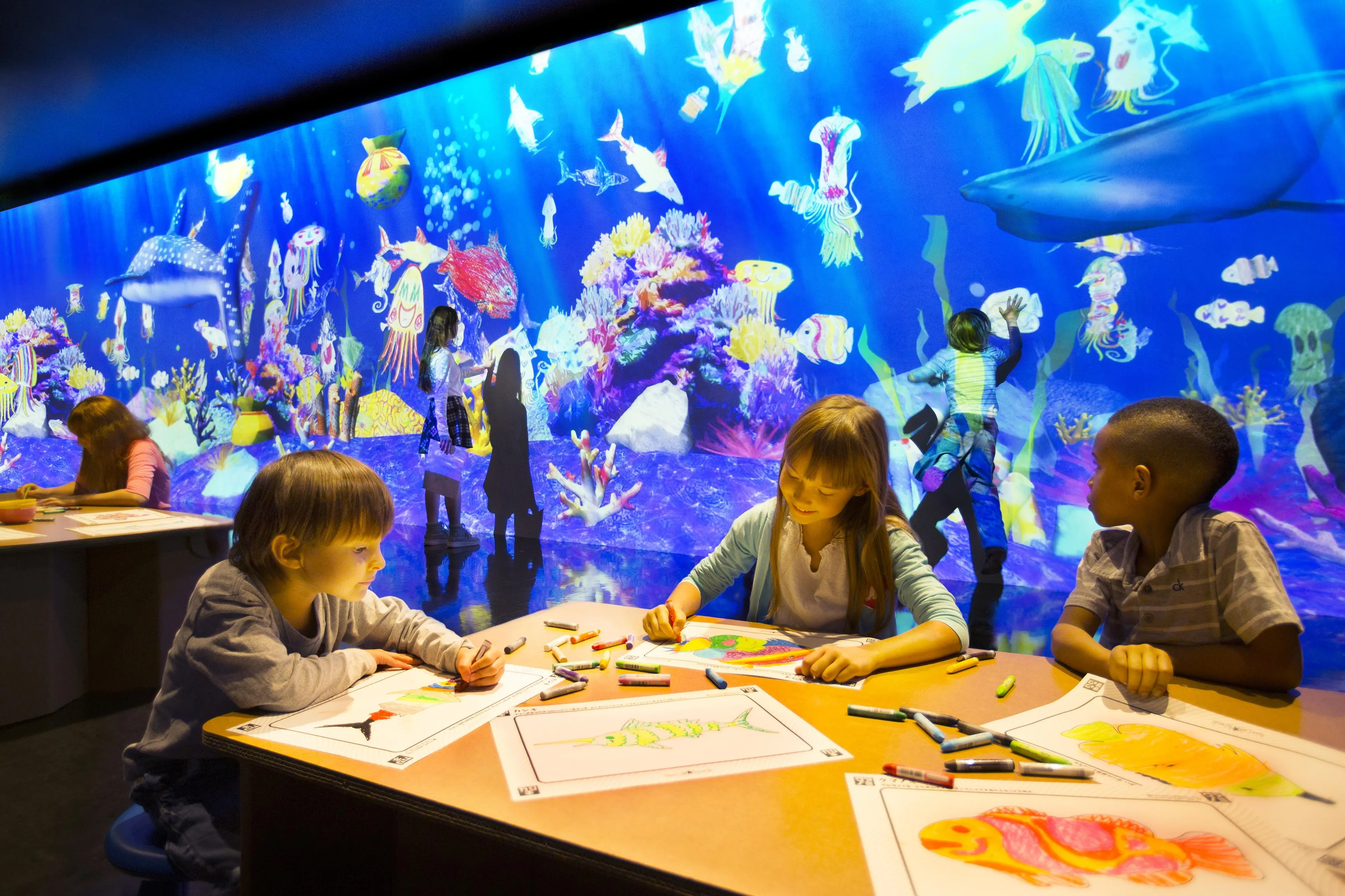
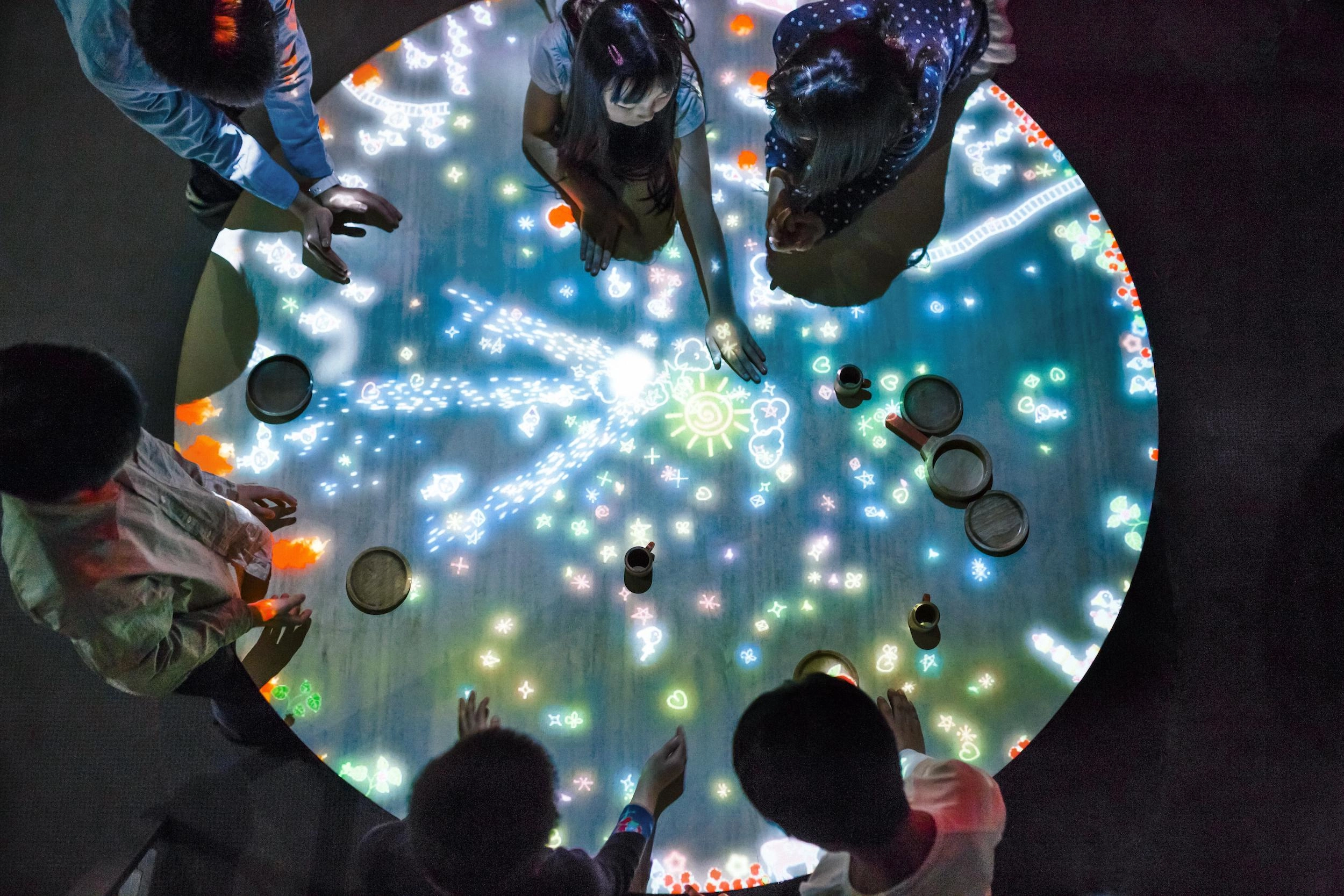
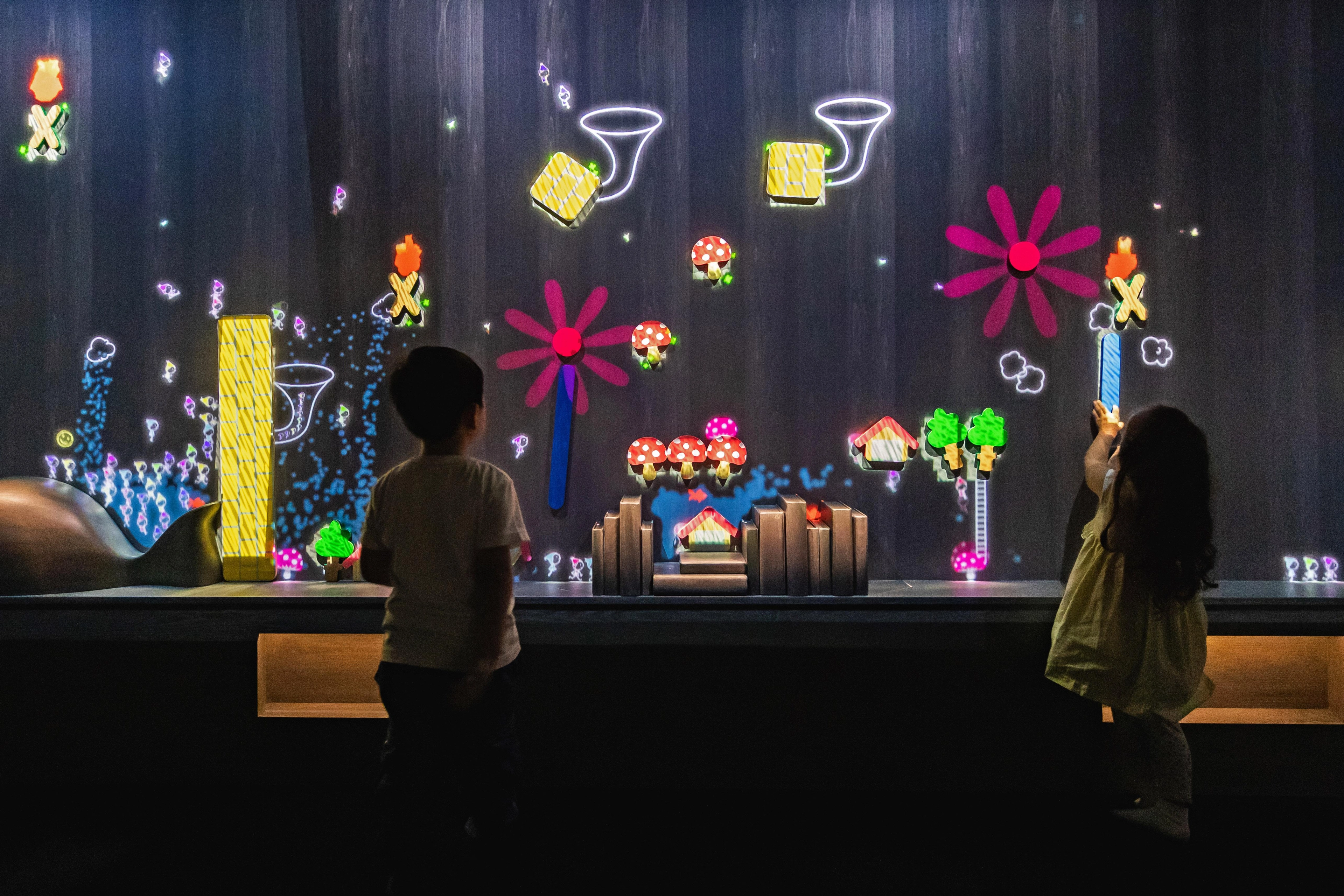
teamLab Future Park is an educational project based on the concept of collaborative creation (co-creation). It is an amusement park where people can enjoy creating the world freely with others.
  • Future Park Highlight Video

Future Park Highlight Video

EN TEA HOUSE

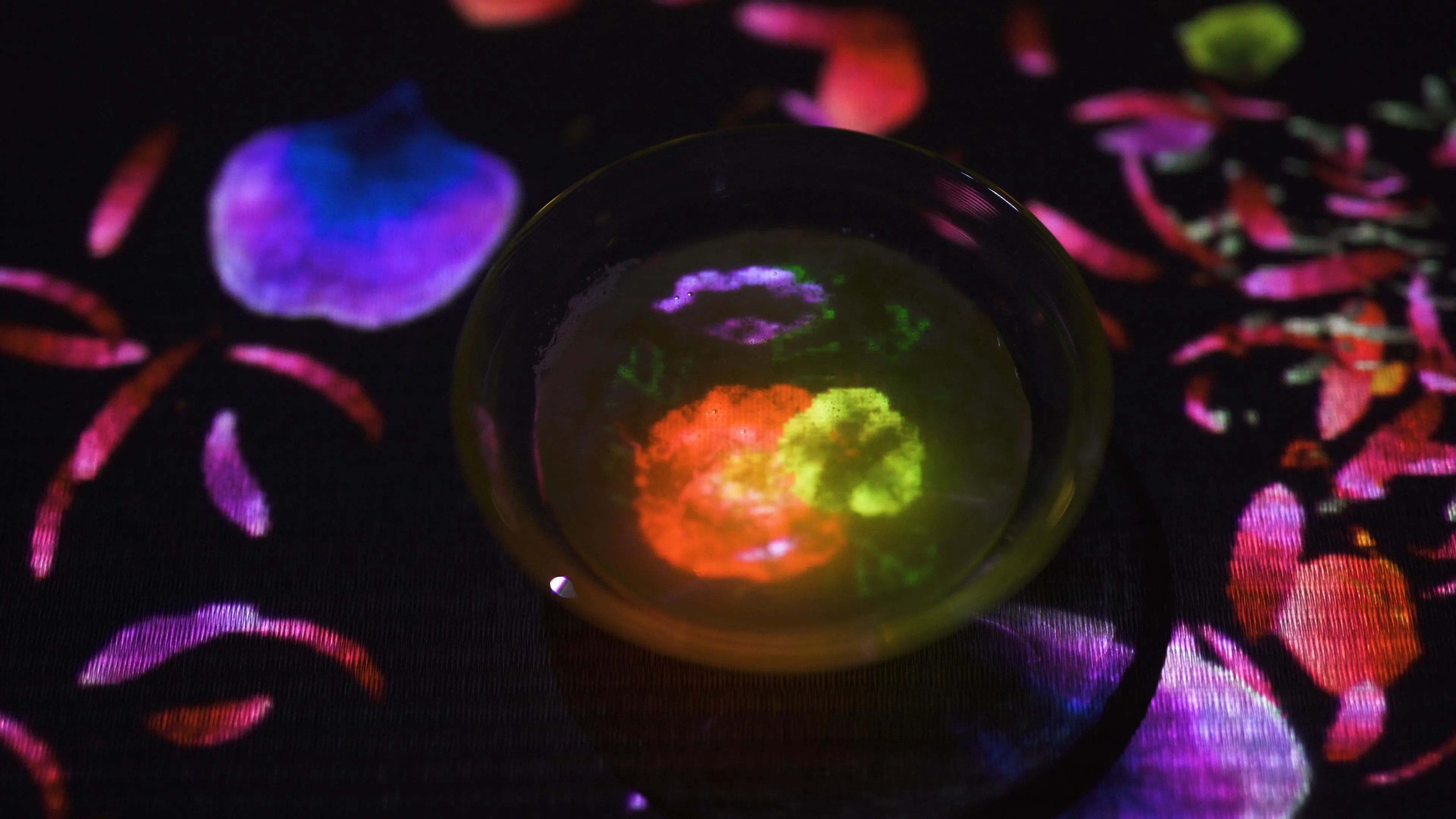
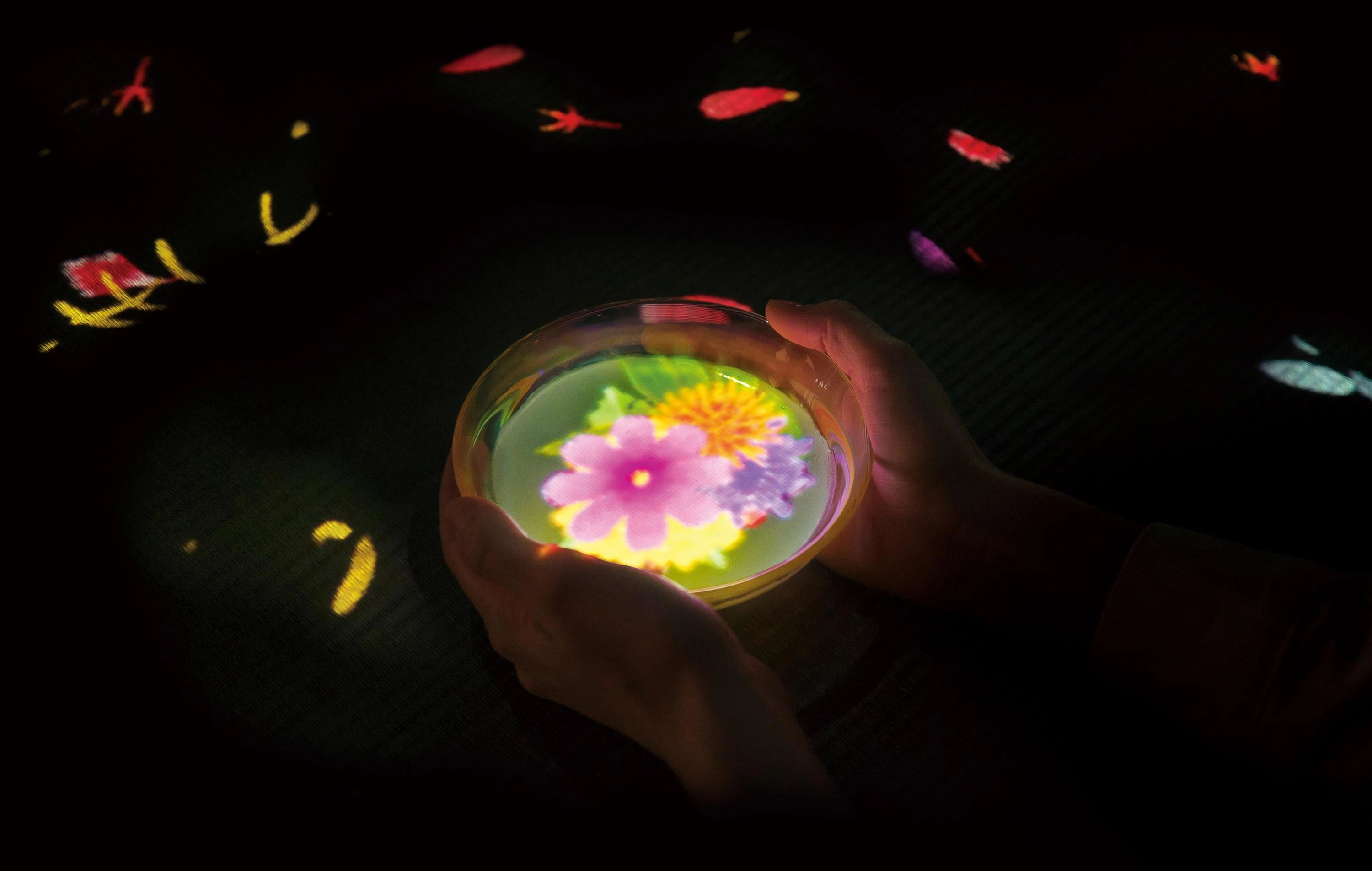
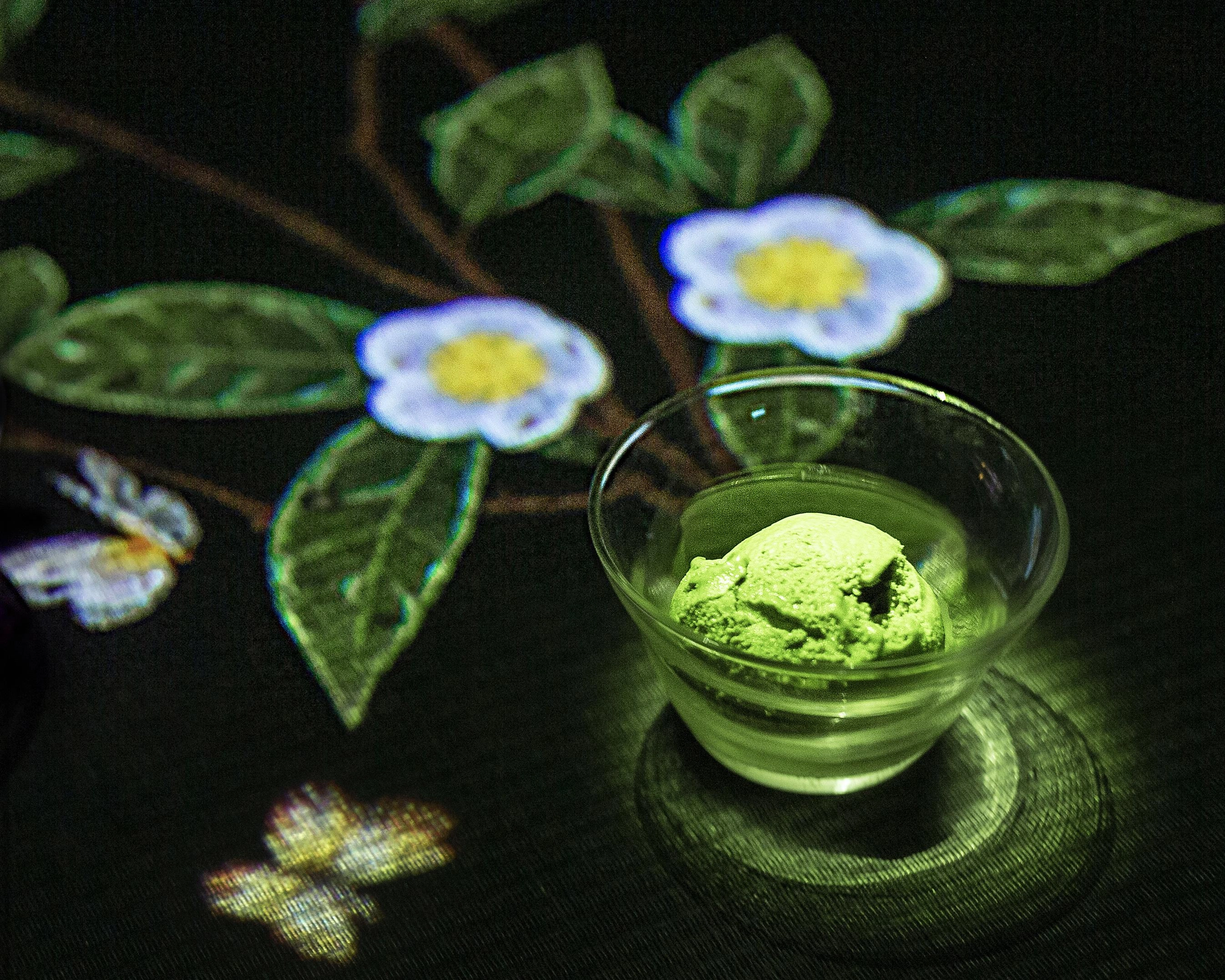
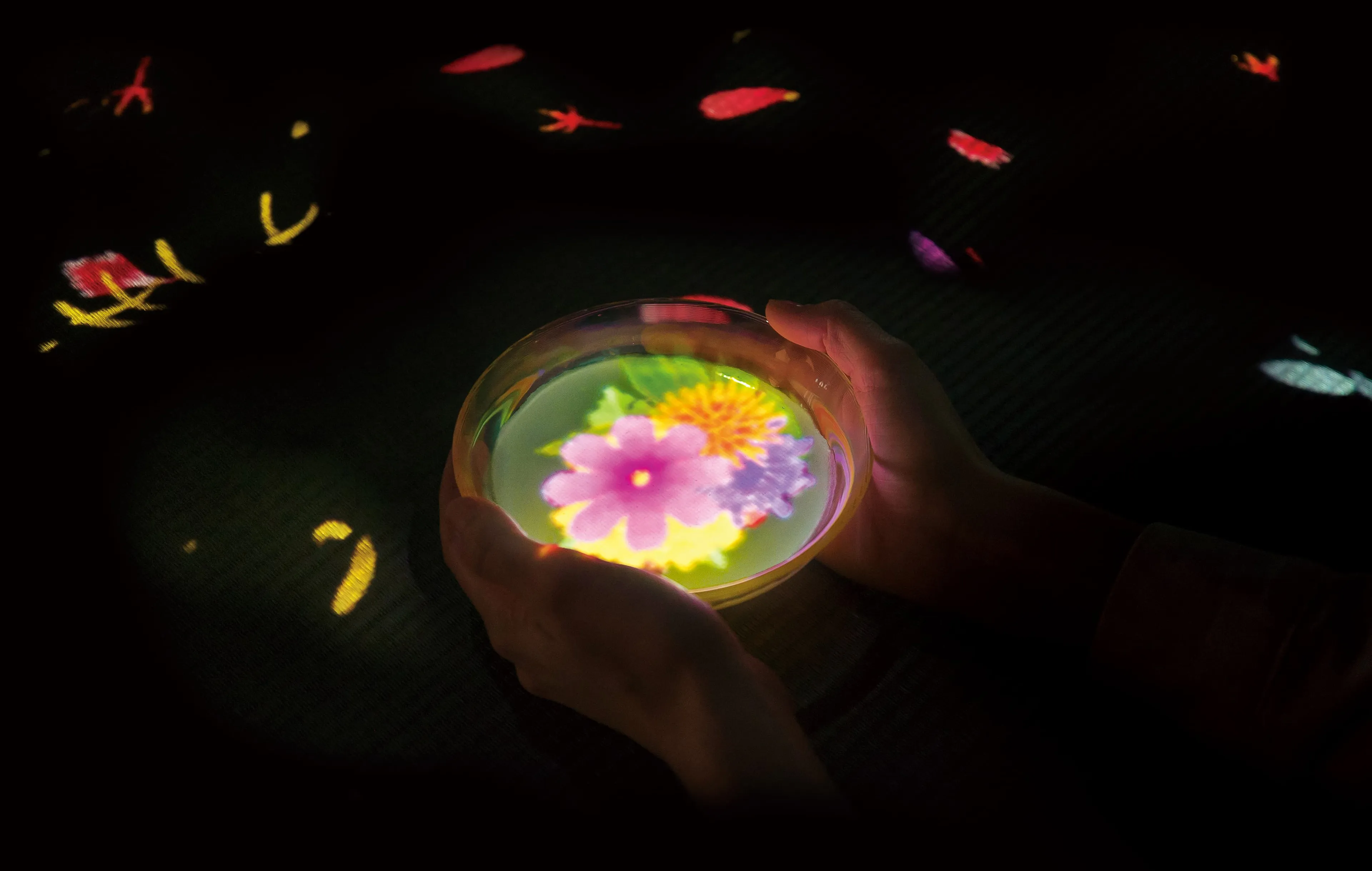
Make tea and a flower blooms inside the teacup. Flowers bloom infinitely as long as there is tea. The tea in the bowl becomes an infinite world in which the flowers continue to bloom. Drink in the infinitely expanding world.
  • EN TEA HOUSE Highlight Video

EN TEA HOUSE Highlight Video

Über teamLab
teamLab (f. 2001) is an international art collective that seeks to navigate the confluence of art, science, technology, and the natural world. Through art, the interdisciplinary group of specialists, including artists, programmers, engineers, CG animators, mathematicians, and architects, aims to explore the relationship between the self and the world, and new forms of perception. In order to understand the world around them, people separate it into independent entities with perceived boundaries between them. teamLab seeks to transcend these boundaries in our perceptions of the world, of the relationship between the self and the world, and of the continuity of time. Everything exists in a long, fragile yet miraculous, borderless continuity. teamLab’s works are in the permanent collection of the National Gallery of Victoria, Melbourne; Art Gallery of New South Wales, Sydney; Art Gallery of South Australia, Adelaide; National Gallery of Australia, Canberra; Amos Rex, Helsinki; Museum of Contemporary Art, Los Angeles; Asian Art Museum, San Francisco; Borusan Contemporary Art Collection, Istanbul; and Asia Society Museum, New York, among others. teamlab.art Biographical Documents

Tea House

Food&Shop画像
EN TEA HOUSE
Make tea and a flower blooms inside the teacup. Flowers bloom infinitely as long as there is tea. The tea in the bowl becomes an infinite world in which the flowers continue to bloom. Drink in the infinitely expanding world.
Mehr ansehen

App

アプリ画像

teamLab App

Understand Deeply and Enjoy More
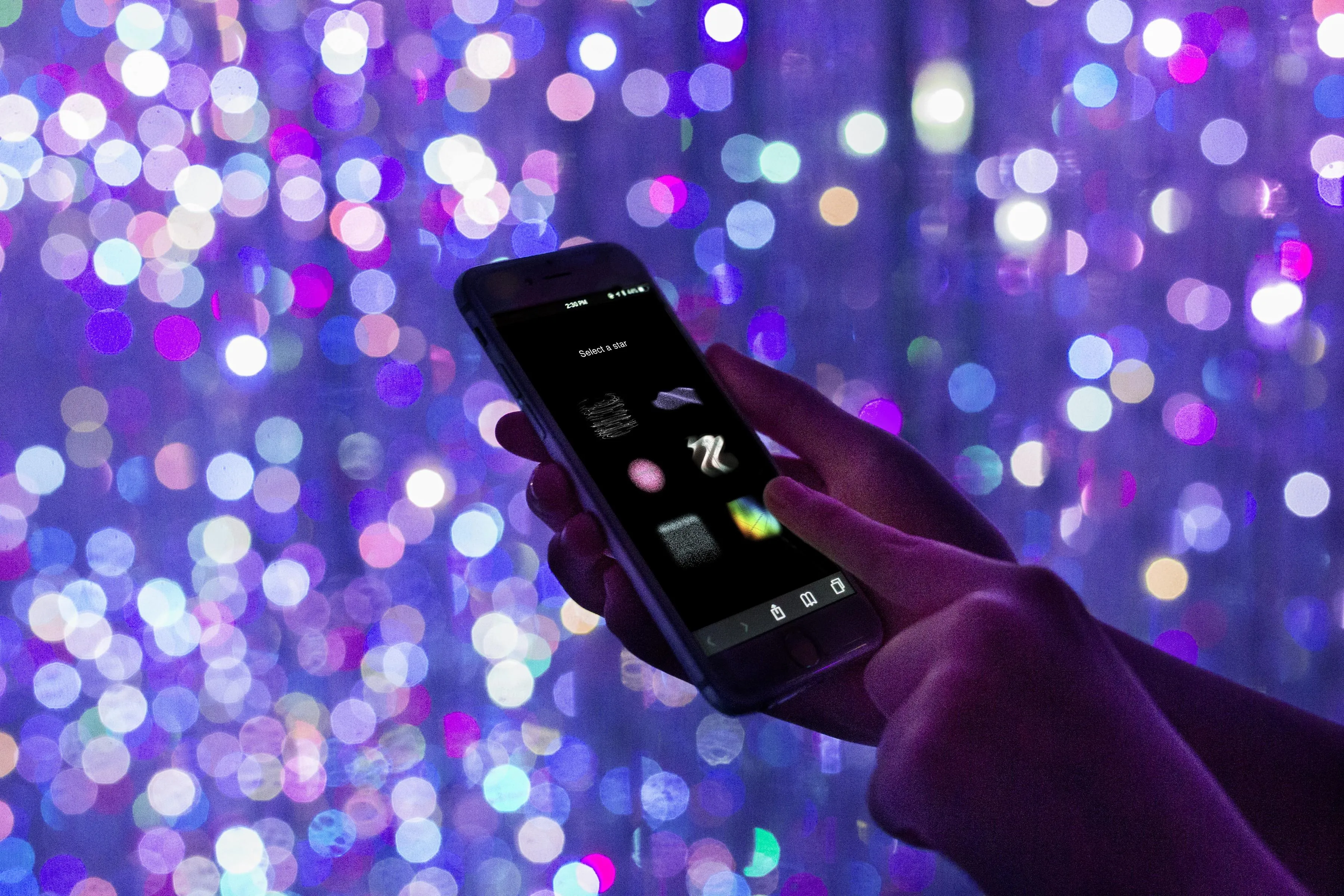
We have prepared a guide app that allows you to read the concepts of the artworks near you.

Create the Artwork with Others
In The Infinite Crystal Universe, you can participate in the art using this app. You create the artwork with those around you.

Besuch

Venue Details

teamLab SuperNature Macao

Dauer

2020.6.15(Mon) - Permanent

Zeiten

11:00 - 19:00

* Last entry 45 min before the museum closing time.

Geschlossen

Wednesdays

* The exhibition may have unscheduled closures due to maintenance. Please visit cotaiticketing.com for the latest updates.

Anreise

Adresse

The Venetian Macao
Cotai Expo Hall F
Estrada da Baía de N. Senhora da Esperança, s/n, Taipa, Macao SAR
Map

Kontakt

Cotai Ticketing

Tel: +853 2882 8818 (Mon-Sun 11:00-19:00)

enquiries@cotaiticketing.com

Website: Contact us

The Venetian Macao

Tickets

Eintrittspreis

Admission Ticket
Regular Ticket
Ages 13 and over

MOP/HKD 288.00

Child Ticket
Ages 3 – 12

MOP/HKD 208.00

Ages 0 – 2

Kostenlos

Add-on Experiences
* Must be purchased in addition to your admission tickets. * For the latest updates, please visit the official ticket page.
EN TEA HOUSE (July and August Only)
Includes tea of your choice, and fragrant Jade green tea ice cream.
* Purchase available at the tea house

MOP/HKD 58.00

Tickets