Environmental Phenomena
2020
The artwork cannot exist on its own; its existence is a phenomenon created by its environment.
Objects like stones and man-made creations maintain a stable structure on their own. A stone will continue to exist even if placed in a sealed box, isolated from the external world.
On the other hand, a vortex created in the ocean disappears instantly when transferred into an enclosed box. In other words, a vortex does not maintain a stable structure independently. A vortex exists within the flow created by its environment, formed by water continuously flowing from the outside to the inside and from the inside to the outside, and changes along with that flow. Its boundaries are ambiguous; both the vortex and its surroundings are made of water, and there is no material distinction between them.
Rather than a solid object, a unique environment is created, and the phenomena produced by that environment create the existence of the artwork. Let us call these Environmental Phenomena. The artwork is inseparable from the environment and changes along with it.
The artwork is released from the material substances that have been responsible for maintaining its existence. Elements like air, water, and light that permeate our daily lives are transformed by the unique environment into phenomena, evolving into new existences.
Transcending the conventional notions of physical objects, the artwork maintains its existence even when people immerse themselves physically into it, and naturally restores itself even if it is broken. The boundaries of its existence are ambiguous and continuous with its surroundings. However, if the environment is lost, the artwork will disappear. In time, people’s consciousness will expand from existence itself to the environment.
Objects continue to exist even if placed in a box isolated from the outside world, but life cannot maintain its existence in such a closed box. Life is also an existence maintained by its environment.
Life may be a miraculous phenomenon that emerges from a continuous flow in an open world.
FEATURED WORKS
teamLab, 2020-, Installation, Sound: Hideaki Takahashi
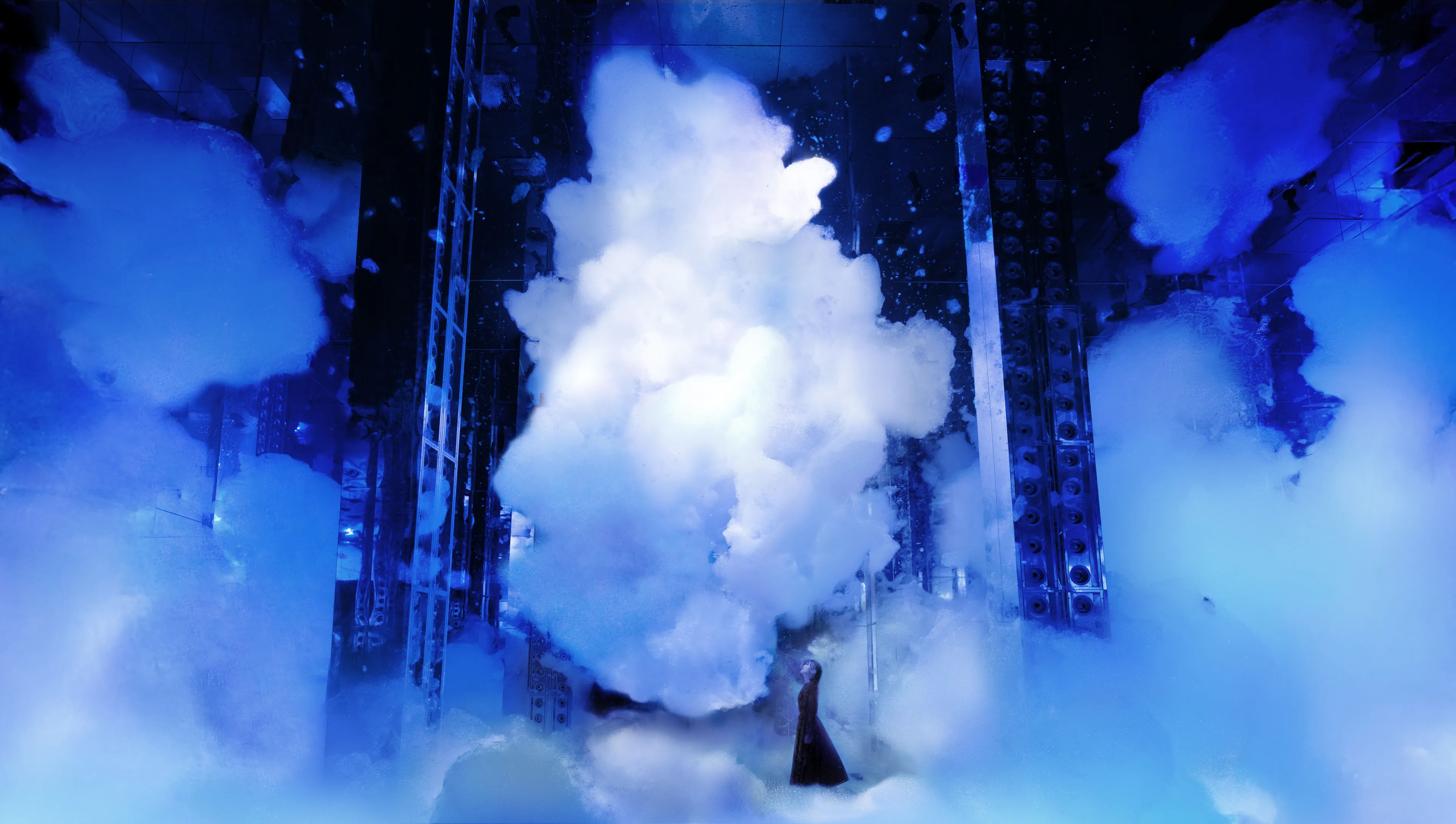
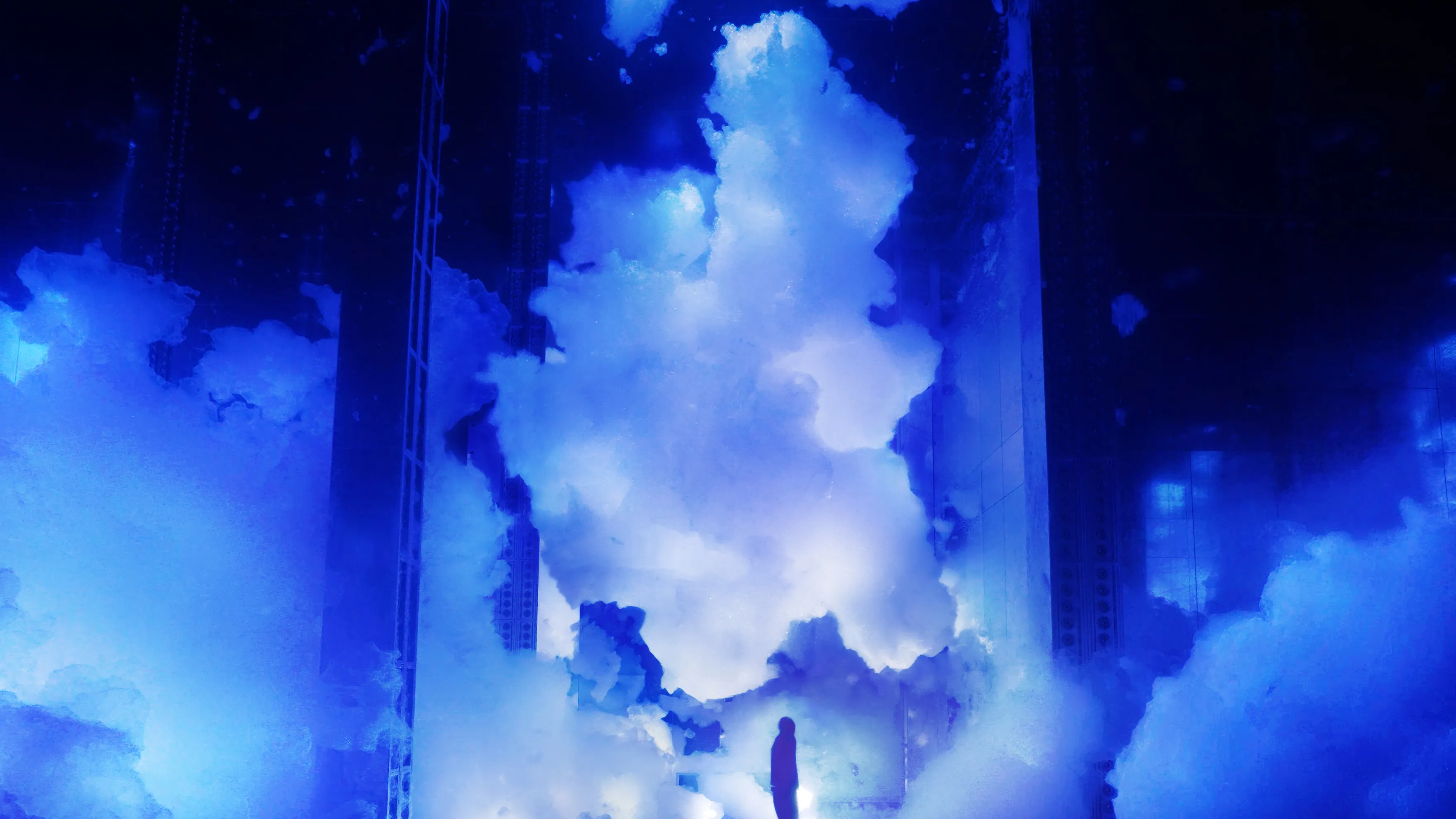
This floating, immense sculpture emerges from a sea of bubbles, transcending the very concept of mass. It neither sinks to the ground nor rises completely to the ceiling, but instead drifts in the middle of the space. The contours of its existence are ambiguous—it fragments into smaller pieces, but merges into a larger mass. Even when people fully immerse themselves in this sculpture, its existence remains intact. If broken by people, it naturally restores itself. However, when the sculpture is destroyed beyond what it can repair, it collapses, unable to recover. Even if people try to move or push this floating sculpture, they cannot do so, and if they stir up wind, the sculpture disperses entirely. Physical human actions cannot move the sculpture.
Objects such as stones and man-made creations maintain a stable structure on their own. A stone will continue to exist even if placed in a sealed box, isolated from the external world.
On the other hand, a vortex created in the ocean disappears instantly when transferred into an enclosed box. In other words, a vortex does not maintain a stable structure independently. A vortex exists within the flow created by its environment formed by water continuously flowing from the outside to the inside and from the inside to the outside, maintained by the vortex’s ordered structure. This flow allows the vortex to shift as the surrounding currents change. Its boundaries are ambiguous. There is no material distinction between the vortex and its surroundings as they are made of water.
Rather than a solid object, this sculpture is created by the order of energy generated by the phenomena of a unique environment. Let us call this existence created by the order of energy, a Higher-Order Sculpture. The artwork is inseparable from the environment and changes along with the environment. It transcends the conventional notions of physical objects—it sustains its existence mid-air, having ambiguous boundaries, and it is able to maintain its shape even when people immerse themselves physically into the sculpture, naturally restoring itself even if the sculpture breaks.
A sculpture based on the premise of an open system.
The only material substances present in this space are water, air, and ordinary soap.
By filling the space with bubbles, a distinct environment is created in which an order of energy is born. By doing so, a massive form emerges from this sea of bubbles that floats steadily in mid-air.
In modern biology, the definition of life cannot be strictly defined, but everything that is structured upon cells, capable of metabolism, and self-reproduction are labeled living things for convenience. In other words, all living things are composed of cells. All cells are enclosed by a cell membrane constructed of a lipid bilayer, with the hydrophilic part facing outward and the hydrophobic part covered within the layers. Both the inside and outside of the enveloping membrane are liquid. Soap bubbles are similarly enveloped by lipid bilayer membranes, and these membranes are structurally identical to cell membranes. However, contrary to cells, the bilayer of the bubble membrane floats in and encloses air, so the hydrophobic part faces outward, while the hydrophilic part is covered within the layers. In other words, if we consider cells to be pouch-shaped membranes in liquid, then bubbles are pouch-shaped membranes in air.
This sculpture is created from substances composed in the same ways as cells, the structuring units of life-forms, and the order of energy created from this environment.
The same is true of life. It consumes external matter and energy as food and discharges it, sustaining its ordered structure as the energy dissipates. Life exists within the flow of matter and energy, and its contour, like a vortex, is ambiguous.
Perhaps, life is a miraculous phenomenon that emerges in the flow of matter and energy, and its structure is the order of energy created by that flow.
teamLab, 2026, from the series <i>Pillars that Dance with the Wind</i>, 2023-, Installation, Sound: Hideaki Takahashi
All life exists within the flow of matter and energy, and the flow itself creates and maintains its structure.
This differs fundamentally from objects that possess an independent, static, and stable structure, such as stones, iron, or the artifacts humans have historically created.
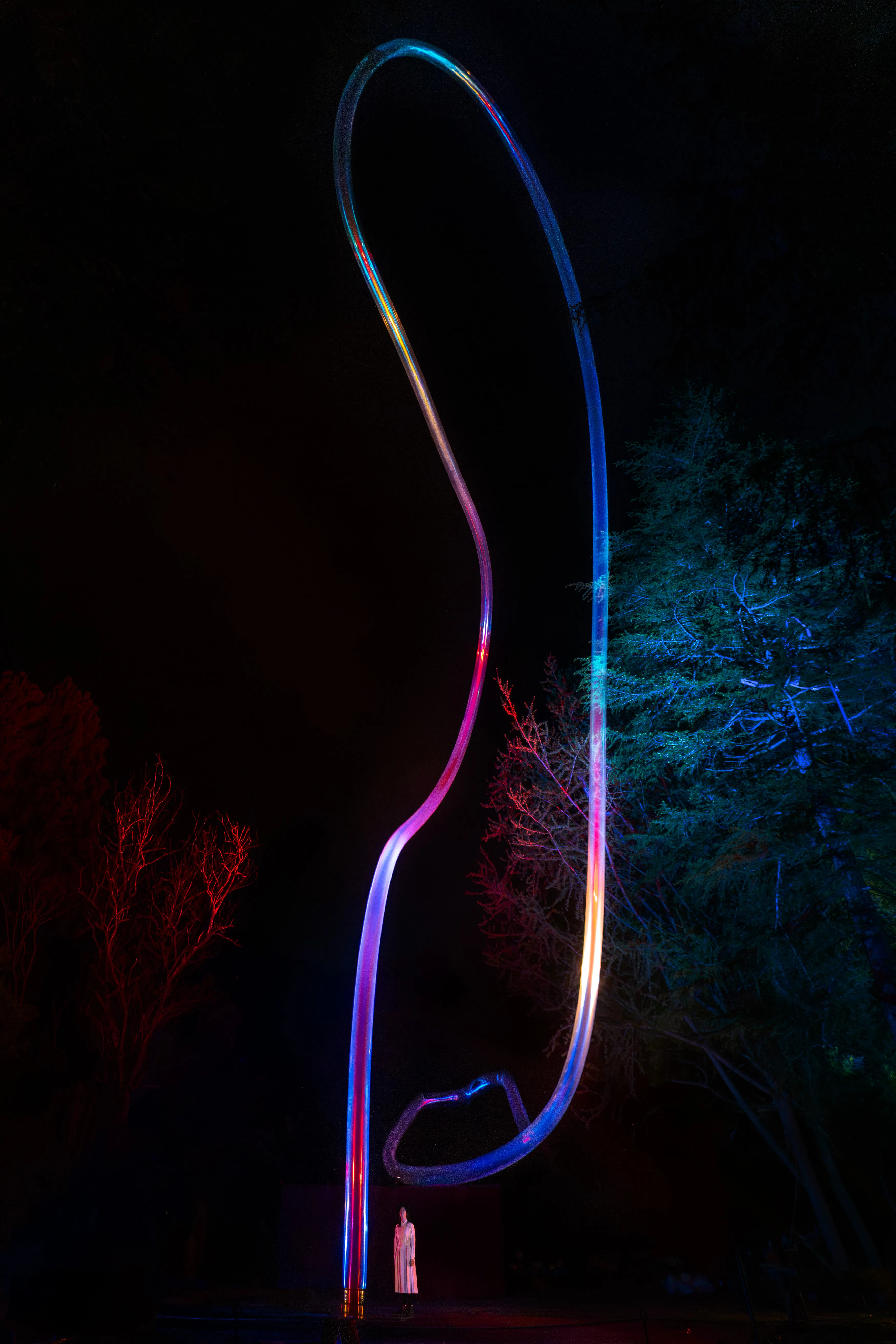
The artwork does not stand by trapping air inside and relying on its internal pressure. The inlet and outlet are the same size, and air continuously flows through the inside. By that very flow, the artwork stands, maintaining its structure and existence. If the flow stops, the material remains, but the artwork ceases to exist.
Here, the object is not being moved by the flow. The flow itself creates the structure and gives rise to existence.
The artwork is strongly influenced by the environment, such as wind, rain, and humidity, significantly changing its movement and height. As long as the environment that gives rise to existence is maintained and the flow continues, the artwork’s existence is maintained even whilst it constantly changes shape.
It is continually moving, flexible, soft, and fragile.
Pillar of Constant Flux is an attempt to expand sculpture from a fixed object into an existence whose structure continues to be generated by a continuous flow within an open environment. Rather than the artist directly creating the shape, the artist creates an environment in which existence is born. Here, the condition for the existence of sculpture shifts from matter to the order created by flow.
teamLab, 2025, from the series <i>Ephemeral Crystallized Light</i>, 2021-, Interactive Installation, Sound: Hideaki Takahashi
Meer bekijken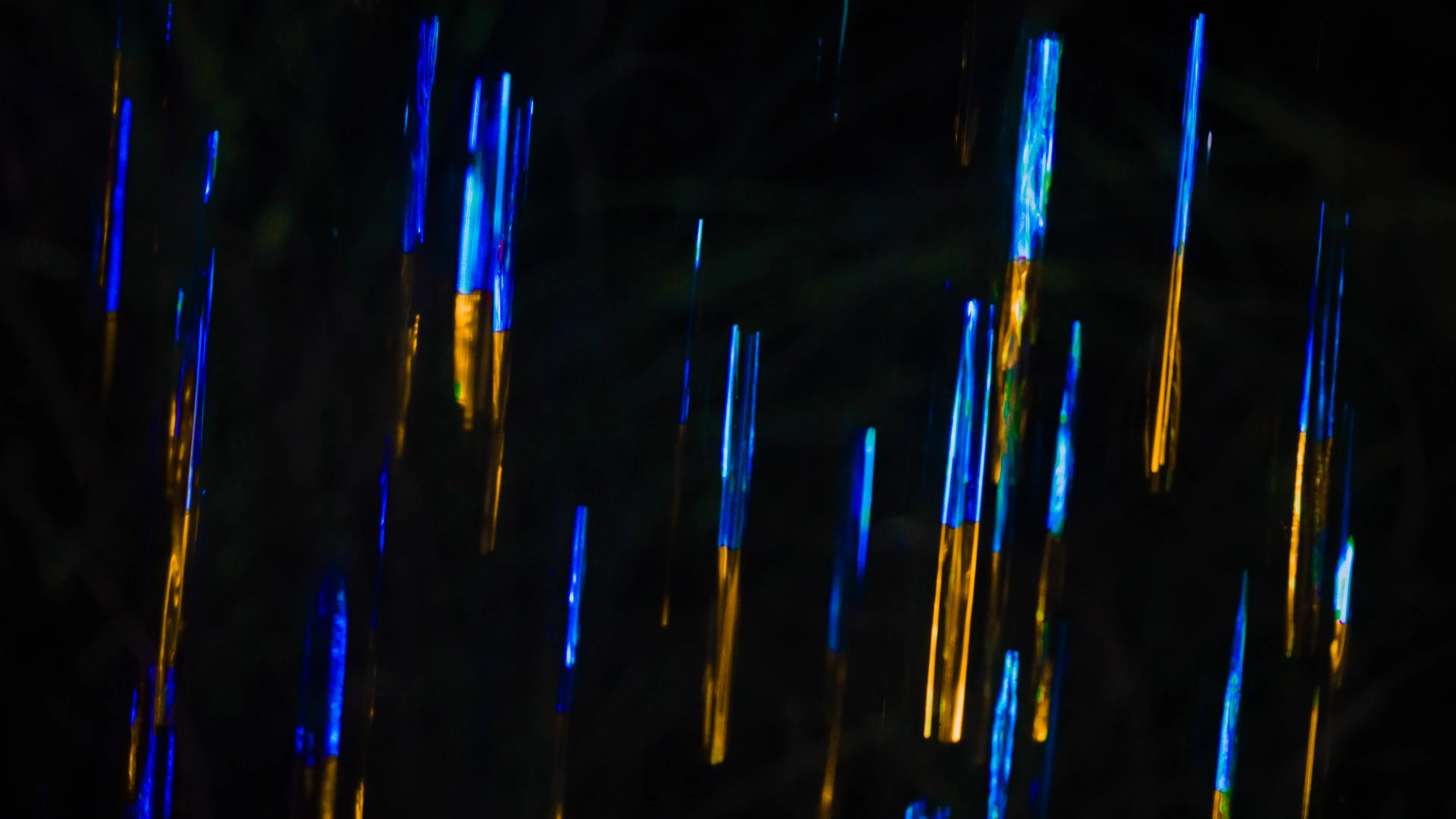
teamLab, 2024, from the series <span style="font-style: italic">Ephemeral Crystallized Light</span> , 2021-, Installation, Sound: Hideaki Takahashi
* Dusk to dawn on heavy rainy days
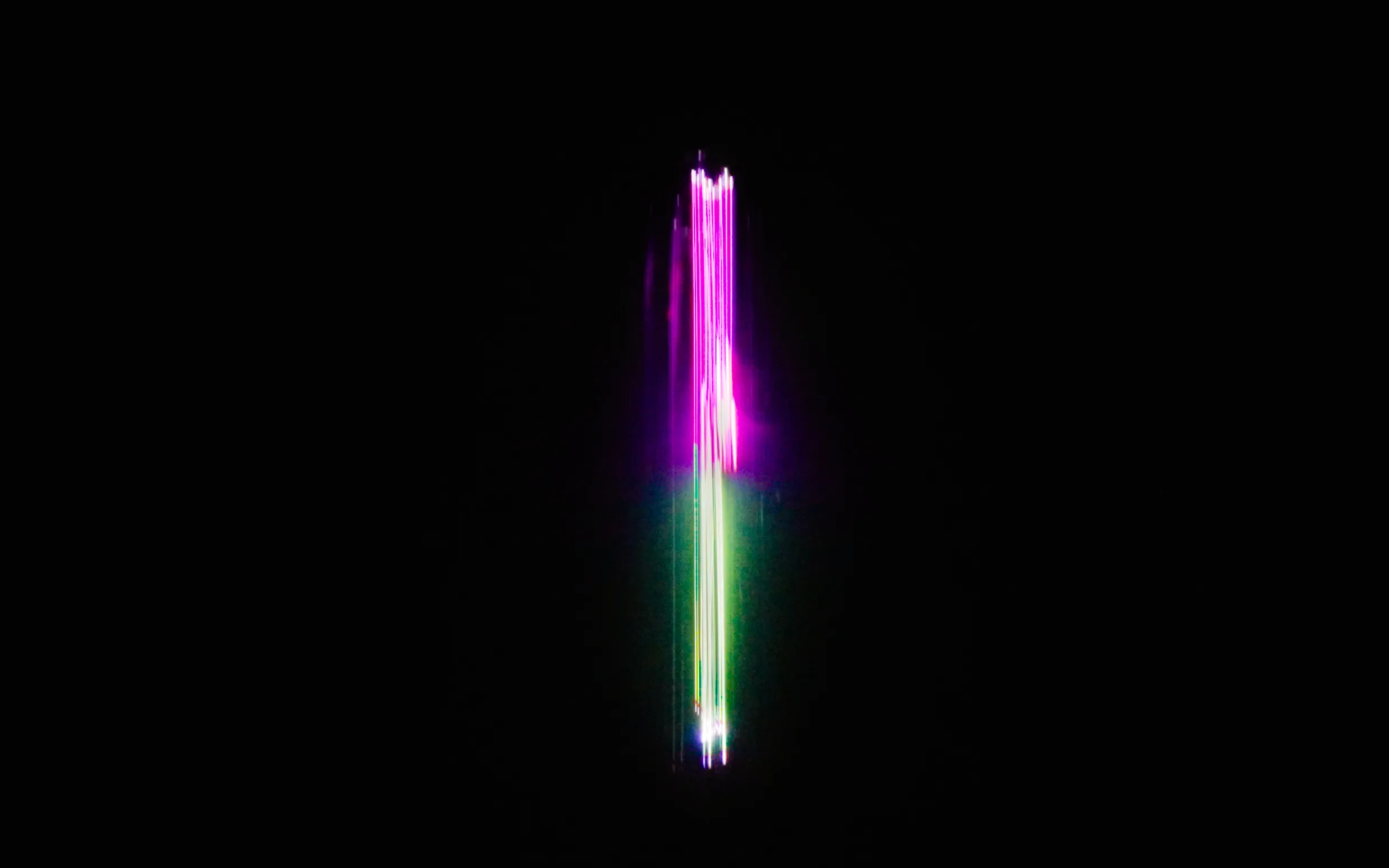
On a night of heavy rain, the falling rain over the grassland becomes an artwork.
Countless masses of light float in the air, each one composed of two colors. The boundaries of each color are clearly separated as though they are solid.
The seemingly solid color separation of the masses of light is not seen in the natural world, and is caused by extreme synchronization. Through self-organization over time, this synchronization phenomenon creates a large ordered structure.
When you touch a solidified light, you realize that the visible part is part of something that continues to flow without interruption.
Life is a phenomenon like crystals of ephemeral light, miraculously solidified into a continuum of energy that continues to flow without interruption from a past whose beginning is unknown.
Spatial Calligraphy of Light and Wind
teamLab, 2024, Installation, Sound: teamLab
* On sunny days with wind
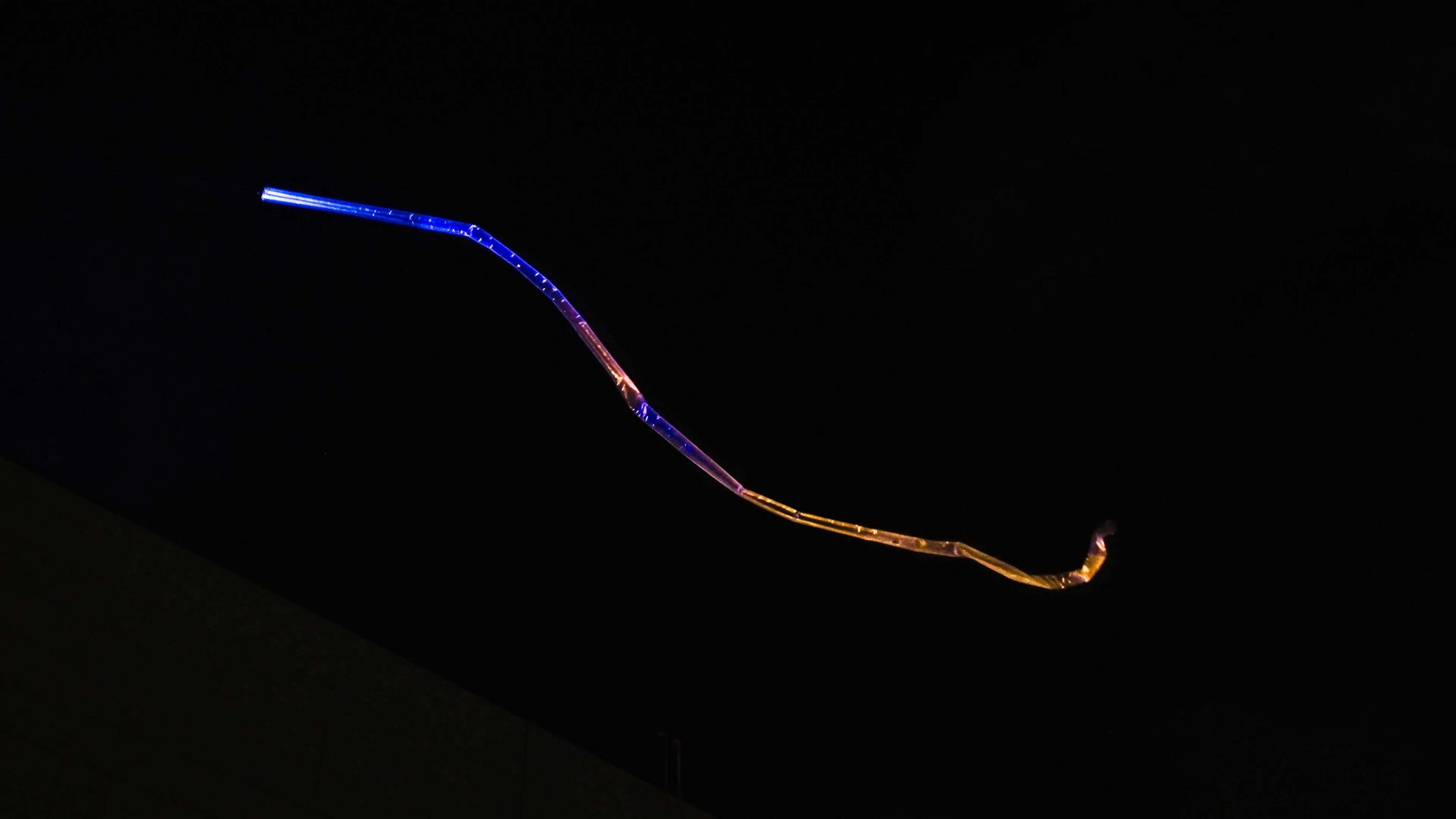
On sunny days when the wind blows, this artwork appears in the sky. It shines when the sun comes out and glows when the sun sets. And when the wind stops, it disappears.
Materials made by humans, such as concrete, maintain a stable structure on their own much like stone.
Vortices on the other hand are created and sustained by the water that continuously flows inwards and outwards, maintaining an ordered structure within that flow. Life similarly maintains order through the continuous inward and outward flow of energy and matter through food.
This artwork does not float in the sky by trapping air inside and relying on its internal pressure. The inlet and outlet are the same size, and the wind continuously flows through the inside. By that very flow, the structure of the lines dancing in the sky is created and its existence is maintained. The artwork has no structure by itself, but rather the structure emerges from the flow; it is soft and flexible like a life form. The flow is what creates order from chaos.
The wind that raises this artwork into the sky is natural wind. Humans cannot control when it blows, or how strongly. The existence of the artwork is grounded not in human intention, but in the environment. When the wind blows, lines are drawn in the sky, and when the wind stops, the lines disappear. The form of the lines continuously drawn in the sky is the form of the wind itself.
This artwork is an attempt to expand sculpture from a fixed object into an existence whose structure continues to be generated by a continuous flow within the open environment of the natural wind.