Second Nature | teamLab

メイン画像
Second Nature
2026.7.03(Fri) - 2027.1.10(Sun)Nita Mukesh Ambani Cultural Centre, Mumbai

Group Exhibition

メイン画像
Second Nature
2026.7.03(Fri) - 2027.1.10(Sun)Nita Mukesh Ambani Cultural Centre, Mumbai

Group Exhibition

작품

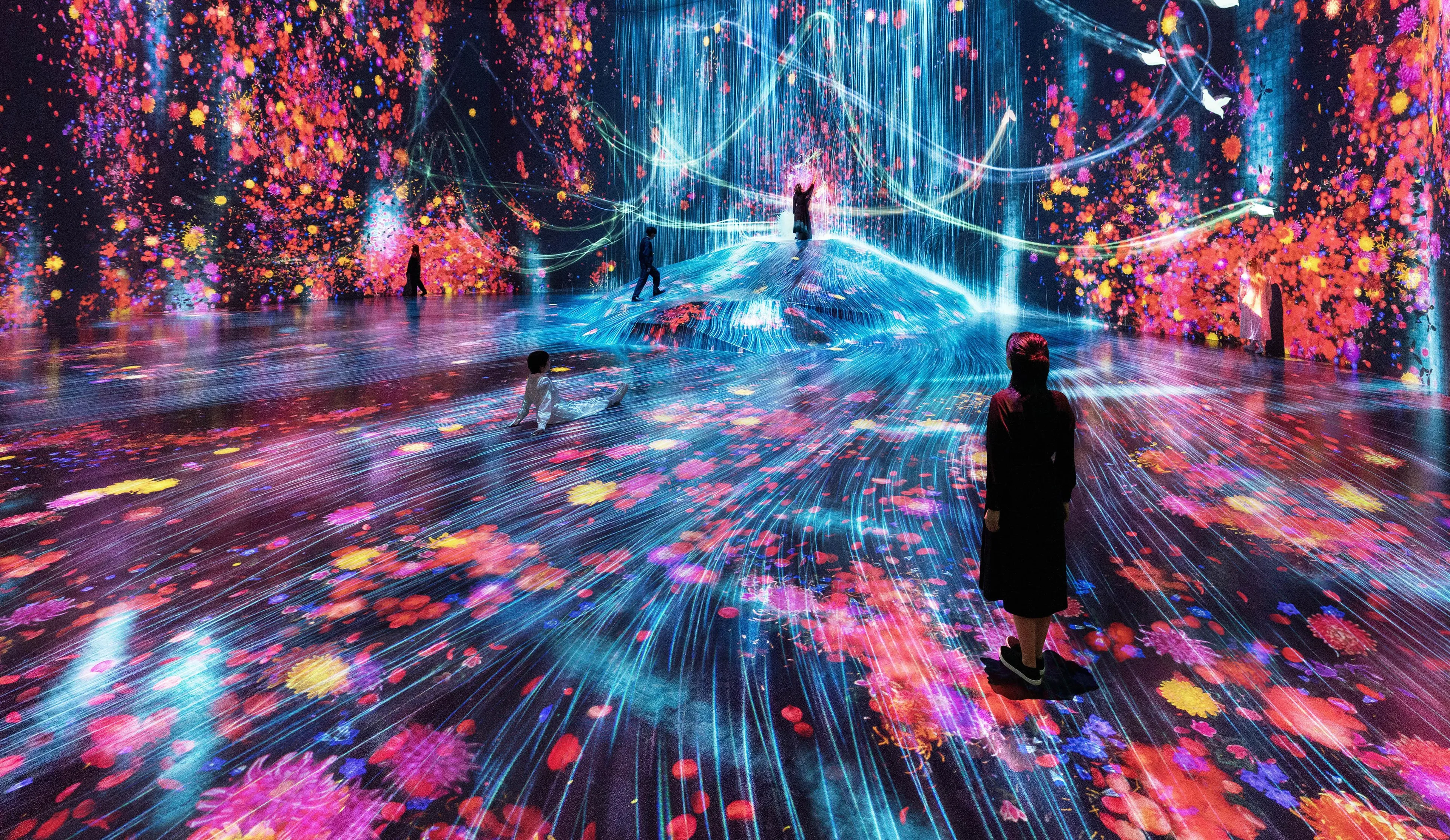
Flowers and People, Cannot be Controlled but Live Together

Flowers bud, bloom, and in the course of time, wither and die. While eternally repeating the process of life and death, the places where they grow change gradually. When people stand still, the flowers surrounding them grow and bloom abundantly, but when people touch the flowers or walk around, they scatter and die all at once.The artwork is not a pre-recorded image that is played back; it continues to be rendered in real time under the influence of people's behavior. The picture at this moment can never be seen again.
In spring in the Kunisaki Peninsula, there are many cherry blossoms in the mountains and canola blossoms at their base. A visit to this region led teamLab to wonder how many of these flowers were planted by people and how many of them were native to the environment. It was a place overflowing with flowers, a place of great serenity and contentment. This nature is an ecosystem influenced by human activity, making us feel that nature and humanity are not in conflict. Perhaps a truly comforting nature is one that encompasses human presence as part of the ecosystem. Based on the premise that nature cannot be completely controlled, this artwork explores human activity that lives closely aligned to the rules of nature.
This artwork is an ecological pictorial space drawn through Ultrasubjective Space, which continues to be generated along with the body, others, time, and the environment. Viewers physically walk around and touch inside the world of the artwork, transforming it together with others in the same space.
This pictorial space differs from images or paintings flattened by a lens or single-point perspective. In such images or paintings, space appears behind the picture plane; the space that opens there and the space the viewer inhabits are split, and the picture plane becomes a boundary surface. The viewpoint is fixed at a single point, and bodily freedom is lost.On the other hand, a picture plane formed by Ultrasubjective Space is not a boundary that separates where we are from the world of the artwork. The world of the artwork is not outside a window; it appears as a single field that is continuously connected, without boundary, to the space in which the viewer’s body exists. Moreover, any position — front, back, left, or right — can become a viewpoint, so viewpoints exist in infinite number, and the viewer is physically free to move.Not bound to a single point, the viewer moves their body and lets their eyes roam freely, continually re-composing the world of the artwork as it changes over time, and building the pictorial space within themselves. In that moment, the artwork becomes a centerless, subjective, and embodied pictorial space in which the viewer walks and touches.
In this space, the boundaries between the viewer and the artwork become ambiguous. The artwork transforms simply by the presence of a body there, and the behavior of others also changes the world of the artwork. In conventional art, other people were often considered an obstacle that interferes with a one-on-one relationship with the artwork. However, here, the presence of others enriches and creates new changes in the artwork.
This artwork is an attempt to expand painting from a world on the other side of the screen into a space continuous with the body, others, time, and the environment. The artwork continues to be generated within the relationships among the behavior of people, the life and death of flowers, the passage of time, and the entire space. Here, the painting does not exist on its own as a completed entity; it relates to people's bodies and includes the presence of others, existing as an ecological field without boundaries.

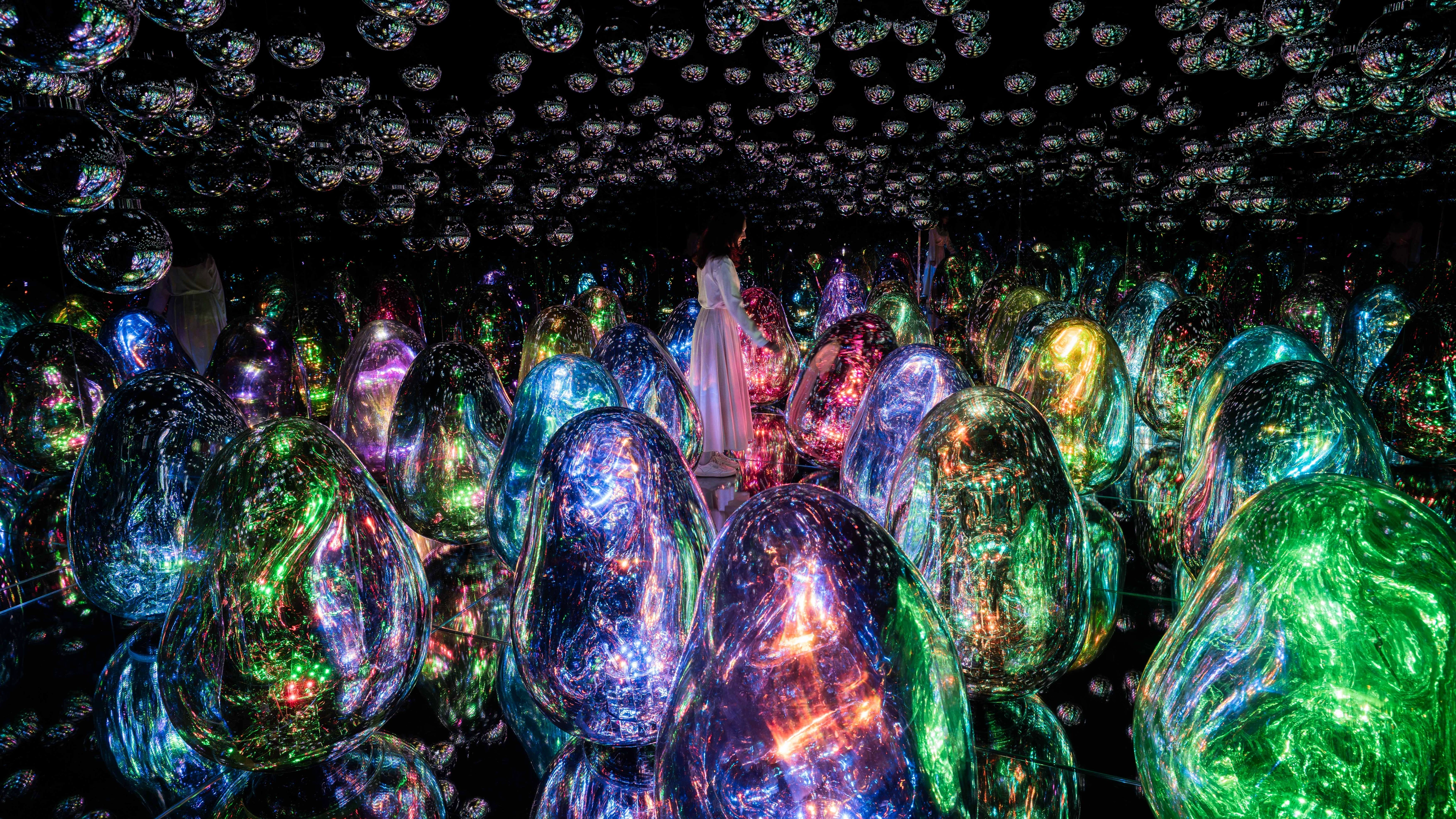
Resonating Microcosms - Solidified Light

When each ovoid is pushed over by a person, it shines brightly and emits a sound tone as it rights itself. The surrounding ovoids also respond one after another, and the same light color and tone continues to resonate out. The artwork space is transformed by people's actions, making people and the environment part of the artwork.
The patterns of color that appear within the ovoid exist as infinite possibilities until they are seen, and only at the moment it is viewed from a certain perspective is a single appearance fixed. They continue to transform in response to the viewer's moving body, the fluctuations of the sculpture itself, and the surrounding environment.
This artwork is part of the Resonant Collective Sculpture series, continuing from teamLabBall (2009-). Although each individual sculpture is an autonomous physical existence, they respond to one another, forming a single continuous field.
In this series, physical actions such as being pushed by a body, moved by others, and when outdoors, the effects of the environment such as wind and rain, the behavior of wild animals, interactions with adjacent sculptures within the same group, and other surrounding artworks—all of these become triggers for resonance. The light, sound, and movement generated in a single sculpture do not remain closed within that individual entity, but there occurs a chain reaction to nearby sculptures, and further into surrounding artworks and spaces, continuing throughout the whole.
Here, it is not only humans that move the artwork. The body, others, the environment, and the artwork are connected to the same ecosystem and responsive field—individual sculptures do not exist on their own as a complete entity, but continue to exist in relationships.
This structure is an attempt to expand sculptures from solid objects, as autonomous individuals, into a network-like existence that continues to be generated within the relationships among the body, others, the environment, and other artworks. In this ecological responsive field, where humans and non-humans participate together, the boundaries of the sculpture do not remain within the contours of individual physical objects.

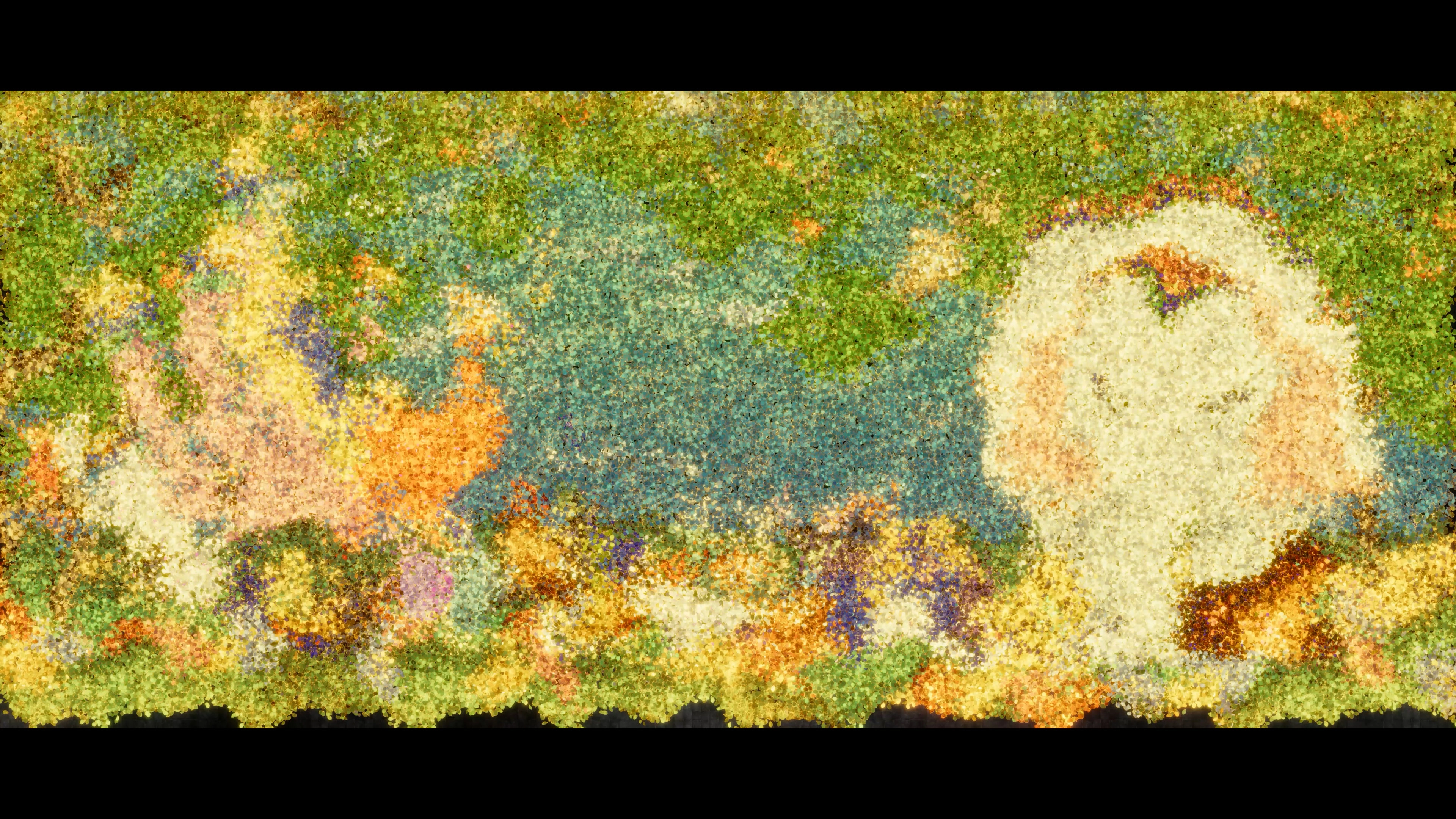
Nirvana: Fleeting Flowers, Radiance Within

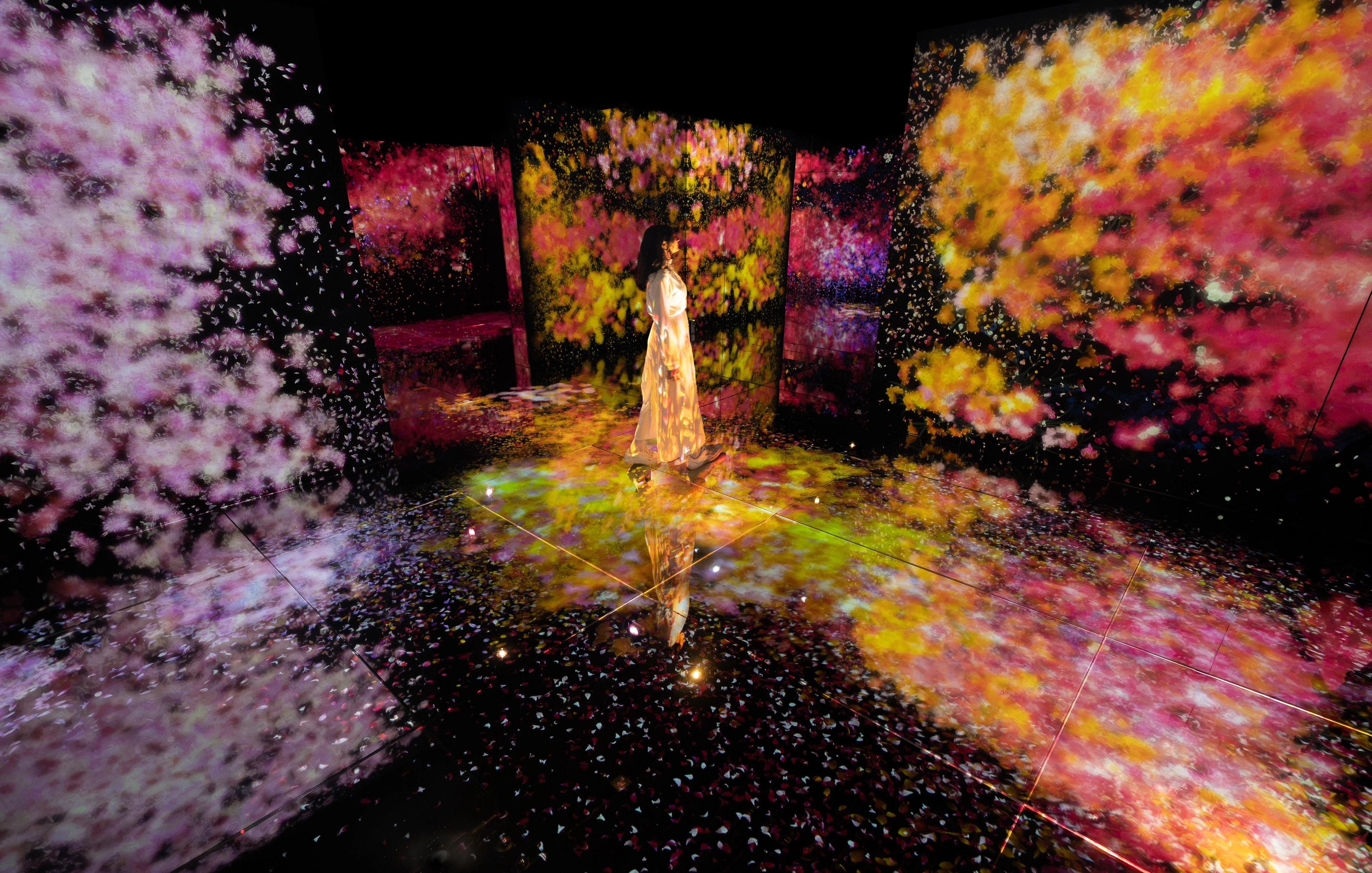
In this artwork from the Fleeting Flower series, the world of the artwork is depicted by flowers that repeat the cycle of life and death. When people touch them, the flowers scatter, and the world fades away. Everything exists miraculously and precariously in the boundless continuity of life.
This artwork is inspired by the screen paintings “Birds, Animals, and Flowering Plants” and “Trees, Flowers, Birds and Animals” by Itō Jakuchū (1716–1800), an early modern Japanese painter who was active in Kyoto in the mid-Edo period. Jakuchū has left us with a unique style of painting in which the surface is made up of a grid of tens of thousands of squares, dividing and placing the colors of animals and plants in each square. When viewed up close, the painting appears as an accumulation of squares, but when seen as a whole from a distance, the divided colors blend through optical mixing and appear as images of animals and plants. The image seen changes depending on the distance. In this artwork, while referencing the logical structure of these square paintings where the image changes depending on the viewpoint and perception, the pictorial space continues to be generated through the life of the flowers, optical mixing of colors, the movement of the body, light, and relationships with others.
The four walls surrounding the entire room form a single pictorial space. Instead of viewing the screen from outside the painting, the viewer enters the world depicted by the flowers. When you touch them, the flowers scatter and the world fades away. At the same time, when others touch the flowers in another location, the flowers in that place scatter, and the world of the artwork changes. One's own body, the presence of others, and the world of the artwork interact with one another within the same space.
Here, the pictorial space is drawn through Ultrasubjective Space, and thus becomes a pictorial space that restores bodily freedom.
While the pictorial world is depicted on the screen, a radiance of sparkles simultaneously covers that world. This sparkle is produced when the very light that depicts the pictorial world reflects on the screen. The sparkle continues to change over time, even if the viewer does not move. Furthermore, in response to the environment and the moving body of the viewer, its appearance changes each time, shining from deep within the pictorial world.
The space created by this radiance of sparkles of light is not an illusion of depth depicted in a flat painting. It is a space that arises at that moment through time, the environment, the movement of the viewer's body and the light that depicts the pictorial world. While the pictorial space appears on the screen, it is continuously connected, without boundary, to the real physical space where the body exists, expanding into the depths of the pictorial space as a bodily space of light.
The bodily pictorial space created by Ultrasubjective Space, and the bodily space of the light overlap. A borderless bodily pictorial world, connected to the space where the viewer is located, comes into being.
This artwork does not exist on its own; it continuously updates its meaning in relationship with people. Your own touch, the touch of others, the movement of the body, and the sparkle of light—all of these transform the world of the artwork. Here, the flowers that bud, bloom, and scatter overlap with the viewer's body, the presence of others, and the sparkling of light. This expands the pictorial space into a bodily pictorial world of light that connects seamlessly with the real world.
teamLab에 대해
아트 컬렉티브 teamLab은 2001년 활동을 시작했다. 국경을 넘어선 연대 속에 집단 창작의 방식으로 예술, 과학, 테크놀로지 그리고 자연계의 교차점을 학제적 접근으로 모색한다. 아티스트, 프로그래머, 엔지니어, CG 애니메이터, 수학자, 건축가 등 다양한 분야의 전문가들로 구성된 teamLab은 예술을 통해 인간과 자연, 개인과 세계의 새로운 관계를 탐구하고 표현한다. teamLab은 우리에게 익숙한 모든 경계에 대해 질문한다. 인간은 각자를 둘러싼 바깥 세상을 감각 기관으로 인지해 스스로와 분리하고 낱낱을 경계지어 독립체로 구분하려 한다. 현대 문명은 그런 방식으로 세계를 이해해 왔다. teamLab은 예술을 통해 감각을 확장하고 개인과 세계의 경계, 시간의 연속성에 대한 인지의 경계를 넘어설 수 있다고 믿는다. 이 세계의 모든 것은 광대한 시간 속에, 생명의 끝없는 연속 안에 가까스로, 하지만 기적적으로 존재하고 있다. teamLab의 작품은 시드니 뉴사우스웨일스 주립 미술관, 애들레이드 사우스오스트레일리아 미술관, 샌프란시스코 아시아 미술관, 뉴욕 아시아 소사이어티, 이스탄불 보루산 현대 미술관, 멜버른 빅토리아 국립 미술관, 헬싱키 아모렉스가 영구 소장하고 있다. teamlab.art Biographical Documents
About the Exhibition
Second Nature, a groundbreaking immersive art exhibition that illuminates the evolving, interdependent relationship between humans, technology, and the natural world. Second Nature is a global collaboration that brings together an international group of artists working at the forefront of art and technology and is organised by the co-founder and the curator of trailblazing experiential art venture Superblue.

Second Nature transforms digital systems into interactive environments that inspire physical participation over passive observation. In the artists’ subversive hands, familiar and occasionally troubling technologies that increasingly permeate and mediate our lives are rendered sensorial, evocative and poetic—capturing the tension between agency and surrender, whether to algorithms or natural cycles of decay and rebirth. Replacing a flattened screen or canvas, these experiential works inspire visitors to move, respond, touch, and become part of the art itself. Second Nature considers possibilities of boundaries between human, nature, and technology – as they begin to dissolve - inviting visitors into the dynamic ecosystems that shape our collective future.

Second Nature is curated by Mollie Dent-Brocklehurst, Co-Founder, Superblue and Founder DoubleMoon, and Margot Mottaz, Head of Curatorial, Superblue.

관람안내

전시회장 정보

Second Nature

기간

2026.7.03(Fri) - 2027.1.10(Sun)

관람 시간

Tuesday - Thursday, Sunday 11:00 - 20:00
Friday - Saturday 11:00 - 22:00

휴관일

Monday

오시는 길

주소

ART HOUSE at Nita Mukesh Ambani Cultural Centre
Jio World Centre, G Block Rd, G Block BKC, Bandra Kurla Complex, Bandra East, Mumbai, Maharashtra 400051

문의

티켓

티켓 구매