teamLab: Between Art and Physical Space | teamLab

メイン画像
teamLab: Between Art and Physical Space
전시 종료
2016.3.04(Fri) - 10.16(Sun)Borusan Contemporary, Istanbul
メイン画像
teamLab: Between Art and Physical Space
전시 종료
2016.3.04(Fri) - 10.16(Sun)Borusan Contemporary, Istanbul

작품

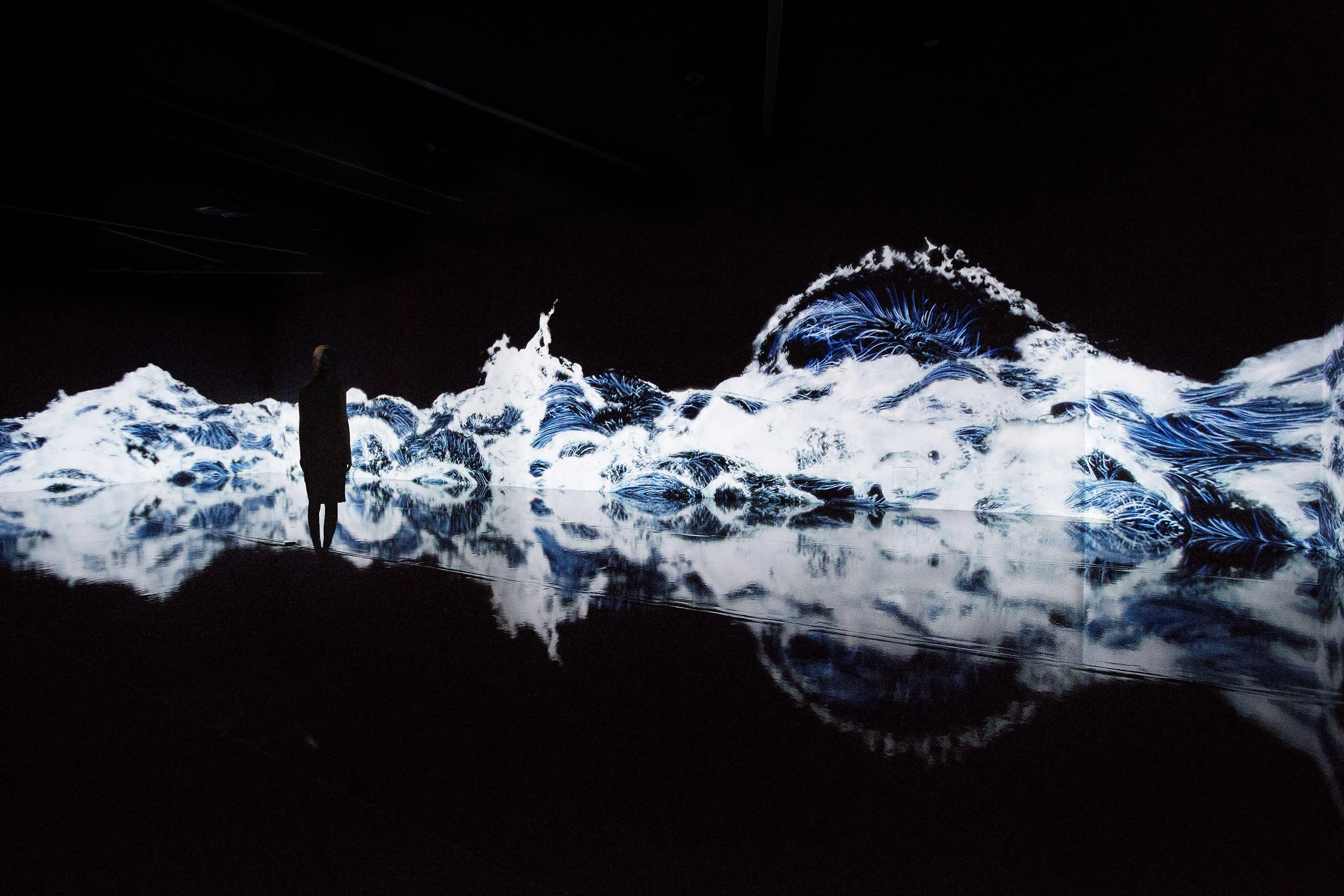
Black Waves

All oceans are connected to each other, and so are all the waves in this world.

In classical East Asian art, waves are often expressed using a combination of lines. These waves created by lines allow us to realize that each wave is one part of a larger flow, and conveys life as though the waves are a living entity.

When the waves rise, we can feel a powerful breath of life, as though life is blooming. It feels as though each wave has a life of its own. But when the waves collapse and disappear, we realize, with a sense of fragility, that they were a part of the ocean. And that ocean is connected to all of the other oceans. In other words, all of the waves in the world are connected to each other.
The waves seem alive because life is like a rising wave. It is a miraculous phenomenon that continuously emerges from a single, continuous ocean.

The waves are expressed through a continuous body of countless water particles. The interactions of particles are calculated, and then the movement of water is simulated in three-dimensional space. Lines are created along the trajectories of the water particles, and drawn on the surface layer of the three-dimensional waves.

The lines are created with what teamLab refers to as Ultrasubjective Space. In contrast to space that is created through, or cut out by, lenses and perspective, Ultrasubjective Space does not fix the viewer’s viewpoint and in turn frees the body. The wall that the waves are seen on does not become a boundary between the viewer and the artwork, and the artwork space is continuous with the space of the viewer’s body.

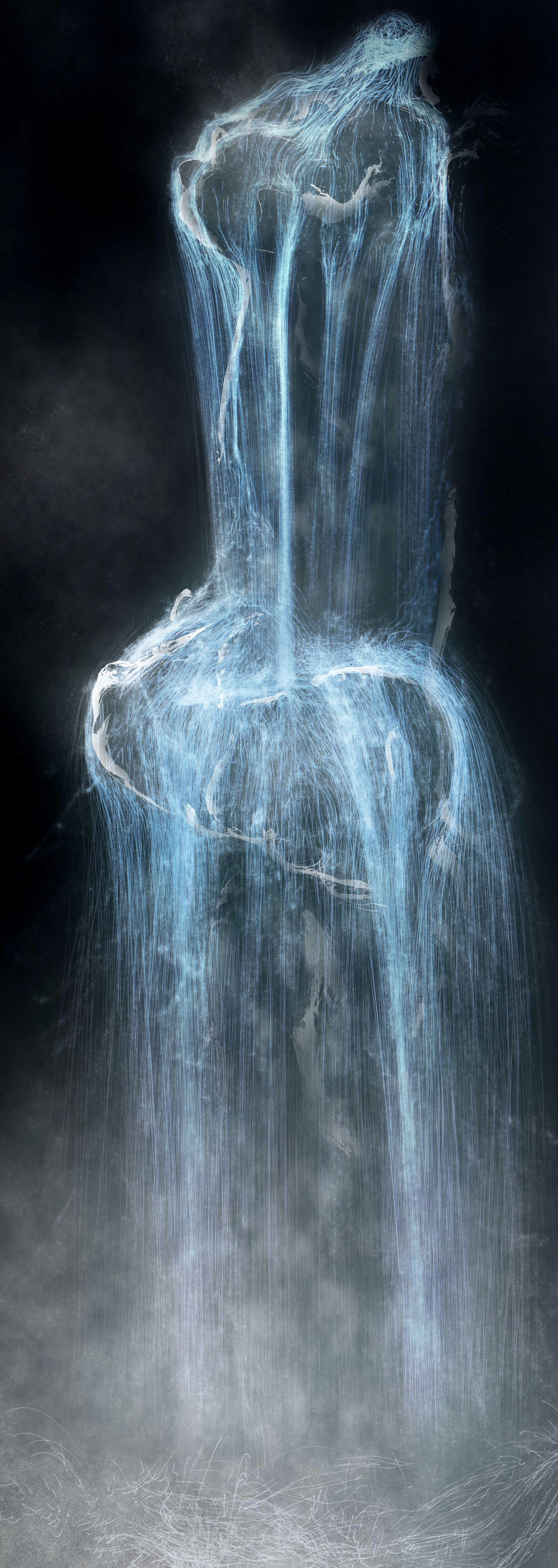
Universe of Water Particles

Universe of Water Particles is a virtual waterfall created in a virtual 3-D space using teamLab’s concept of ultrasubjective space, a term that refers to the depiction of space found in premodern Japanese painting.

Computer-generated water consisting of hundreds of thousands of water particles is virtually poured onto a virtually sculpted rock. The computer calculates the movement of the particles to produce a simulation of water that flows in accordance with the laws of physics. Lines are drawn in relation to a selection of 0.1% of the particles. The sinuousness of the lines depends on the overall interaction of the water particles.

In premodern Japanese painting, oceans, rivers, and other bodies of water were expressed using a series of lines. These lines give the impression of movement and life, as though water was a living entity. This form of expression leads us to explore why premodern people sensed life in rivers and oceans. Universe of Water Particles fuses the objective world of today’s knowledge with the subjective world of premodern people.

When viewing this artwork, regardless of the fact that the waterfall is a reproduction of physical phenomena, it can be possible to feel a sense of life in the collection of lines.

If, when viewing this artwork—as opposed to a video of a waterfall shot with a video camera—people feel the barrier between themselves and the waterfall dissolve, they become immersed in the work as if the waterfall is luring them in. Perhaps we can find a connection to the way premodern Japanese people perceived the world and consequently behaved towards it.

If we regard ourselves as part of nature, and consider nature as something not just to be observed, it is possible to feel that there is no boundary between ourselves and nature.

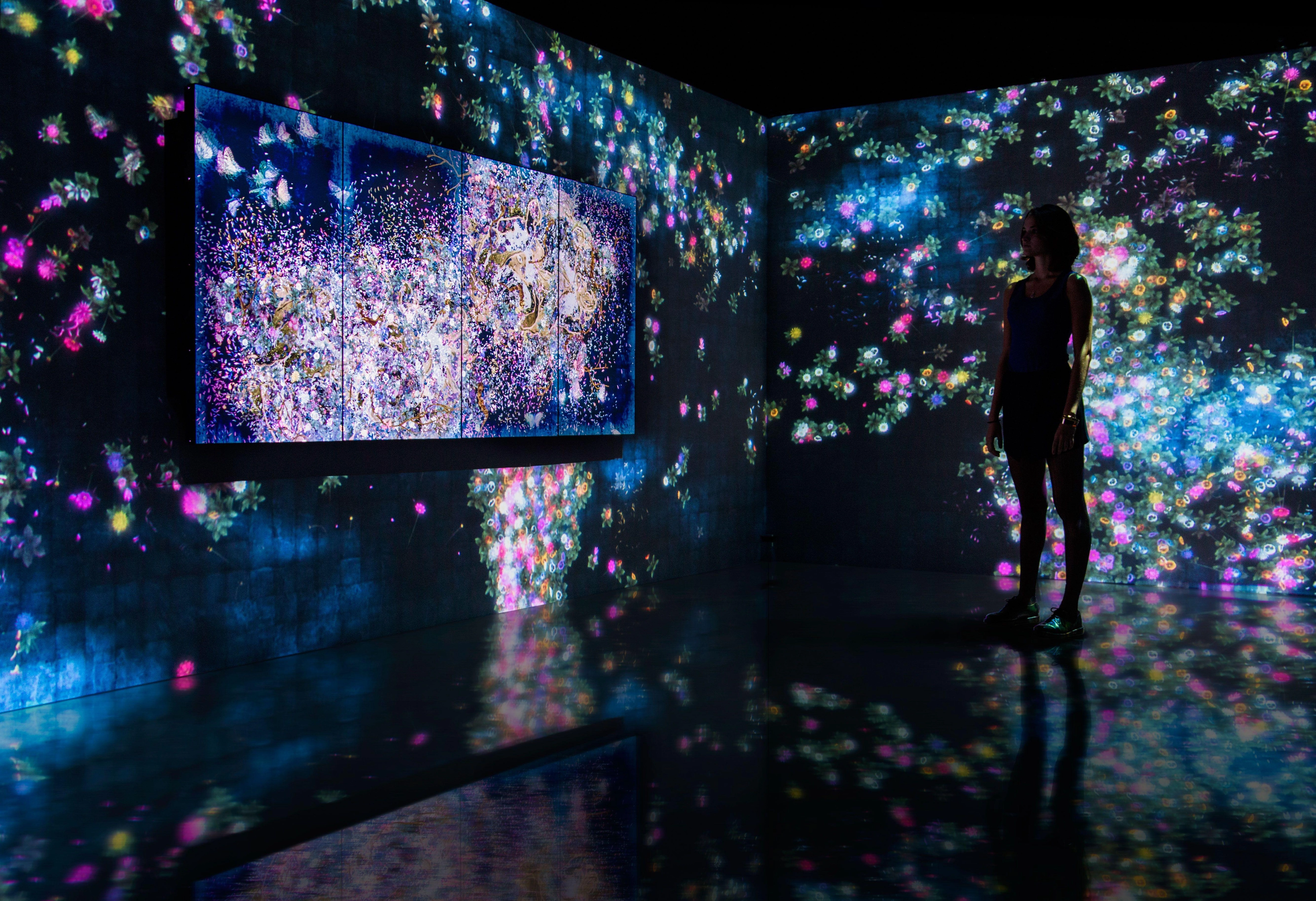
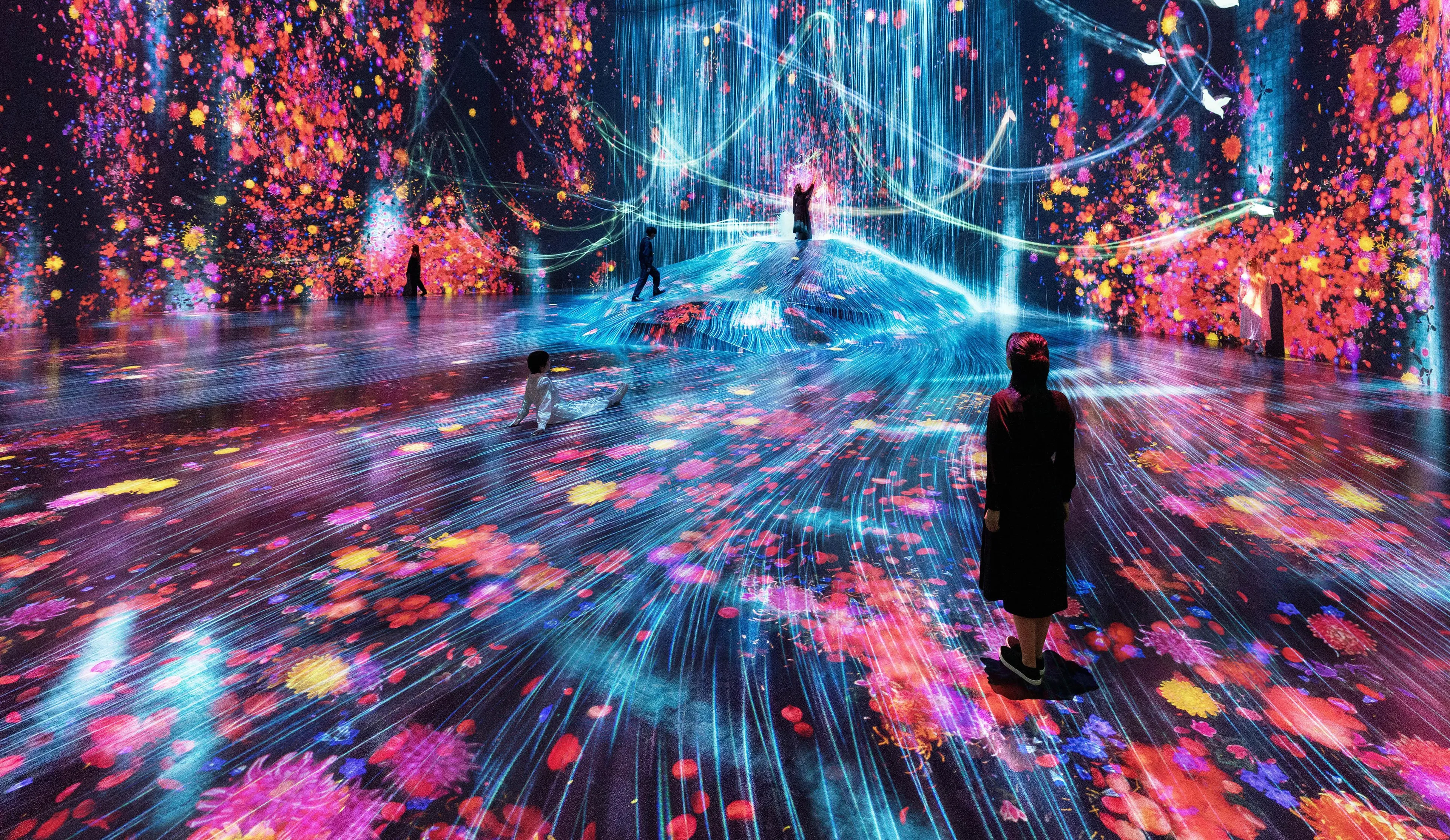
Flowers and People, Cannot be Controlled but Live Together – A Whole Year per Hour

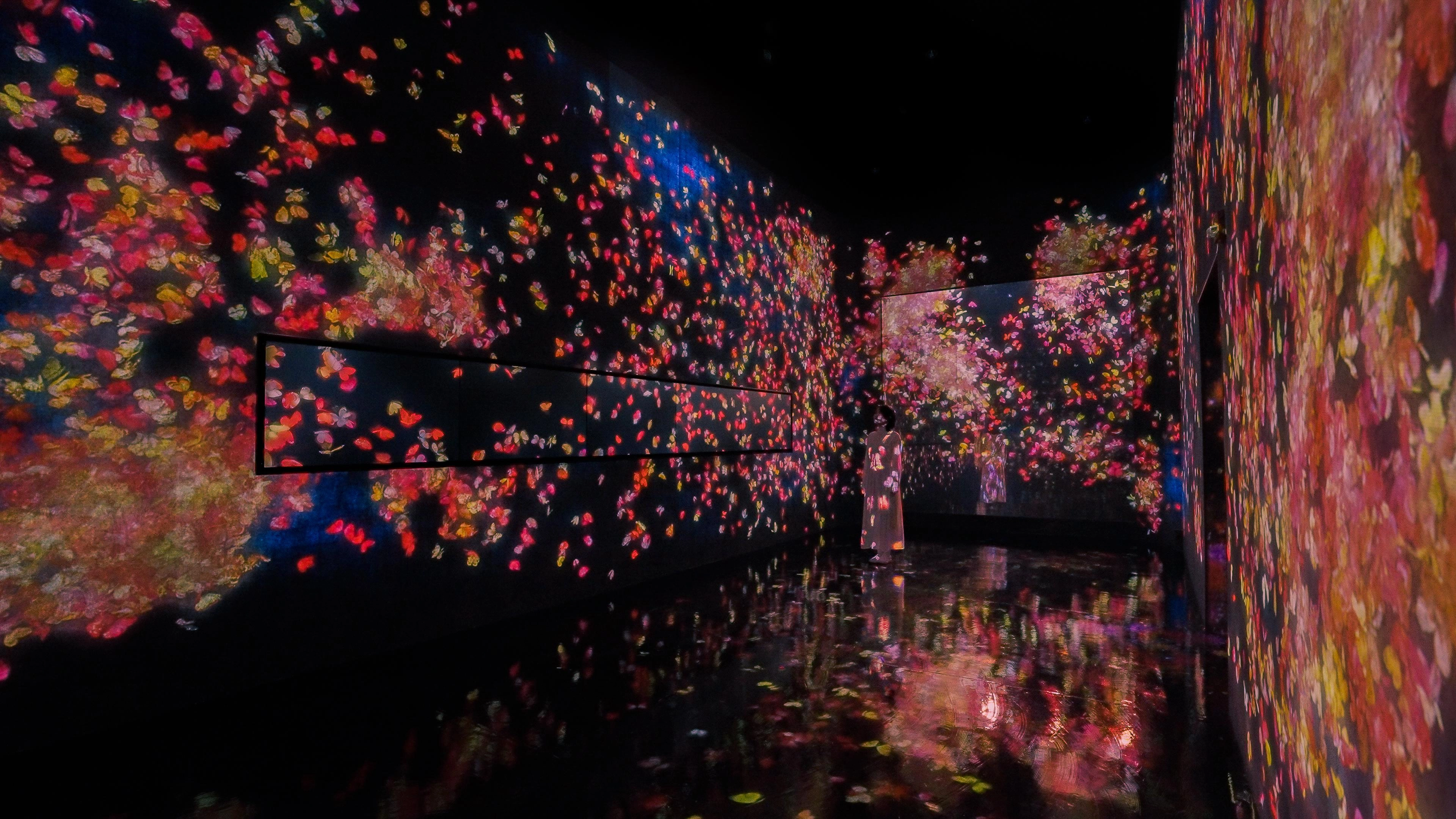
Flowers bud, bloom, and in the course of time, wither and die. While eternally repeating the process of life and death, the places where they grow change gradually. When people stand still, the flowers surrounding them grow and bloom abundantly, but when people touch the flowers or walk around, they scatter and die all at once.The artwork is not a pre-recorded image that is played back; it continues to be rendered in real time under the influence of people's behavior. The picture at this moment can never be seen again.
In spring in the Kunisaki Peninsula, there are many cherry blossoms in the mountains and canola blossoms at their base. A visit to this region led teamLab to wonder how many of these flowers were planted by people and how many of them were native to the environment. It was a place overflowing with flowers, a place of great serenity and contentment. This nature is an ecosystem influenced by human activity, making us feel that nature and humanity are not in conflict. Perhaps a truly comforting nature is one that encompasses human presence as part of the ecosystem. Based on the premise that nature cannot be completely controlled, this artwork explores human activity that lives closely aligned to the rules of nature.
This artwork is an ecological pictorial space drawn through Ultrasubjective Space, which continues to be generated along with the body, others, time, and the environment. Viewers physically walk around and touch inside the world of the artwork, transforming it together with others in the same space.
This pictorial space differs from images or paintings flattened by a lens or single-point perspective. In such images or paintings, space appears behind the picture plane; the space that opens there and the space the viewer inhabits are split, and the picture plane becomes a boundary surface. The viewpoint is fixed at a single point, and bodily freedom is lost.On the other hand, a picture plane formed by Ultrasubjective Space is not a boundary that separates where we are from the world of the artwork. The world of the artwork is not outside a window; it appears as a single field that is continuously connected, without boundary, to the space in which the viewer’s body exists. Moreover, any position — front, back, left, or right — can become a viewpoint, so viewpoints exist in infinite number, and the viewer is physically free to move.Not bound to a single point, the viewer moves their body and lets their eyes roam freely, continually re-composing the world of the artwork as it changes over time, and building the pictorial space within themselves. In that moment, the artwork becomes a centerless, subjective, and embodied pictorial space in which the viewer walks and touches.
In this space, the boundaries between the viewer and the artwork become ambiguous. The artwork transforms simply by the presence of a body there, and the behavior of others also changes the world of the artwork. In conventional art, other people were often considered an obstacle that interferes with a one-on-one relationship with the artwork. However, here, the presence of others enriches and creates new changes in the artwork.
This artwork is an attempt to expand painting from a world on the other side of the screen into a space continuous with the body, others, time, and the environment. The artwork continues to be generated within the relationships among the behavior of people, the life and death of flowers, the passage of time, and the entire space. Here, the painting does not exist on its own as a completed entity; it relates to people's bodies and includes the presence of others, existing as an ecological field without boundaries.
차가운 생명

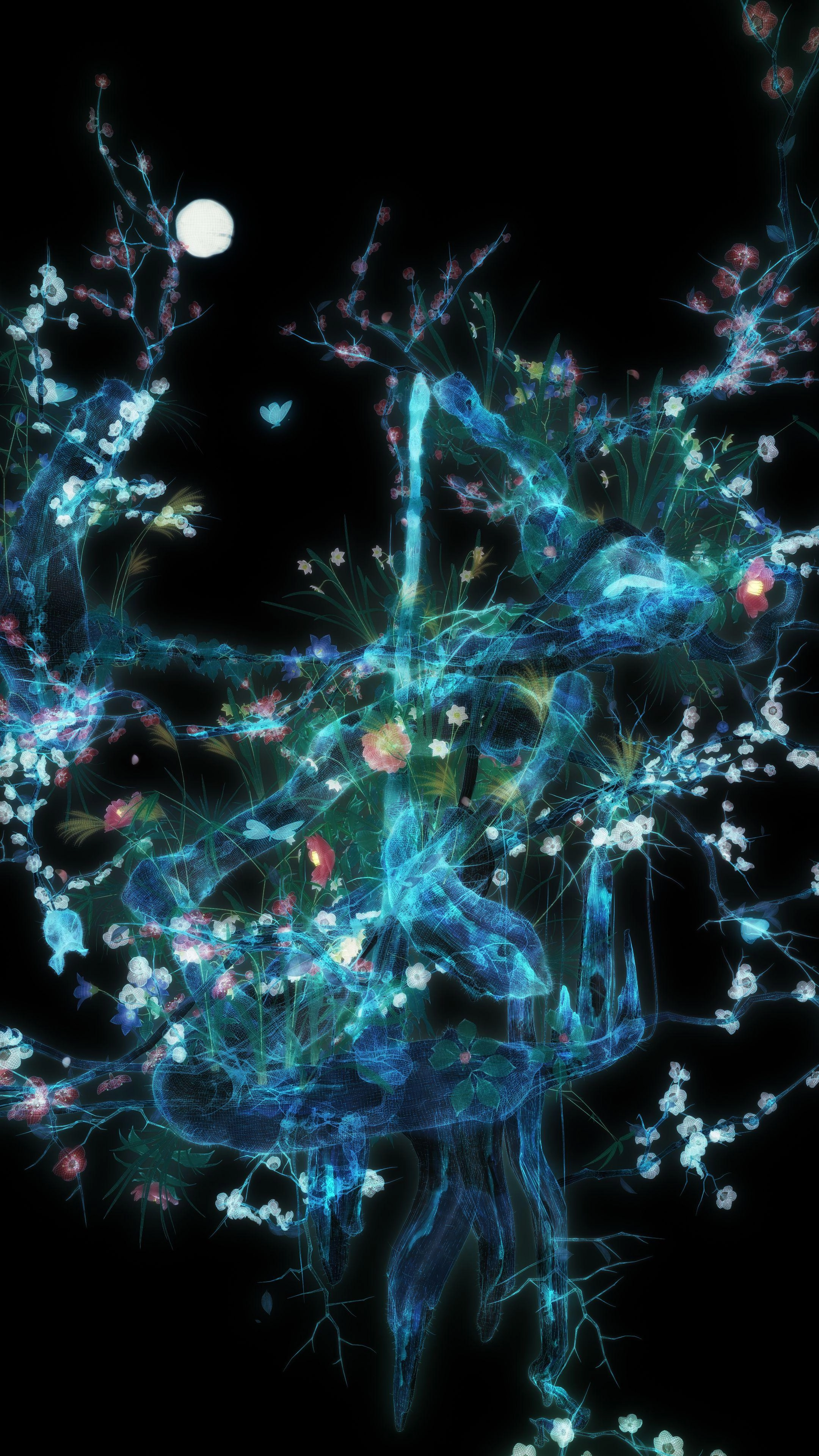
본 작품은 ‘생명은 생명의 힘으로 산다’(2011)의 표면을 벗겨내, 그 구조를 드러내고 있다.

컴퓨터는 3차원적인 물체의 형상을 격자로 그려진 추상적이며 고차원적인 정보로 표현한다. 3차원으로 그려진 물체는 그 표면을 벗겨내면 격자의 집합으로 이루어져 있다. 작품은 표면을 벗겨낸 상태, 즉 구조가 그려진 추상적이며 고차원적인 정보의 상태를 그대로 표현해내고 있다.

자연의 축복과 위협, 그리고 문명의 축복과 위협은 모두 끊임없이 연결되어 있다. 절대적인 악의를 갖고 있는 것도 아니며, 그렇다고 해서 완벽하게 아름다운 것만도 아니다. 알기 쉬운 해답이 존재하는 것도 아니며, 감정적으로 쉽게 정리할 수 있는 문제도 아니다. 하지만 어떠한 상황이 오더라도 ‘살아가는 것’은 전부 긍정하고 싶다. 생명은 아름답다.

teamLab 설립 후 꾸준히 작업을 이어온 공간에 쓰는 서(書), ‘공서(空書)’. 서예의 먹자국이 갖는 깊이나 속도, 힘의 강약과 같은 요소들을 새롭게 해석해 입체적으로 재구축한 작품이다. 나비와 새, 꽃 등의 동식물이 머물며 변화하는 계절과 더불어 생명을 표현했다. ‘산천초목실개성불(山川草木悉皆成佛, 살아있는 모든 것은 성불한다)’이라는 말에서 알 수 있 듯, 선종(禪宗)에서는 어떠한 것에도 구애받지 않은 자연 그대로의 모습이야말로 부처 그 자체라고 생각한다. 작품은 현대를 살아가는 우리들이 고찰하는 생명의 마음을 형상화하고 있다.
teamLab에 대해
아트 컬렉티브 teamLab은 2001년 활동을 시작했다. 국경을 넘어선 연대 속에 집단 창작의 방식으로 예술, 과학, 테크놀로지 그리고 자연계의 교차점을 학제적 접근으로 모색한다. 아티스트, 프로그래머, 엔지니어, CG 애니메이터, 수학자, 건축가 등 다양한 분야의 전문가들로 구성된 teamLab은 예술을 통해 인간과 자연, 개인과 세계의 새로운 관계를 탐구하고 표현한다. teamLab은 우리에게 익숙한 모든 경계에 대해 질문한다. 인간은 각자를 둘러싼 바깥 세상을 감각 기관으로 인지해 스스로와 분리하고 낱낱을 경계지어 독립체로 구분하려 한다. 현대 문명은 그런 방식으로 세계를 이해해 왔다. teamLab은 예술을 통해 감각을 확장하고 개인과 세계의 경계, 시간의 연속성에 대한 인지의 경계를 넘어설 수 있다고 믿는다. 이 세계의 모든 것은 광대한 시간 속에, 생명의 끝없는 연속 안에 가까스로, 하지만 기적적으로 존재하고 있다. teamLab의 작품은 시드니 뉴사우스웨일스 주립 미술관, 애들레이드 사우스오스트레일리아 미술관, 샌프란시스코 아시아 미술관, 뉴욕 아시아 소사이어티, 이스탄불 보루산 현대 미술관, 멜버른 빅토리아 국립 미술관, 헬싱키 아모렉스가 영구 소장하고 있다. teamlab.art Biographical Documents teamLab is represented by Pace Gallery, Martin Browne Contemporary and Ikkan Art.

전시회장 정보

teamLab: Between Art and Physical Space

기간

2016.3.04(Fri) - 10.16(Sun)

휴관일

Weekdays

관람료

Free

오시는 길

주소

Borusan Contemporary
Baltalimanı Hisar Street Perili Kosk No:5 34470 Rumeli Hisari/Sariyer Istanbul Turkey