teamLab Islands Dance! Art Museum and Learn & Play! Future Park in Oita | teamLab

メイン画像
ロゴ画像
AFGELOPEN TENTOONSTELLING
2016.7.15(Fri) - 9.25(Sun)Oita Art Museum, Oita
メイン画像
ロゴ画像
AFGELOPEN TENTOONSTELLING
2016.7.15(Fri) - 9.25(Sun)Oita Art Museum, Oita

DANCE! Art Museum


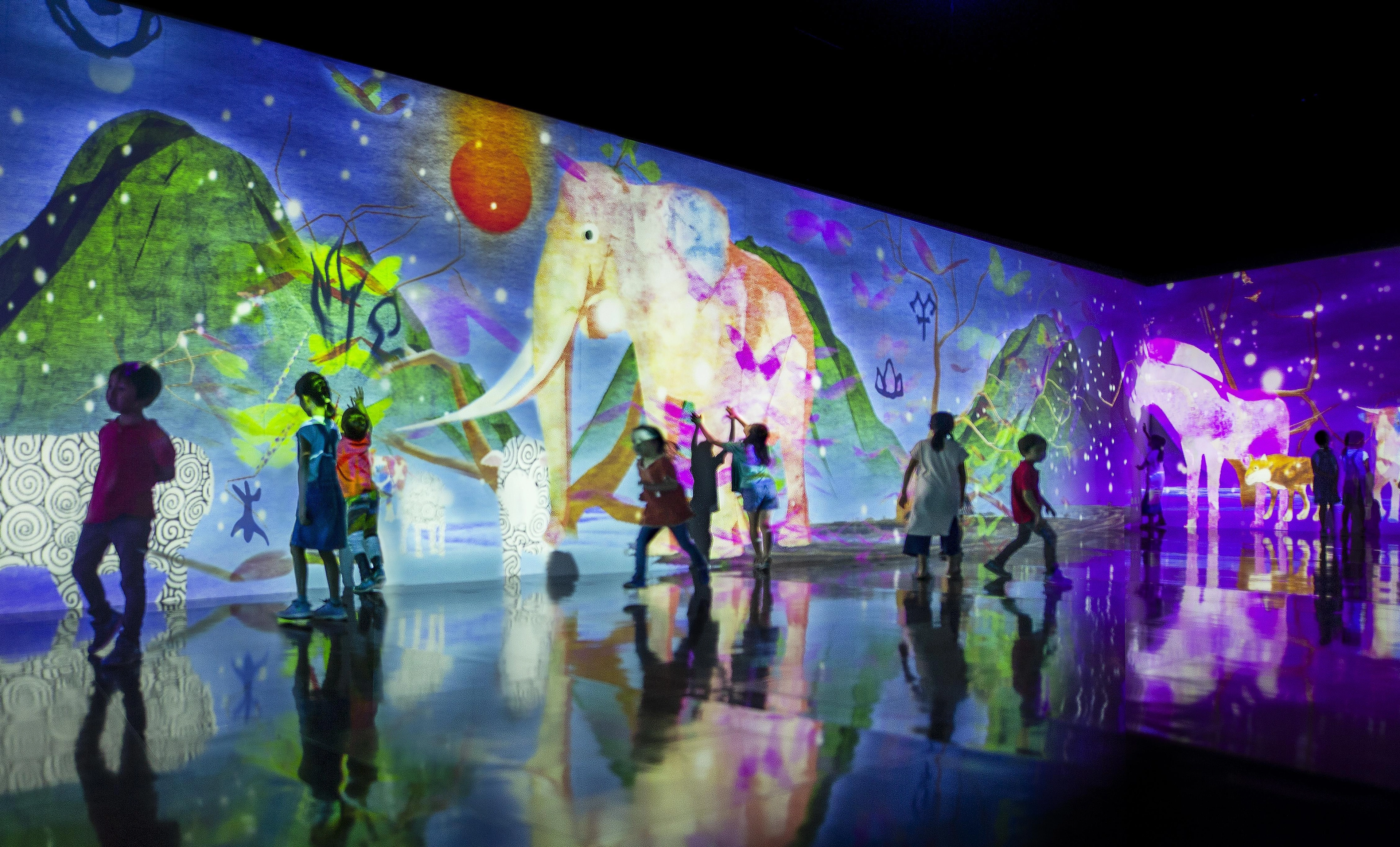
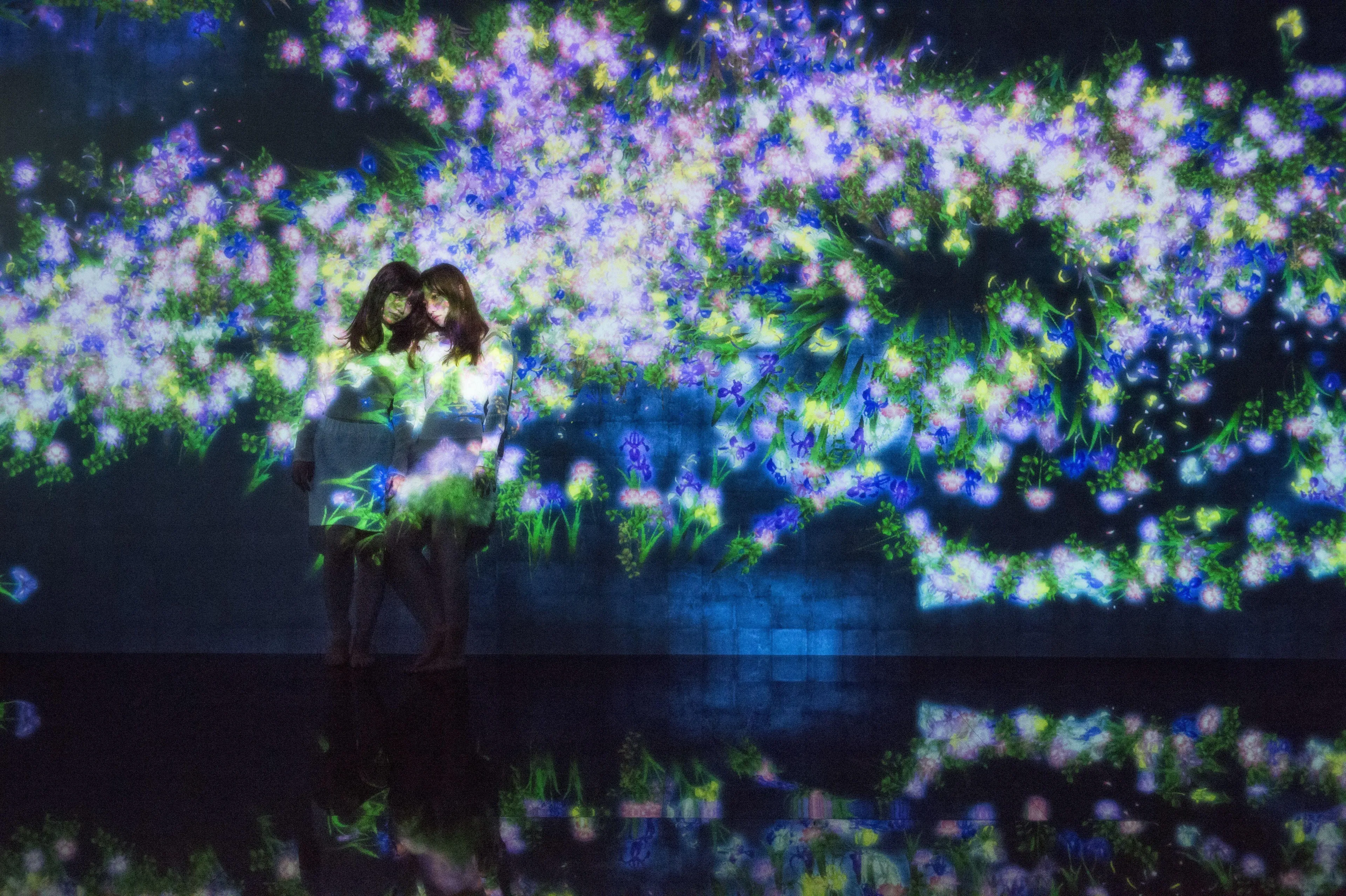
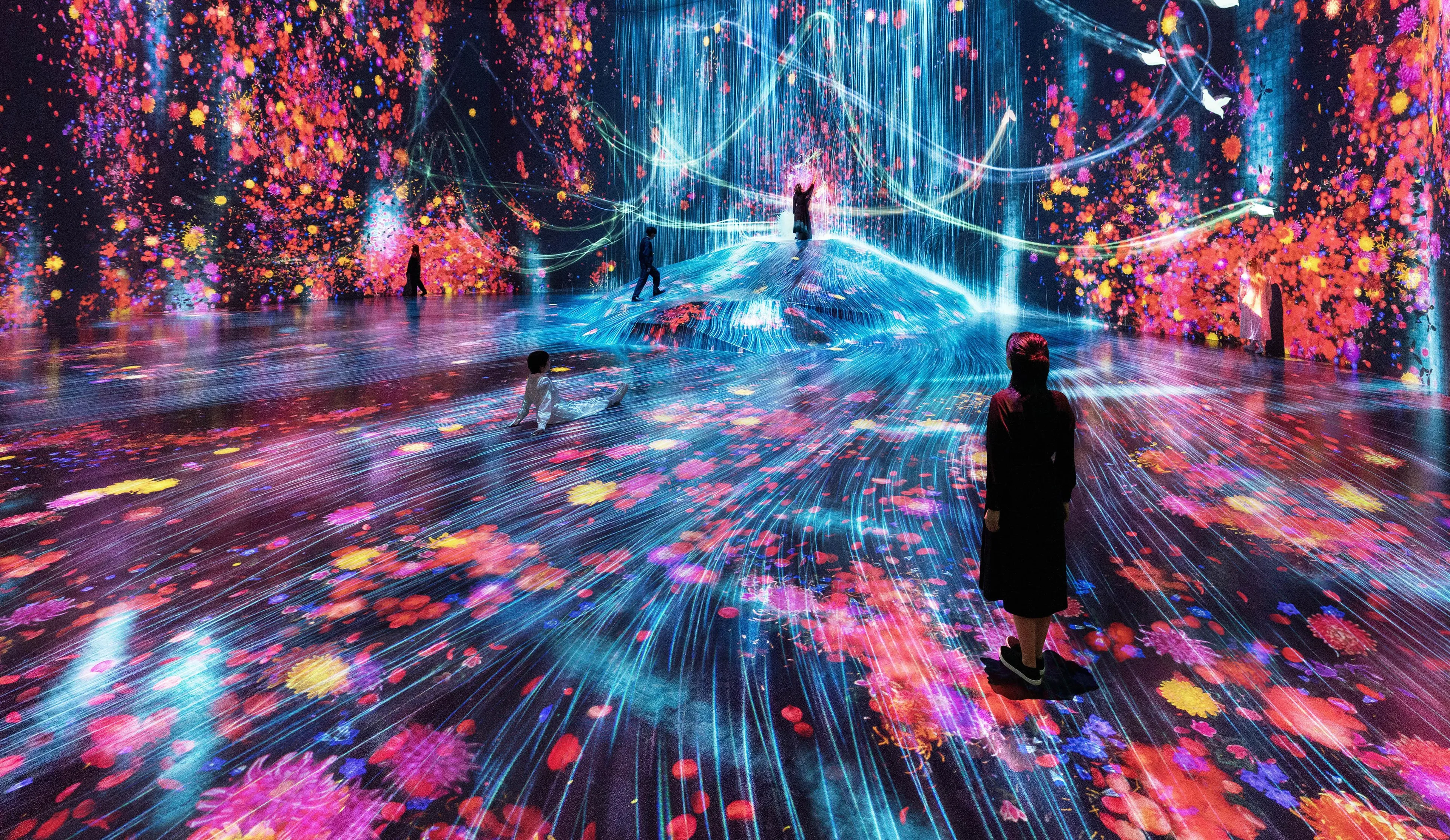
Flowers and People, Cannot be Controlled but Live Together – A Whole Year per Hour

Flowers bud, bloom, and in the course of time, wither and die. While eternally repeating the process of life and death, the places where they grow change gradually. When people stand still, the flowers surrounding them grow and bloom abundantly, but when people touch the flowers or walk around, they scatter and die all at once.The artwork is not a pre-recorded image that is played back; it continues to be rendered in real time under the influence of people's behavior. The picture at this moment can never be seen again.
In spring in the Kunisaki Peninsula, there are many cherry blossoms in the mountains and canola blossoms at their base. A visit to this region led teamLab to wonder how many of these flowers were planted by people and how many of them were native to the environment. It was a place overflowing with flowers, a place of great serenity and contentment. This nature is an ecosystem influenced by human activity, making us feel that nature and humanity are not in conflict. Perhaps a truly comforting nature is one that encompasses human presence as part of the ecosystem. Based on the premise that nature cannot be completely controlled, this artwork explores human activity that lives closely aligned to the rules of nature.
This artwork is an ecological pictorial space drawn through Ultrasubjective Space, which continues to be generated along with the body, others, time, and the environment. Viewers physically walk around and touch inside the world of the artwork, transforming it together with others in the same space.
This pictorial space differs from images or paintings flattened by a lens or single-point perspective. In such images or paintings, space appears behind the picture plane; the space that opens there and the space the viewer inhabits are split, and the picture plane becomes a boundary surface. The viewpoint is fixed at a single point, and bodily freedom is lost.On the other hand, a picture plane formed by Ultrasubjective Space is not a boundary that separates where we are from the world of the artwork. The world of the artwork is not outside a window; it appears as a single field that is continuously connected, without boundary, to the space in which the viewer’s body exists. Moreover, any position — front, back, left, or right — can become a viewpoint, so viewpoints exist in infinite number, and the viewer is physically free to move.Not bound to a single point, the viewer moves their body and lets their eyes roam freely, continually re-composing the world of the artwork as it changes over time, and building the pictorial space within themselves. In that moment, the artwork becomes a centerless, subjective, and embodied pictorial space in which the viewer walks and touches.
In this space, the boundaries between the viewer and the artwork become ambiguous. The artwork transforms simply by the presence of a body there, and the behavior of others also changes the world of the artwork. In conventional art, other people were often considered an obstacle that interferes with a one-on-one relationship with the artwork. However, here, the presence of others enriches and creates new changes in the artwork.
This artwork is an attempt to expand painting from a world on the other side of the screen into a space continuous with the body, others, time, and the environment. The artwork continues to be generated within the relationships among the behavior of people, the life and death of flowers, the passage of time, and the entire space. Here, the painting does not exist on its own as a completed entity; it relates to people's bodies and includes the presence of others, existing as an ecological field without boundaries.
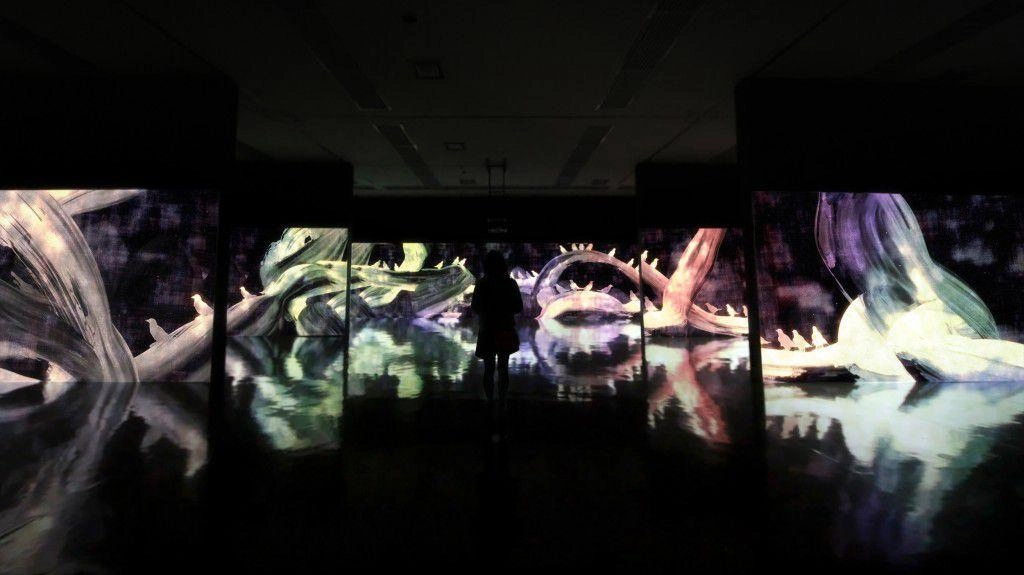
Crows are chased and the chasing crows are destined to be chased as well, Division in Perspective – Light in Dark

A digital installation in three dimensions on seven screens.

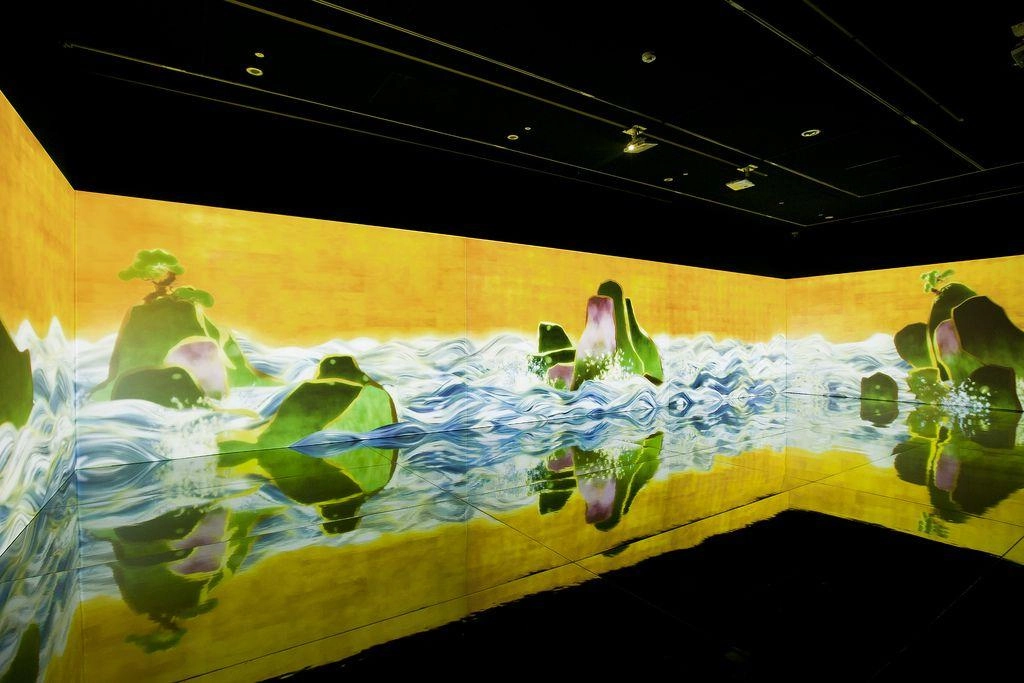
This artwork explores Japanese spatial awareness. It exists in a three-dimensional space that we call ultrasubjective space. The Japanese mythical bird Yatagarasu,* rendered in light, flies around the space leaving trails of light in its path, creating spatial calligraphy. As the crows chase and are chased by one another through the air, they turn into flowers and eventually scatter.

The Itano Circus is a unique technique pioneered by creator animator Ichiro Itano. In this technique, a screen is packed to capacity with swarms of flying missiles that are drawn in a completely distorted perspective. These distortions give the audience a stronger sense of dynamic movement and impact. Through ultra-high-speed camera work and staging that envelops the viewer’s perspective, this technique creates an overwhelmingly beautiful image.

In this digital artwork, an homage to the Itano Circus, teamLab has recreated this distortion of space formerly used in 2-D animation in a 3-D space. This is an exploration of 1) what sort of logical structure of perception constitutes this distortion of space pioneered by Japan’s animators, and 2) the hypothesis that this is in line with the continuous tradition of Japanese spatial perception. By recreating this distortion in a 3-D space, teamLab widens the perspectival viewpoint. This work is also an experiment in visual experience, as it divides the viewer’s perspective while deploying divided perspective into 3-D space.

*Yatagarasu, the three-legged crow, is a creature found in Japanese mythology. It is believed to represent the sun and the will of Heaven.

United, Fragmented, Repeated and Impermanent World

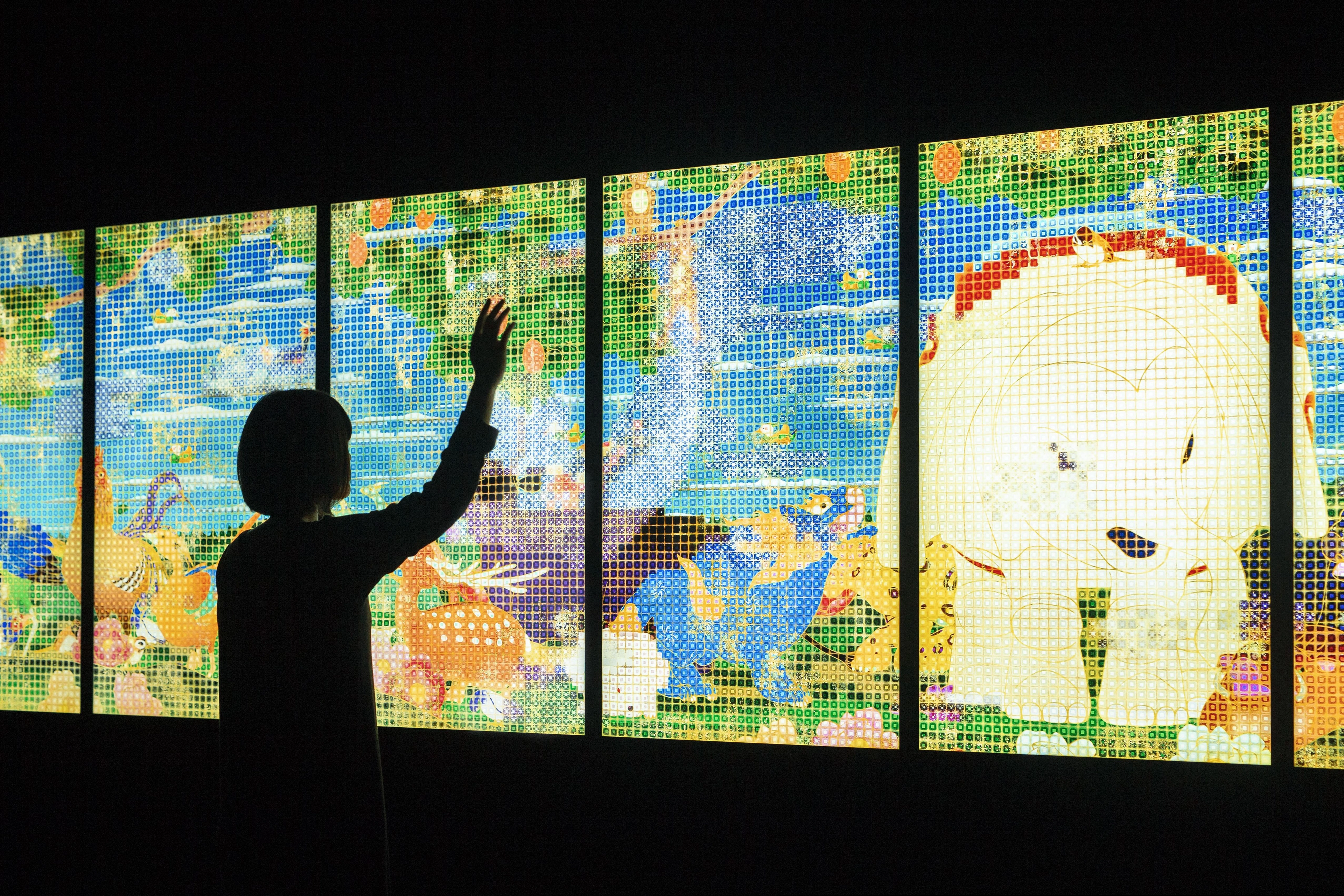
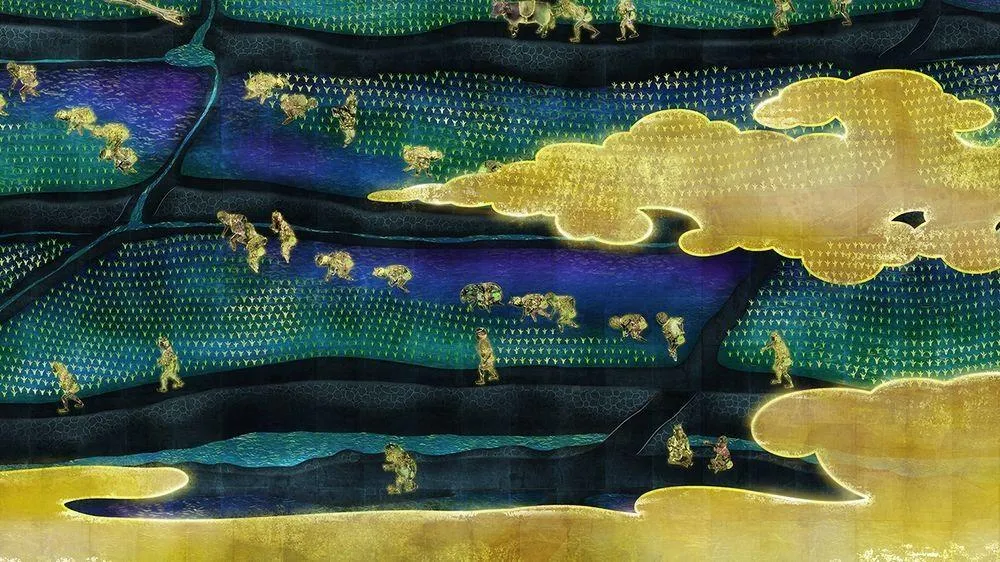
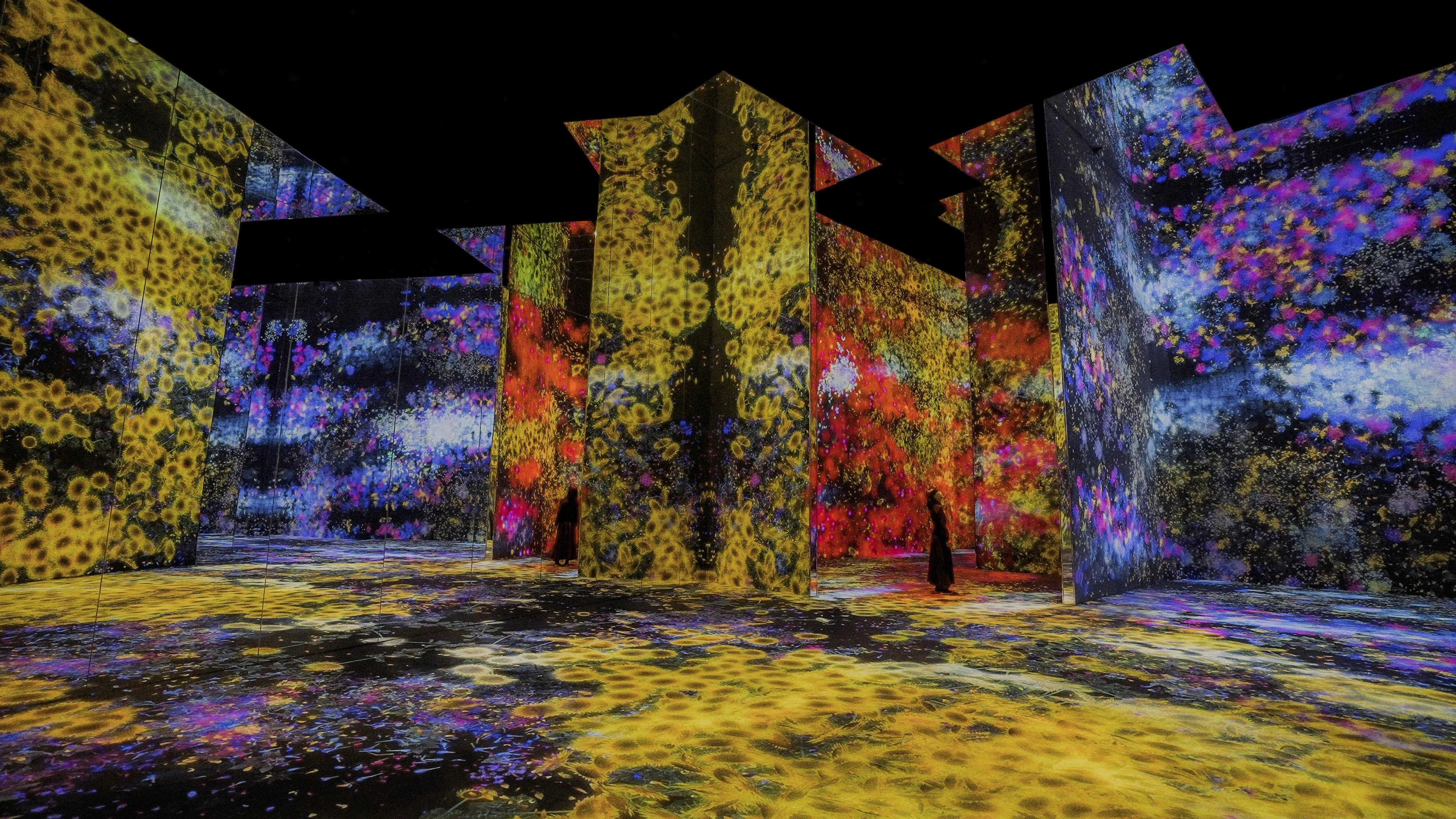
Itō Jakuchū (1716–1800) was an early modern Japanese painter who was active in Kyoto in the mid-Edo period. Jakuchū has left us with a unique style of painting in which the surface is made up of a grid of tens of thousands of squares that are individually colored. This work was inspired by the screen paintings Birds, Animals, and Flowering Plants and Trees, Flowers, Birds and Animals.
Jakuchū’s square paintings remind us of computer-generated pixel art. It has been proposed that Jakuchū’s squares pictures were inspired by industrial production constraints in the designs of Nishijin (traditional high-quality silk fabric that is woven in Nishijin, Kyoto). Pixel art was also born from functional limitations. Those functional limitations no longer exist but pixel art is still a very popular form of expression. This is perhaps why we feel an intuitive digital sense to Jakuchū's square works. The colors of Jakuchū’s work are the result of the optical phenomena of visual mixing of color combinations within the squares. It appears as if Jakuchū understood optical mixing of colors at a time before Impressionism and Pointillism. 
This artwork was created in a virtual 3-D space in which 3-D animals move. The space was then converted into what teamLab calls ultrasubjective space. Then,  the color in the 3-D space is split by the color pattern of the squares. For example, if the pattern of a square is colored in red and blue, that part corresponds to purple in the three dimensional space. 
The squares of the screen are fixed while the space continues to move, and thus the color inside the squares is on a different time axis to the space. Seen as a whole from a distance, brilliantly shining  colors occur, and the world of plants and animals in the space will move at a slow time axis. When viewed up close, the colors divided by the finely drawn patterns of each square will change on a rapid time axis. Two time axes co-exist in this work.
In addition, parts of the image squares are filled in with the most frequent color in the squares, forming an abstract world. Furthermore, when a visitor stands in front of the work, the squares near them are similarly painted. The plants and animals move in space, but are abstracted by the fixed squares on-screen, creating a new visual expression through pixel art.

Universe of Water Particles

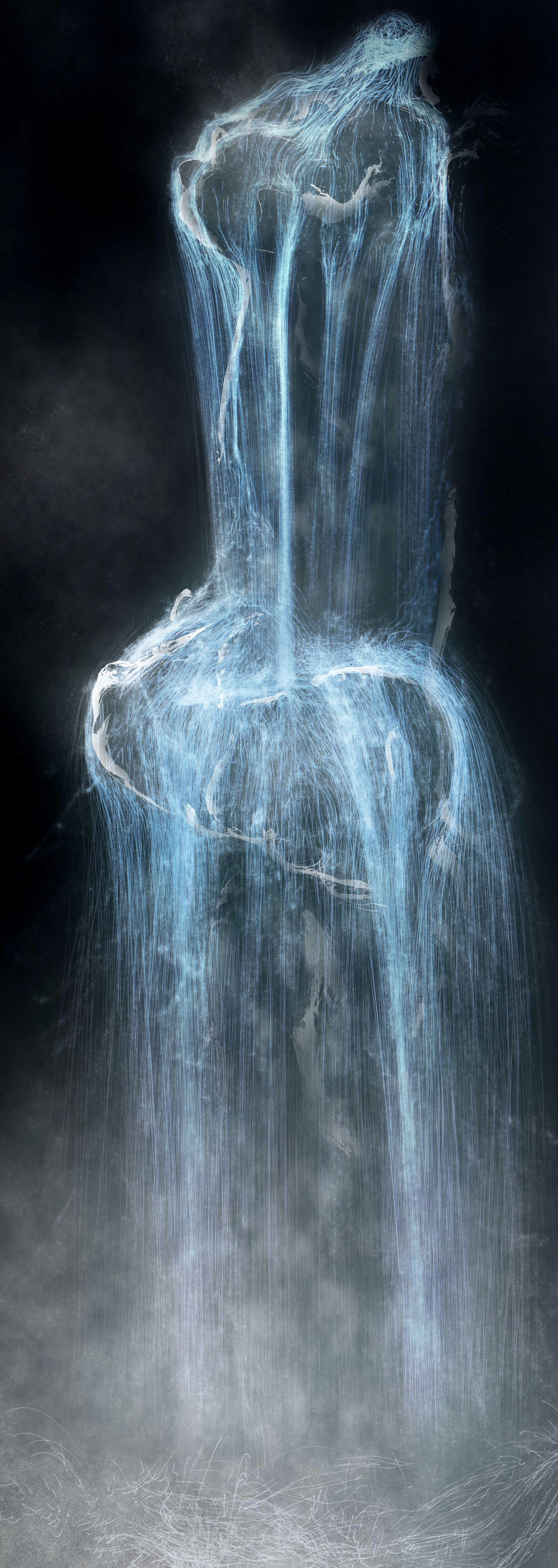
Universe of Water Particles is a virtual waterfall created in a virtual 3-D space using teamLab’s concept of ultrasubjective space, a term that refers to the depiction of space found in premodern Japanese painting.

Computer-generated water consisting of hundreds of thousands of water particles is virtually poured onto a virtually sculpted rock. The computer calculates the movement of the particles to produce a simulation of water that flows in accordance with the laws of physics. Lines are drawn in relation to a selection of 0.1% of the particles. The sinuousness of the lines depends on the overall interaction of the water particles.

In premodern Japanese painting, oceans, rivers, and other bodies of water were expressed using a series of lines. These lines give the impression of movement and life, as though water was a living entity. This form of expression leads us to explore why premodern people sensed life in rivers and oceans. Universe of Water Particles fuses the objective world of today’s knowledge with the subjective world of premodern people.

When viewing this artwork, regardless of the fact that the waterfall is a reproduction of physical phenomena, it can be possible to feel a sense of life in the collection of lines.

If, when viewing this artwork—as opposed to a video of a waterfall shot with a video camera—people feel the barrier between themselves and the waterfall dissolve, they become immersed in the work as if the waterfall is luring them in. Perhaps we can find a connection to the way premodern Japanese people perceived the world and consequently behaved towards it.

If we regard ourselves as part of nature, and consider nature as something not just to be observed, it is possible to feel that there is no boundary between ourselves and nature.

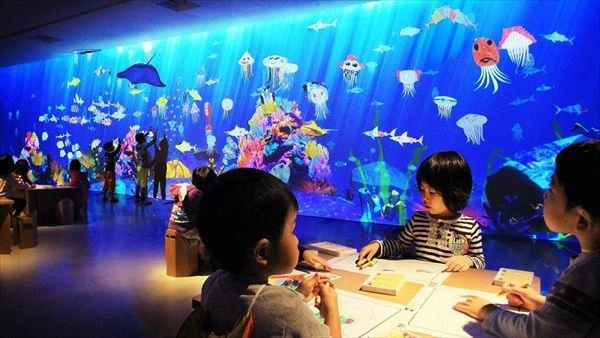
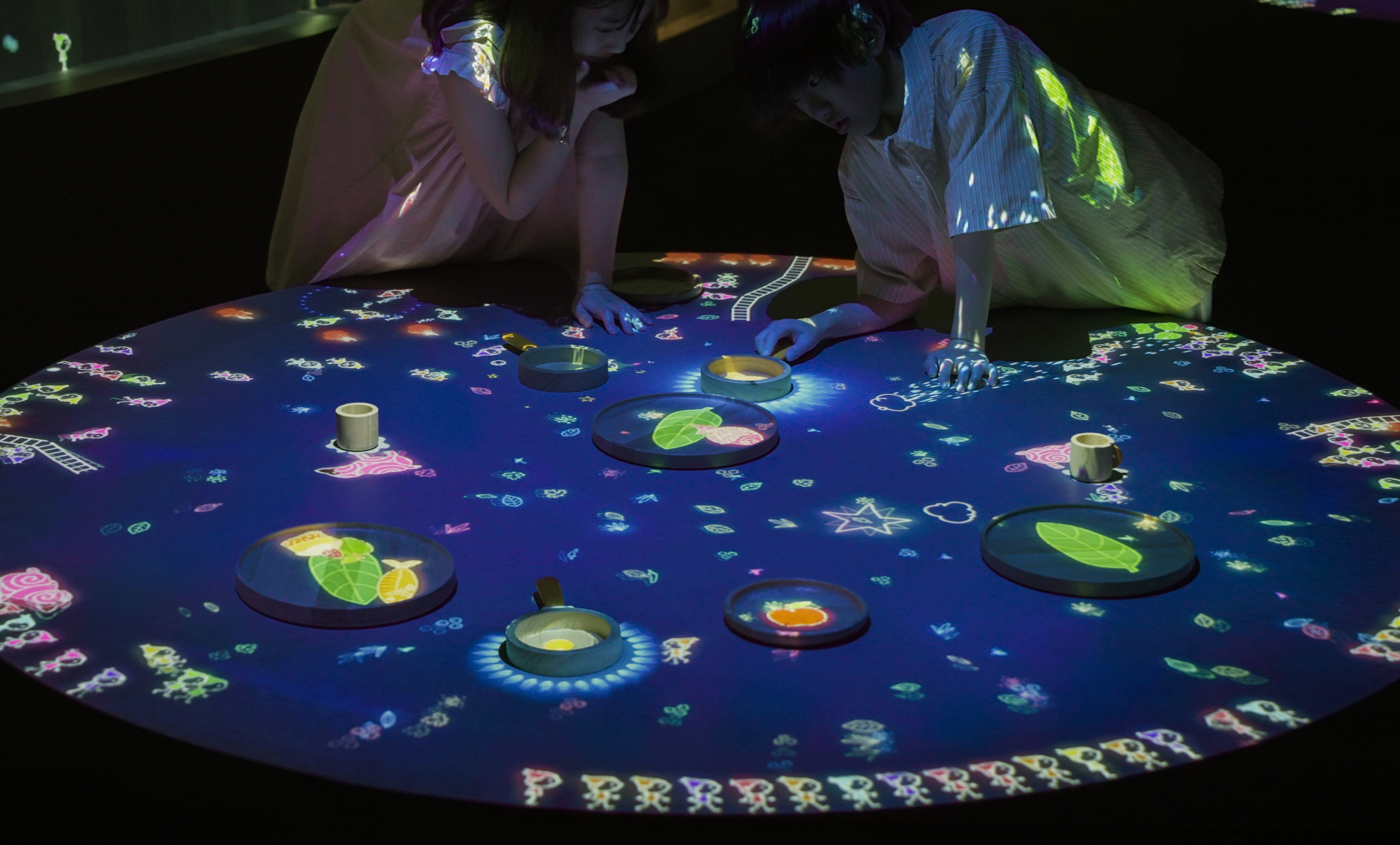
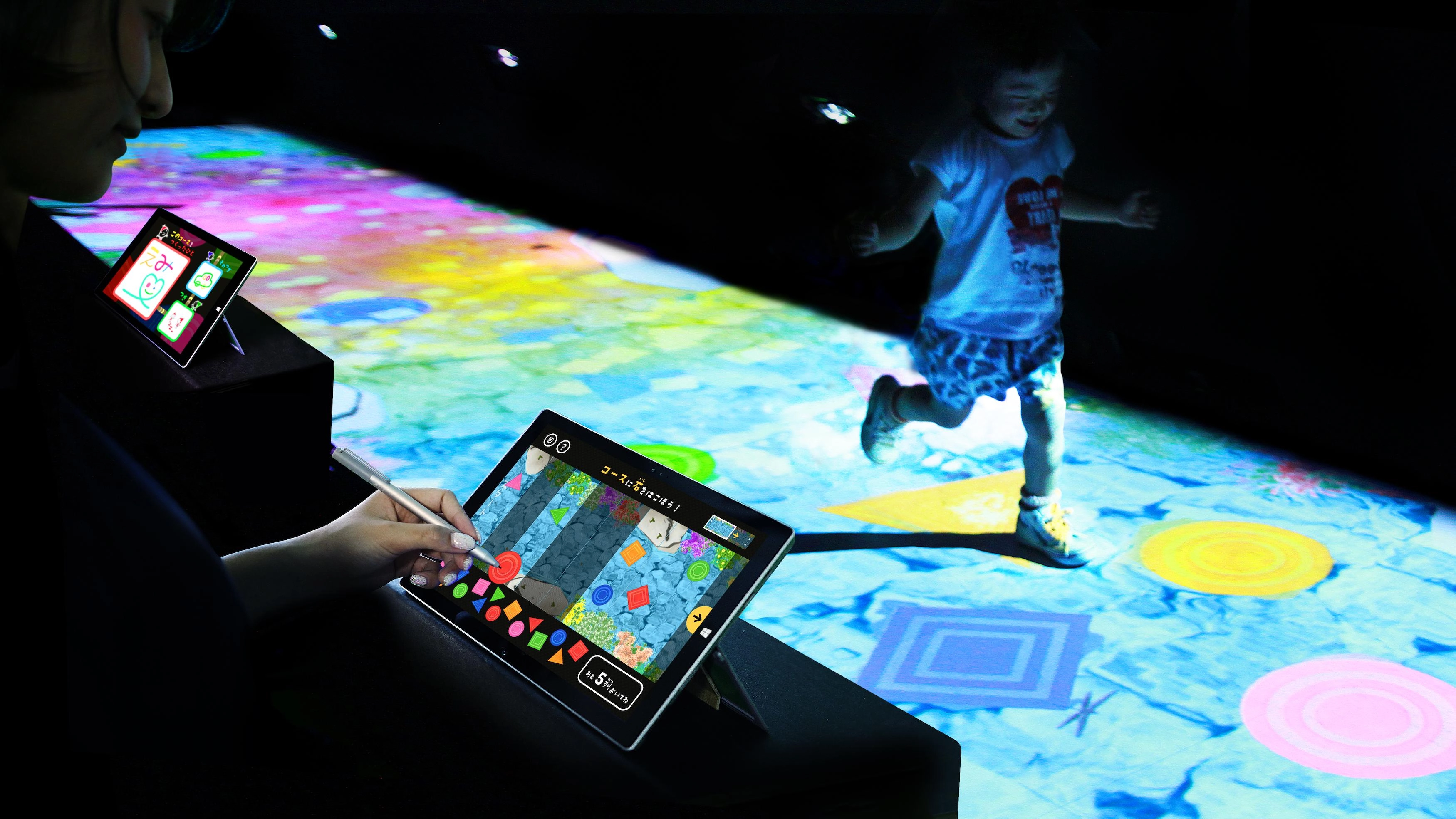
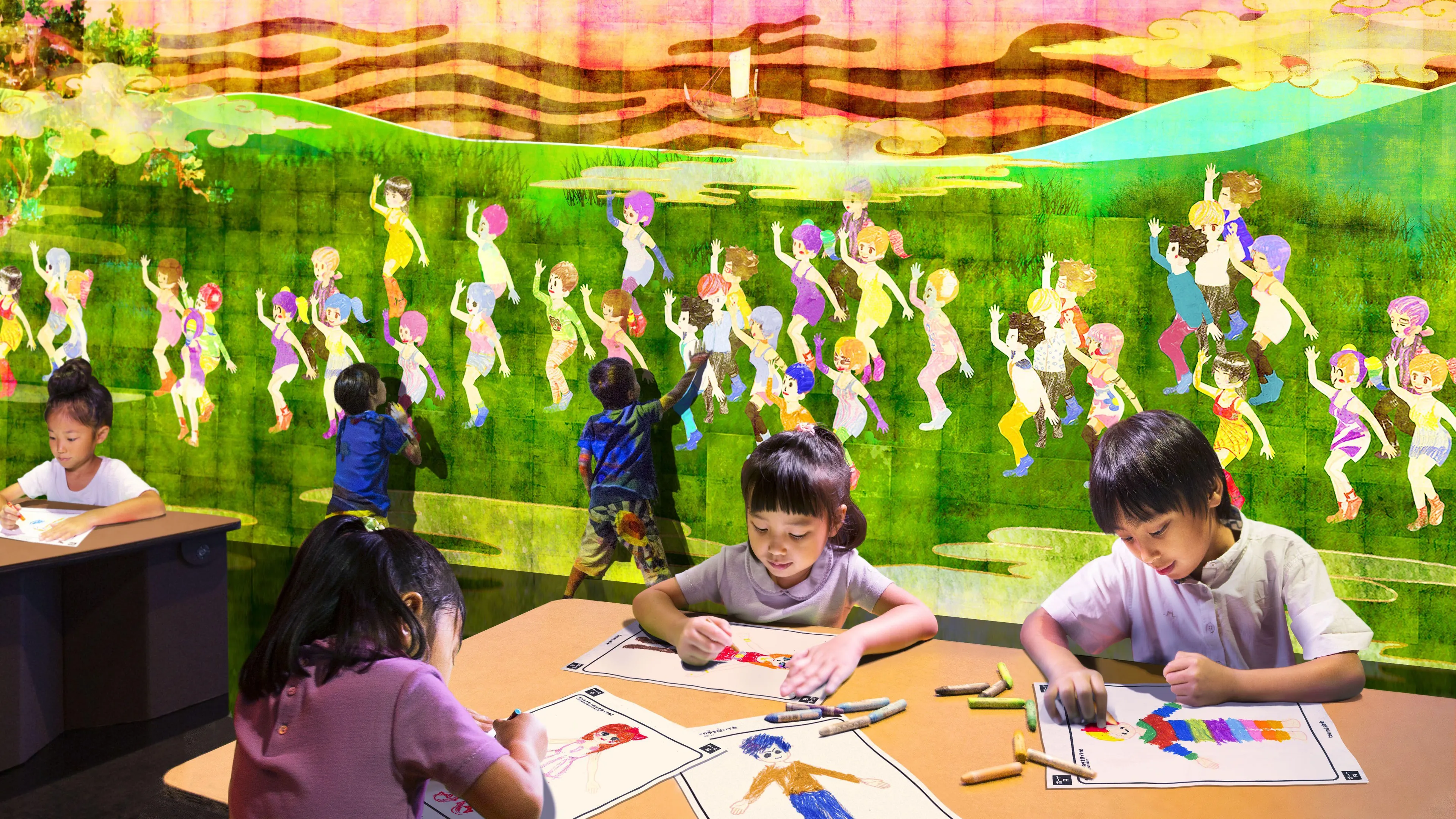
Learn & Play! Future Park


Over teamLab
teamLab (f. 2001) is an international art collective. Their collaborative practice seeks to navigate the confluence of art, science, technology, and the natural world. Through art, the interdisciplinary group of specialists, including artists, programmers, engineers, CG animators, mathematicians, and architects, aims to explore the relationship between the self and the world, and new forms of perception. In order to understand the world around them, people separate it into independent entities with perceived boundaries between them. teamLab seeks to transcend these boundaries in our perceptions of the world, of the relationship between the self and the world, and of the continuity of time. Everything exists in a long, fragile yet miraculous, borderless continuity. teamLab’s works are in the permanent collection of the National Gallery of Victoria, Melbourne; Art Gallery of New South Wales, Sydney; Art Gallery of South Australia, Adelaide; National Gallery of Australia, Canberra; Amos Rex, Helsinki; Museum of Contemporary Art, Los Angeles; Asian Art Museum, San Francisco; Borusan Contemporary Art Collection, Istanbul; and Asia Society Museum, New York, among others. teamlab.art Biographical Documents teamLab is represented by Pace Gallery, Martin Browne Contemporary and Ikkan Art.

Venue Details

teamLab Islands Dance! Art Museum and Learn & Play! Future Park in Oita

Looptijd

2016.7.15(Fri) - 9.25(Sun)

Openingstijden

10:00 - 18:00
(Last entrance at 17:30)

Sluitingsdagen

September 12 (Mon)
September 20 (Tue)

Prijzen

At the Door
Adults: JPY 1500
High School & College Students: JPY 1200

In Advance/Group Pricing (over 20 guests)
Adults: JPY 1300
High School & College Students: JPY 1000

Pair Tickets (Reduced Price for 2 Tickets)
* Pair split ticket (Available through Lawson Ticket, Ticket Pia, and Seven-Eleven only)
Adults: JPY 2600
High School : JPY 2000

* Junior High School student and younger are free (certification required)
* Elementary school students and under must be accompanied by a guardian (over 18). One guardian may accompany up to 4 children.
* Peawari ticket Lawson Ticket, Ticket Pia (Seven - Eleven) limited sale
* Guests with physical or mental disabilities and their caretakers are free (certification required)
* Guests carrying an "Oita Art Museum Annual Passport" get are free for their first visit. But second and subsequent admission fees will be 1000 yen.

[Ticket Sales]
Advance tickets on sale from June 1, 2016 to July 14, 2016
Lawson ticket [L Code: 83333]
Ticket Pia [P code: 990-306]
Tokiwa Hall, Tokiwa Beppu, TOS housing Messe, Oita City Art Museum

Route

Adres

Oita Art Museum
Oita-ken, Oita city, Daiji Ueno 865