
FEATURED WORKS
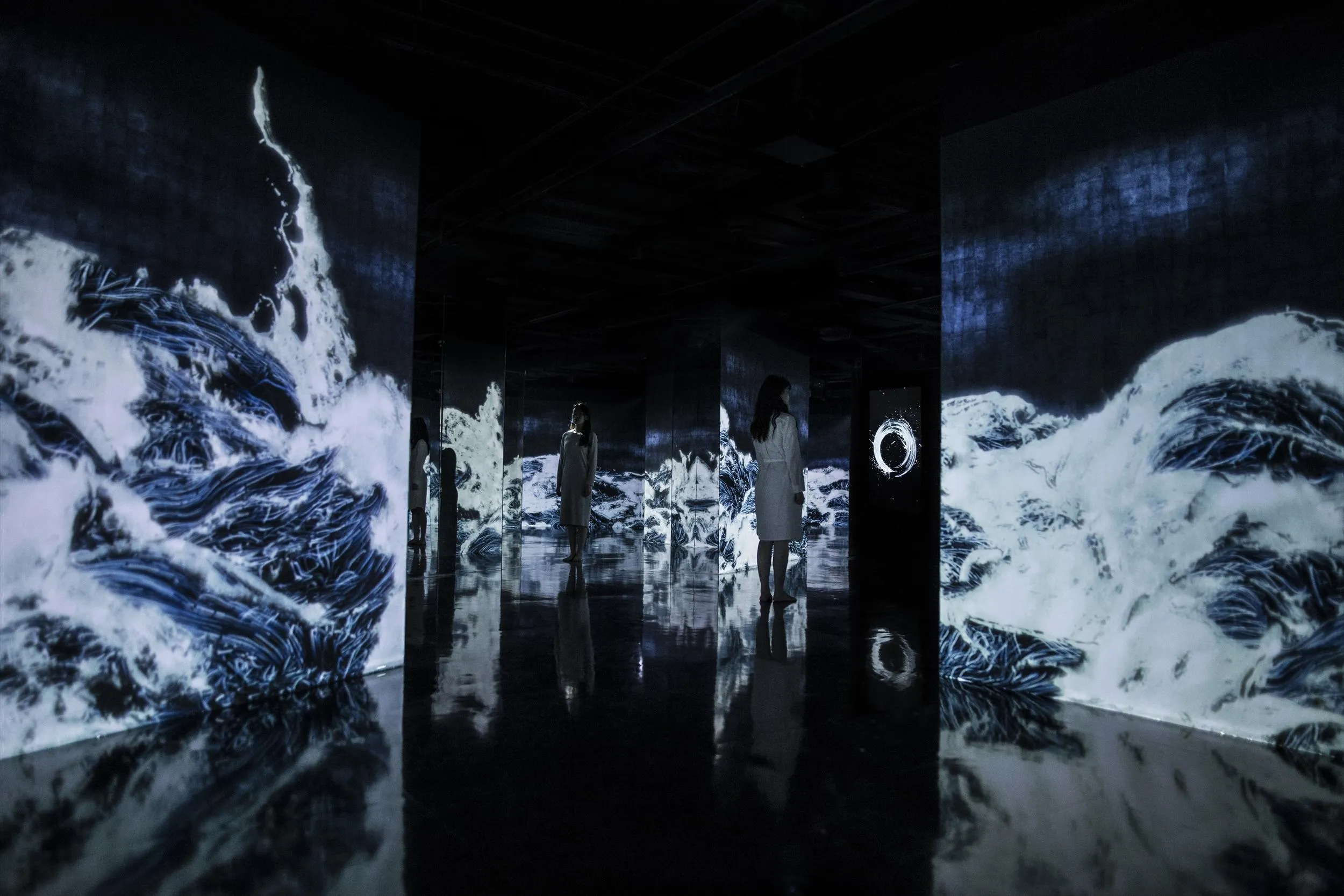
Black Waves: Lost, Immersed and Reborn
teamLab, 2019, Digital Installation, Continuous Loop, Sound: Hideaki Takahashi
This is an installation made of one continuous wave. The waves projected are all connected and form a single, unbroken body of water. As we immerse and meld ourselves into the waves, we explore a continuity among people, as well as a new relationship that transcends the boundaries between people and the world.
The movement of waves in water is simulated in a computer-generated three-dimensional space. The water is expressed as a continuous body after calculating the interactions of hundreds of thousands of particles. To visualize the waves, the behavior of the particles of the water was then extracted and lines were drawn in relation to the movement of the particles. The wave created in a 3-D space is then turned into an artwork in accordance with what teamLab refers to as ultrasubjective space.
In premodern Japanese painting, oceans, rivers, and other bodies of water were expressed as a series of lines. These lines give the impression of life, as though water was a living entity.
This form of expression leads us to question why premodern people sensed life in rivers and oceans. Also, why did they behave as if they themselves were a part of nature? Perhaps something can be discovered by fusing the fixed objective world of today’s common knowledge with the subjective world of premodern people.
While viewing this artwork, if we feel a sense of life in the collection of lines—what can be called the subjective world of premodern people—then perhaps this is one aspect of objective recognition.
When viewing this artwork, as opposed to watching waves shot with a video camera, people may feel that the barrier between themselves and the waves disappears. They feel immersed in the work, perhaps even feeling life in the collection of lines, as if the waves are luring them in. Perhaps we can find a connection to the way premodern Japanese people perceived the world and consequently behaved toward the world.
If we regard ourselves as a part of nature, and consider nature not just as something to be observed, we might join premodern people in perceiving rivers and oceans as living entities. This is a way of seeing the world that lures us in and allows us to feel that there is no boundary between ourselves and nature.
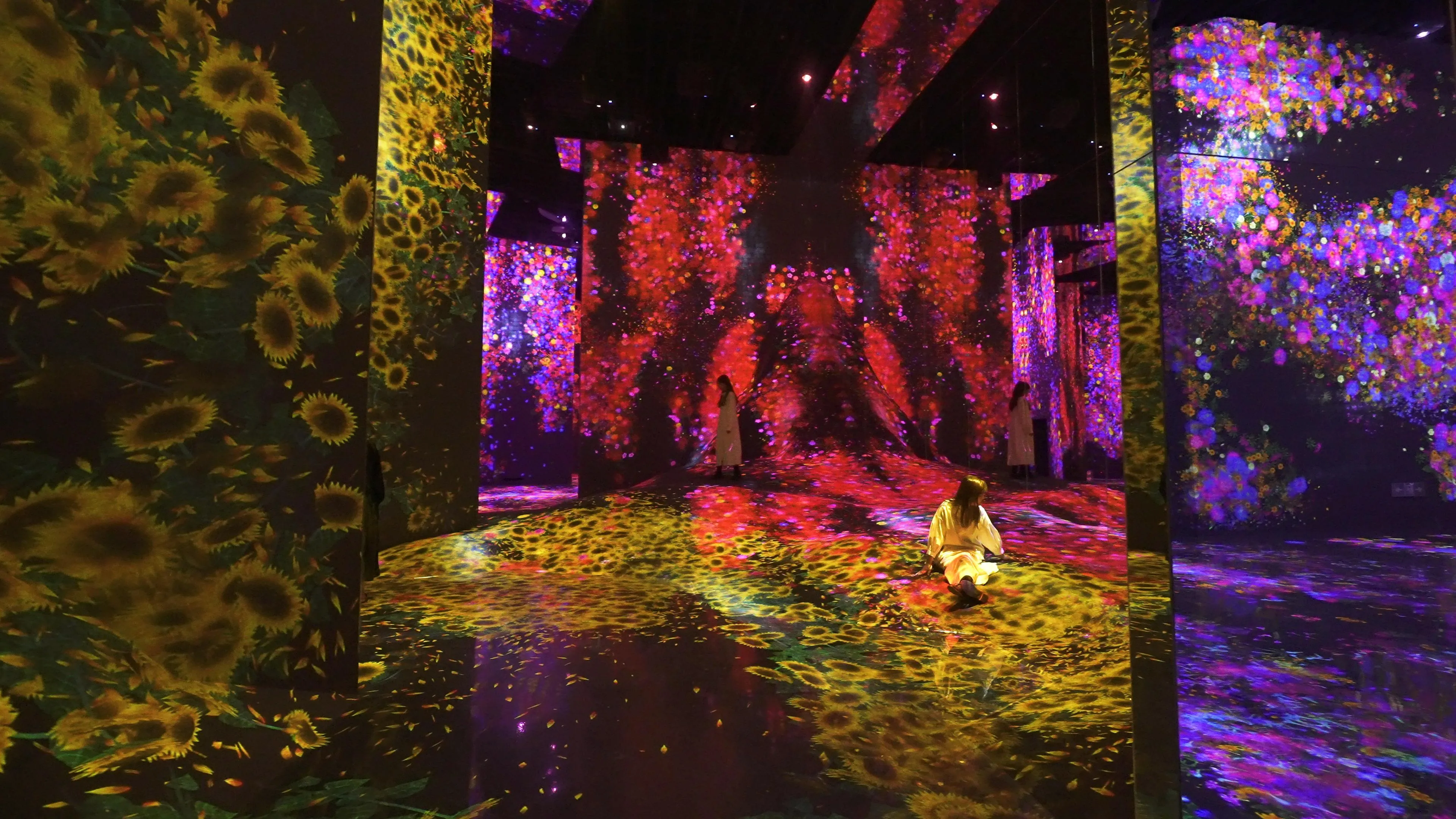
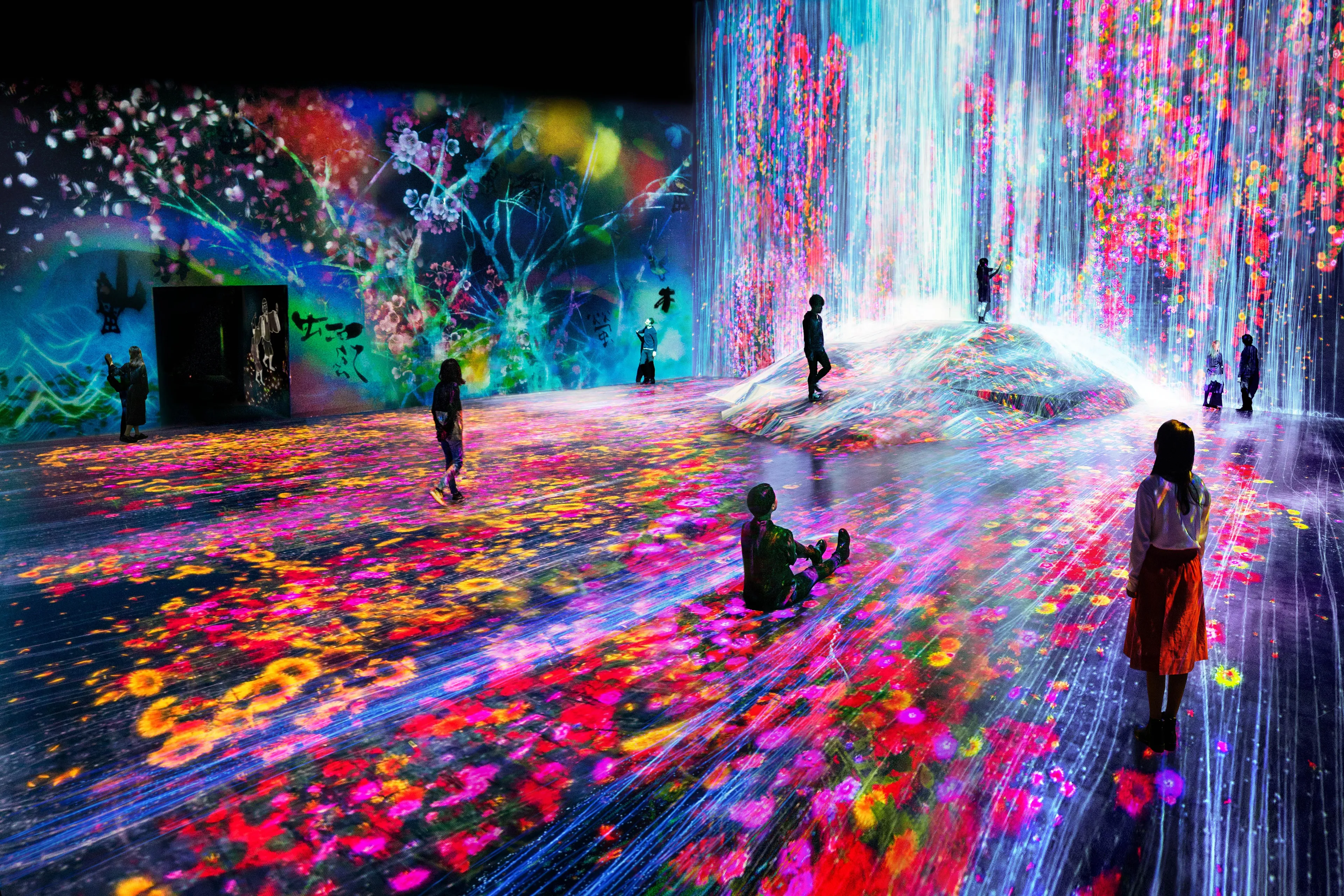
Forest of Flowers and People: Lost, Immersed and Reborn
teamLab, 2017, Interactive Digital Installation, Endless, Sound: Hideaki Takahashi
A seasonal year of flowers blossom according to the changing seasons, and the place where they grow gradually moves.
The flowers bud, grow, and blossom before their petals begin to wither and eventually fade away. The cycle of growth and decay repeats itself in perpetuity. If a person stays still, the flowers surrounding them grow and bloom more abundantly. If viewers touch or step on the flowers, they shed their petals, wither, and die all at once.
The artwork is not a pre-recorded image that is played back: it is created by a computer program that continuously renders the work in real time. The interaction between people and the installation causes continuous change in the artwork: previous visual states can never be replicated, and will never reoccur. The picture at this moment can never be seen again.
In spring in the Kunisaki Peninsula, there are many cherry blossoms in the mountains and canola blossoms at their base. This experience of nature caused teamLab to wonder how many of these flowers were planted by people and how many were native to the environment. It is a place of great serenity and contentment, but the expansive body of flowers is an ecosystem influenced by human intervention, and the boundary between the work of nature and the work of humans is unclear. Rather than nature and humans being in conflict, a healthy ecosystem is one that includes people. In the past, people understood that they could not grasp nature in its entirety, and that it is not possible to control nature. People lived more closely aligned to the rules of nature that created a comfortable natural environment. We believe that these valleys hold faint traces of this premodern relationship with nature that once existed, and we hope to explore a form of human intervention based on the premise that nature cannot be controlled.
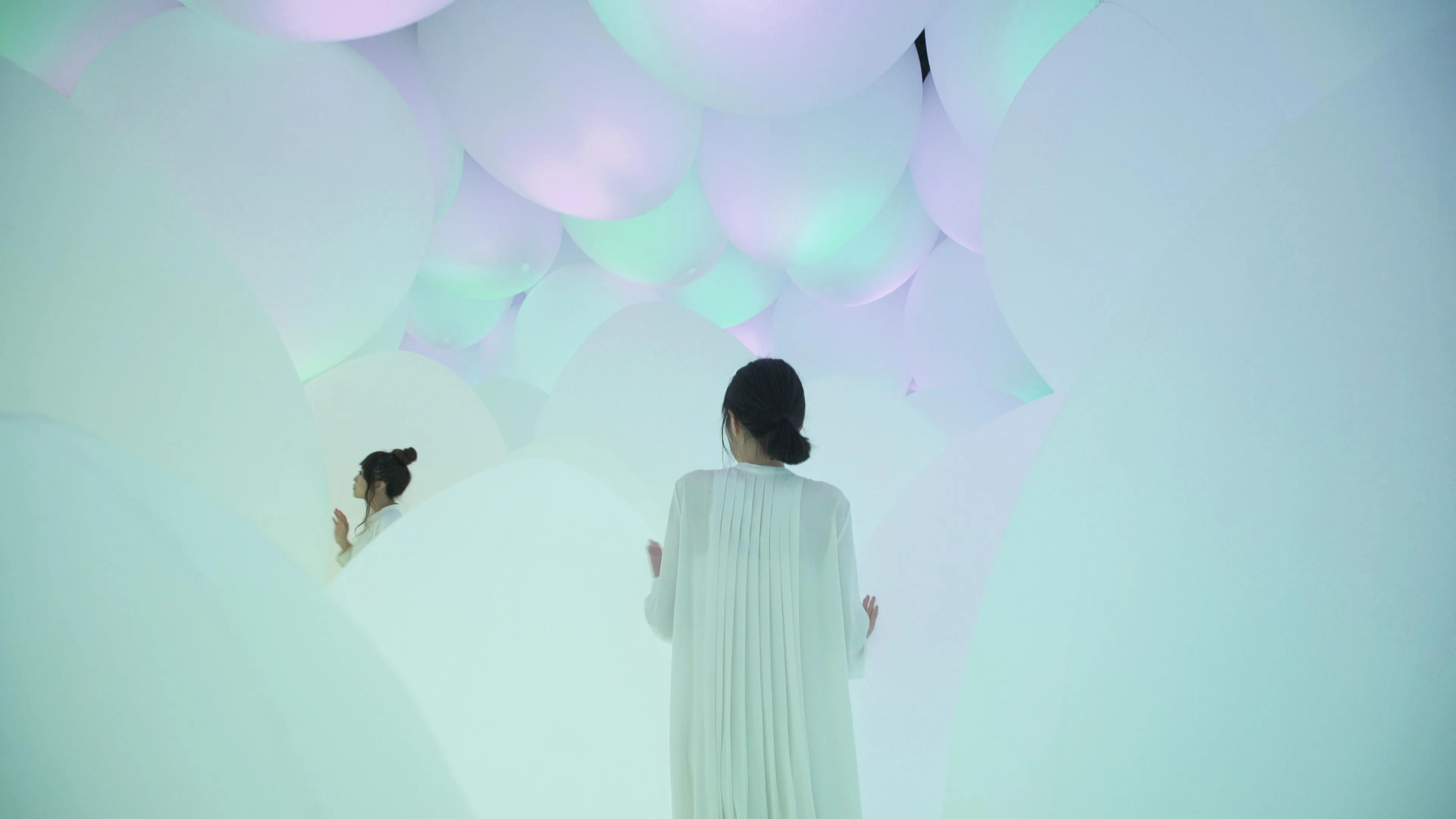
Weightless Forest of Resonating Life - Flattening 3 Colors and 9 Blurred Colors
teamLab, 2019, Interactive Digital Installation, Sound: Hideaki Takahashi
The space is filled with ovoids of light. People move through the ovoids and enter the space.
People recognize the multi-dimensionality of the space when the group of ovoids shine with various blurred colors, but the space feels flat when the ovoids are monochromatic. As the space changes between three dimensions and two dimensions, the whole body is immersed in both a three dimensional space and a flat plane.
When people strike the ovoids of light, it causes the color of the ovoid to change, and a tone specific to that color resonates out. The surrounding ovoids will respond, and the same color and tone will resonate radially throughout the space.
Each ovoid moves freely, but no matter where it is, the behavior of light is maintained across the entirety of the space. Therefore, the light behaves as a group and can be thought of as one three-dimensional existence. The light resonates out spherically across the space from the impacted ovoid. While recognizing the light’s three dimensional existence, people push through the ovoids to enter into that existence.
Since the ovoid colors are produced by light, it is possible to create 9 blurred colors (light in water, sunlight on water plants, morning glow, morning sky, sky at twilight, peach, plum, iris, and spring maple), as well as 3 colors that flatten the space (blue, red, and green), resulting in a total of twelve colors.
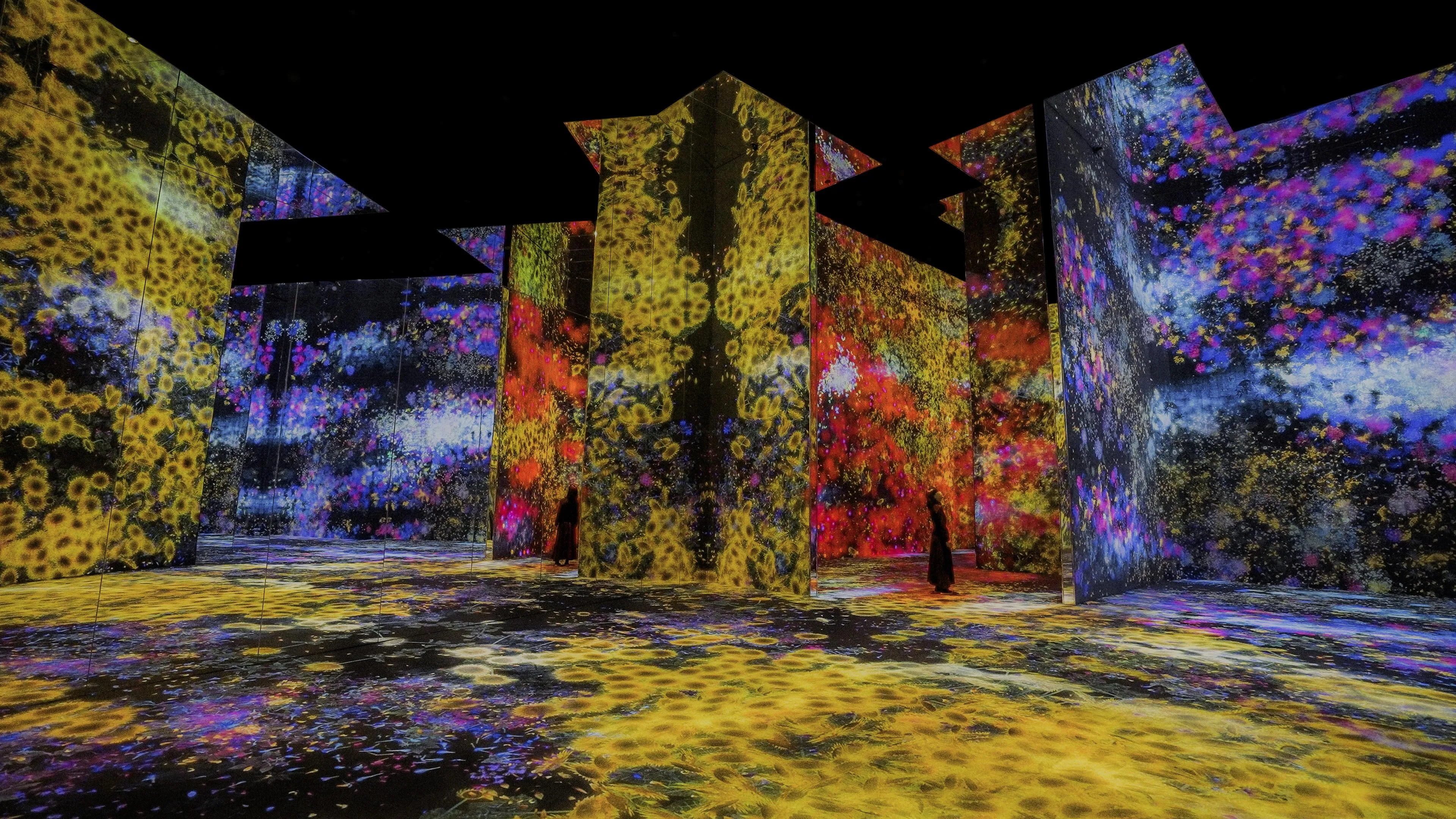
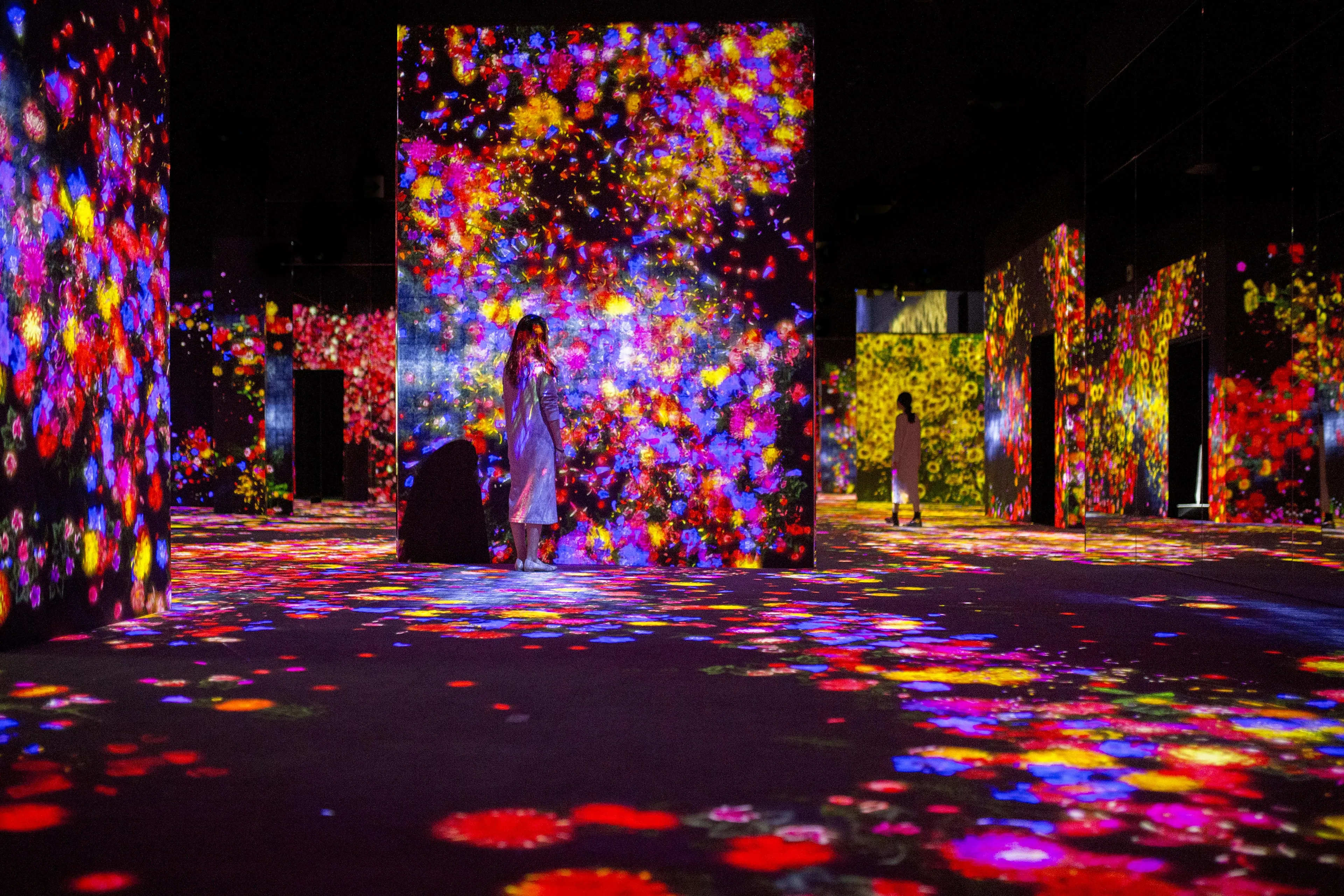
Flowers and People, Cannot be Controlled but Live Together – A Whole Year per Hour
teamLab, 2014-, Interactive Installation, Endless, Sound: Hideaki Takahashi
Flowers bud, bloom, and in the course of time, wither and die. While eternally repeating the process of life and death, the places where they grow change gradually. When people stand still, the flowers surrounding them grow and bloom abundantly, but when people touch the flowers or walk around, they scatter and die all at once.
The artwork is not a pre-recorded image that is played back; it continues to be rendered in real time under the influence of people's behavior. The picture at this moment can never be seen again.
In spring in the Kunisaki Peninsula, there are many cherry blossoms in the mountains and canola blossoms at their base. A visit to this region led teamLab to wonder how many of these flowers were planted by people and how many of them were native to the environment. It was a place overflowing with flowers, a place of great serenity and contentment. This nature is an ecosystem influenced by human activity, making us feel that nature and humanity are not in conflict. Perhaps a truly comforting nature is one that encompasses human presence as part of the ecosystem. Based on the premise that nature cannot be completely controlled, this artwork explores human activity that lives closely aligned to the rules of nature.
This artwork is an ecological pictorial space drawn through Ultrasubjective Space, which continues to be generated along with the body, others, time, and the environment. Viewers physically walk around and touch inside the world of the artwork, transforming it together with others in the same space.
This pictorial space differs from images or paintings flattened by a lens or single-point perspective. In such images or paintings, space appears behind the picture plane; the space that opens there and the space the viewer inhabits are split, and the picture plane becomes a boundary surface. The viewpoint is fixed at a single point, and bodily freedom is lost.
On the other hand, a picture plane formed by Ultrasubjective Space is not a boundary that separates where we are from the world of the artwork. The world of the artwork is not outside a window; it appears as a single field that is continuously connected, without boundary, to the space in which the viewer’s body exists. Moreover, any position — front, back, left, or right — can become a viewpoint, so viewpoints exist in infinite number, and the viewer is physically free to move.
Not bound to a single point, the viewer moves their body and lets their eyes roam freely, continually re-composing the world of the artwork as it changes over time, and building the pictorial space within themselves. In that moment, the artwork becomes a centerless, subjective, and embodied pictorial space in which the viewer walks and touches.
In this space, the boundaries between the viewer and the artwork become ambiguous. The artwork transforms simply by the presence of a body there, and the behavior of others also changes the world of the artwork. In conventional art, other people were often considered an obstacle that interferes with a one-on-one relationship with the artwork. However, here, the presence of others enriches and creates new changes in the artwork.
This artwork is an attempt to expand painting from a world on the other side of the screen into a space continuous with the body, others, time, and the environment. The artwork continues to be generated within the relationships among the behavior of people, the life and death of flowers, the passage of time, and the entire space. Here, the painting does not exist on its own as a completed entity; it relates to people's bodies and includes the presence of others, existing as an ecological field without boundaries.
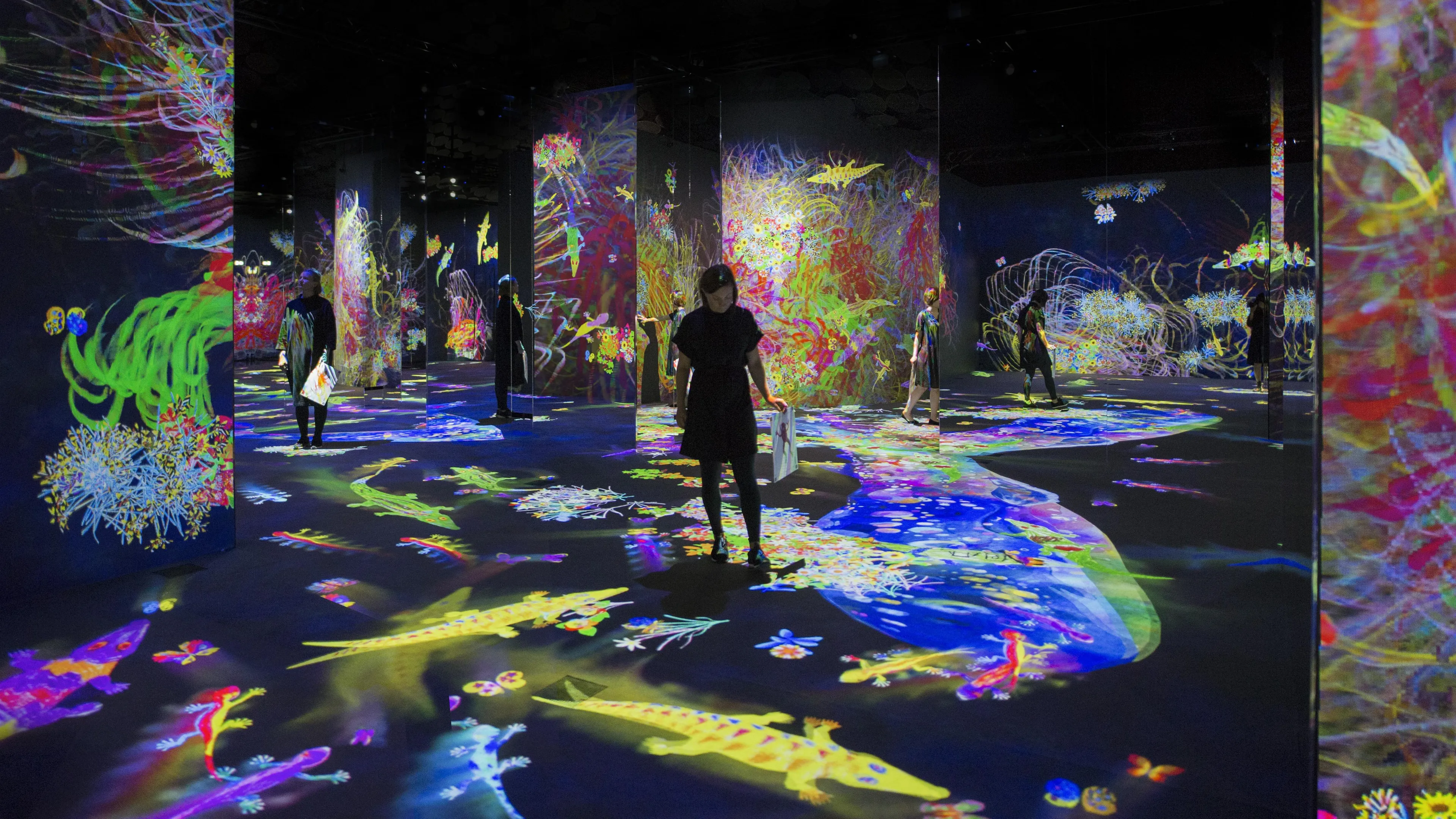
Graffiti Nature: Lost, Immersed and Reborn
teamLab, 2018, Interactive Digital Installation, Sound: Hideaki Takahashi
All the various creatures drawn by everyone live in this space. Color in a creature on the paper provided, and see the picture you have drawn come to life and move in front of you.
Living things eat and are eaten by other living things in one shared ecosystem.
The creatures you draw will multiply if they eat other living things, but they will die and disappear if they do not eat enough, or if they are eaten by other creatures.
The crocodiles eat the snakes, the snakes eat the lizards, the lizards eat the frogs, and the frogs eat the butterflies, each one propagating as they consume. Likewise, the butterflies multiply in places where flowers grow.
Although flowers will bloom if people stay still, their petals will scatter if people walk around and step on them. Crocodiles will die if people step on them too much.
As we immerse and meld ourselves into the work with others, we explore a continuity among people, as well as a new relationship that transcends the boundaries between people and the world.